Introduction: The God of a Thousand Faces — and Just as Many Creatures
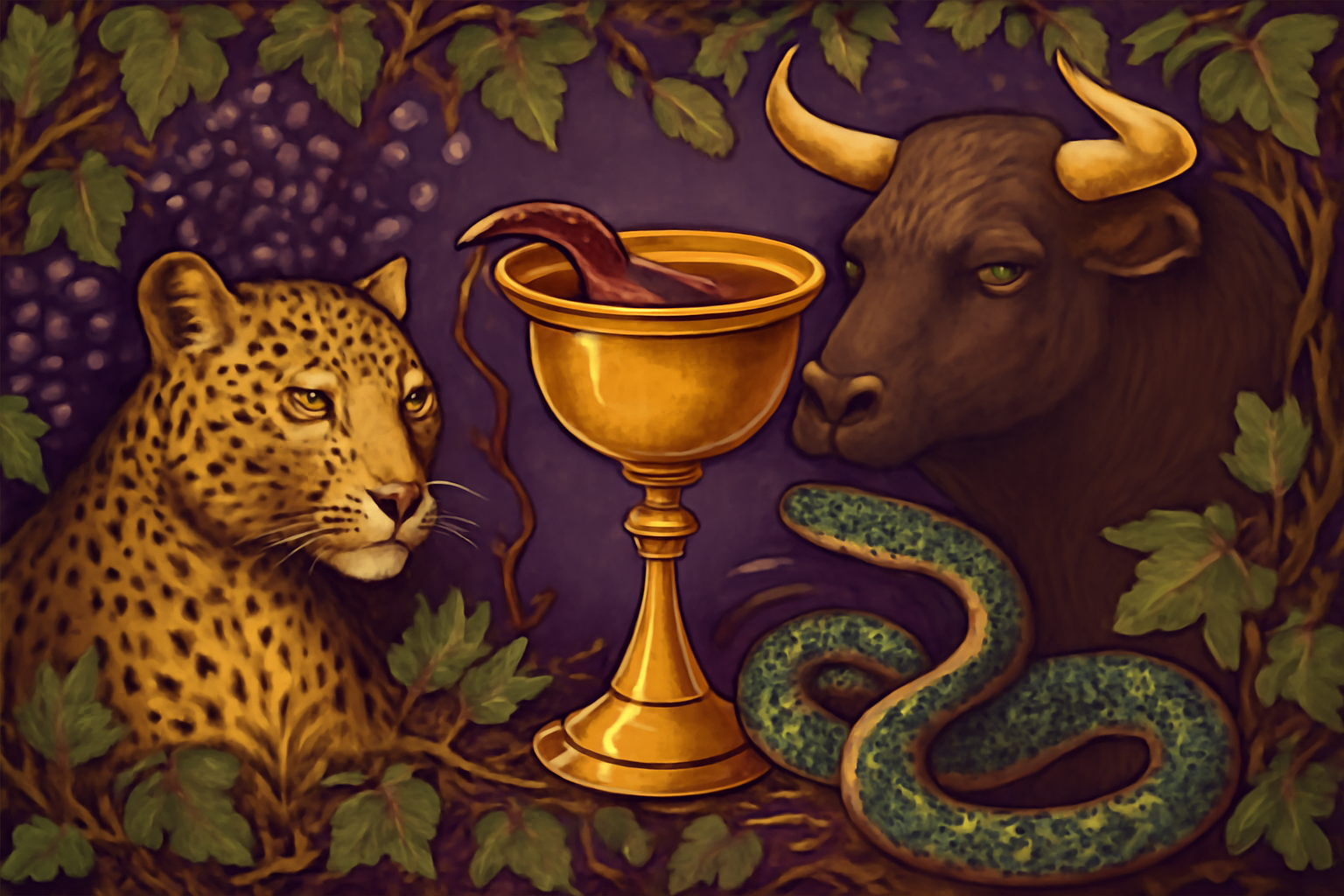
Most people envision Dionysus as a lounging figure cradling a goblet of wine—comfortable, domesticated, almost bourgeois in his leisure. The historical record suggests something far wilder, far more primal, and far more dangerous than that settled image allows. One of the sharpest lenses through which to glimpse his actual nature is the extraordinary menagerie of creatures bound to him mythologically and ritually. While other Olympians—Apollo with his swan, Athena with her owl—claimed a single definitive beast, Dionysus accumulated animal associations more profusely than nearly any deity in the Greek pantheon. Every creature linked to him illuminates something different: transformation, primordial wildness, the dissolution of boundaries between death and new life, the collapsing of the line separating civilization from chaos. If you’ve been hunting for the Dionysus animal symbol in singular form, this post exists to show you that singular was never the answer.
When we speak of Dionysus — the ancient Greek god of wine, ecstasy, fertility, and theater — mainstream imagination tends toward a single reductive figure. But Dionysus was far more layered, far more primal, and far more perilous than that convenient portrait suggests. One of the clearest windows into his true nature is the remarkable range of animals associated with him. While gods like Apollo claimed the swan or Athena claimed the owl, Dionysus had more animal symbols than almost any other Olympian deity. Each creature connected to him tells a story about transformation, wildness, death, rebirth, and the blurry line between civilization and chaos. If you’ve been searching for the Dionysus animal symbol — singular — prepare to discover there was never just one.
The Leopard and Panther: Companions of Divine Wildness
Pose this question to any scholar of classical antiquity: which creature most powerfully embodies animal represents Dionysus? The answer arrives with near-universal consistency—the leopard, or its spotted relative, the panther. These magnificent felines became so inseparable from the wine god that their image permeates nearly every artistic tradition that depicted him, spanning everything from painted pottery vessels to tesselated Roman floors.
Mythological narratives depict leopards and panthers drawing Dionysus’s chariot as he undertook his globe-spanning triumphal progression, a journey documented across numerous ancient texts. Ovid’s Metamorphoses references the god’s exotic, beast-drawn cortège, while Nonnus of Panopolis, composing his vast epic Dionysiaca during the 5th century CE, renders the creatures in sumptuous, elaborate detail. These spotted cats functioned not merely as beasts of burden—they were incarnations of Dionysus’s own dual essence, materialized expressions of his nature as simultaneously beautiful and seductive, yet capable of turning brutally savage without transition.
The symbolic weight runs deep and intricate. Leopards and panthers possess stunning aesthetic power coupled with terrifying predatory capacity. They traverse their world without sound, strike with no forewarning, and resist domestication entirely regardless of how long humans keep them captive. This rendered them ideally suited to embody Dionysiac ecstasy—the state of ekstasis, which in literal translation means “standing outside oneself,” that ritual devotion to him was engineered to produce. Those who followed him most intensely, especially the maenads (frenzied female votaries), allegedly gained leonine or panther-like ferocity during their ritual trances, according to ancient written records.
Throughout ancient artistic traditions, Dionysus appears wrapped in leopard pelt (nebris), balanced atop a panther in command, or flanked by the creatures amid representations of divine processional victory. A remarkable 2nd-century CE tessellated floor discovered in Pella, the classical Macedonian seat of power, presents Dionysus mounted upon a panther with effortless control. The consistency across centuries delivers an unmistakable message: proximity to Dionysus meant proximity to something untamed, gorgeous, and wholly unforeseeable.
The Bull: When the God Became the Beast
Among all the sacred animals of Dionysus, the bull occupies perhaps the most theologically resonant position—not because Dionysus merely kept company with bulls, but because he transformed into one.
Ancient literary sources, notably Euripides’ The Bacchae and assorted Orphic liturgical texts, narrate episodes in which Dionysus assumed bovine form at moments of heightened divine manifestation. In The Bacchae, the chorus directly addresses him in this animal guise, imploring his appearance in that very shape. Throughout the Orphic religious tradition—a mystical current flowing through ancient Greek spiritual life—Dionysus-Zagreus underwent dismemberment and consumption by the Titans while embodied as a bull, and this death followed by resurrection constituted the theological foundation of Orphic cosmology regarding the soul’s cosmic trajectory.
The bull functioned as the foremost sacrificial victim offered to Dionysus in ritual contexts. In antiquity, immolating a bull represented one of the most demanding and materially costly devotional undertakings a community could execute, permitted only for occasions of the highest religious gravity. The ritual killing of a bull consecrated to Dionysus functioned as a ceremonial recreation of the god’s own dying and returning—the worshipping community consuming the victim’s flesh in an act of sacred participation that obliterated the boundaries separating human, beast, and divine realms.
As symbolic currency, the bull connected Dionysus to the generative abundance of crops and livestock, to primal masculine force, and to the untamed energies dwelling outside civilization’s reach. Bull representations appeared across Dionysiac cultic paraphernalia, temple architectural decoration, and the rhyton tradition—drinking vessels occasionally molded in the shape of bovine heads—producing a poetically recursive image of wine pouring forth from the sacred animal presiding over the wine god’s domain.
The Serpent: Rebirth Coiled in Ancient Hands
Among the Dionysus animal connections, the serpent stands as perhaps the most disquieting, which proves entirely appropriate. In the classical Greek conceptual universe, snakes inhabited a condition of profound duality—simultaneously emblematic of mortality, curative power, chthonic dominion, and the perpetual renewal embodied in their discarded integument.
Within the documented practices of Dionysiac worship, serpents surface as implements manipulated and worn by maenads conducting their transport-like nocturnal mountain ceremonies. Euripides provides vivid description in The Bacchae: the maenads wind living serpents across their torsos, handle them fearlessly, and wield them as instruments of assault during moments of theophanic madness. This was not mere theatrical embellishment—a convergence of textual documentation and material evidence indicates that serpent-handling represented a tangible component of actual archaic mystery cult observance.
In multiple mythological traditions, Dionysus himself adopted serpentine form, and accounts of his infancy introduce snakes functioning simultaneously as peril and guardianship. According to one narrative current, the infant god lay within a cradle where serpents kept sentinel. Within Orphic metaphysical systems, the primordial entity known as Phanes—occasionally identified with Dionysus—emerged coiled with serpents from the cosmos’s first instant.
The serpent’s symbolic role within Dionysiac contexts concentrates on chthonic potency (the subterranean and underworld dimensions) and the perpetual cycle of ending and emergence threading through all Dionysus mythology. A snake’s capacity to discard its outer layer and emerge renewed mirrors Dionysus’s own repeated cycle—emergence from his mother Semele’s womb, emergence from his father Zeus’s thigh, emergence following the dismemberment narrated in Orphic cosmology. The serpent, folded eternally upon itself, offered the perfect emblem for this unceasing recurrence.
The Goat: From Sacrifice to the Stage
Among Dionysus’s animal associations, the goat’s significance proves unexpectedly momentous for Western culture itself—it furnished the etymological origin of tragedy.
The term tragōidia in archaic Greek literally translates as “goat song,” though contemporary classicists remain divided on its precise semantic origin (a performance featuring goat-song? a victor’s prize consisting of a goat? a composition sung by performers costumed as goat-satyrs?). Yet the bond connecting goats to Dionysiac observance remains incontrovertible. Greek tragic drama emerged from choral performances staging the City Dionysia festivities in Athens—sacred commemorations honoring Dionysus—and the goat occupied a foundational symbolic position in such worship from its inception.
Goats represented primary sacrificial creatures in Dionysiac observances, partly because of their symbolic alignment with satyrs—the hybrid-bodied beings (part human, part goat) who constituted Dionysus’s mythic entourage. Satyrs, rendered in ancient imagery with caprine lower bodies, tails, and pointed auricular features (or, in earlier artistic conventions, equine characteristics), perpetually accompanied the god: as musicians, as participants in revelry, as embodiments of appetite beyond constraint. Their goat aspect tethered Dionysus to wilder, more pastoral dimensions of landscape, to corporeal appetite, and to an epoch preceding civilization’s imposition of behavioral constraint.
In the realm of ancient dramatic performance—particularly satyr-plays, those irreverent shorter pieces presented following tragic cycles at Athenian theatrical festivals—performers garmented themselves in goat-pelt costumes, underscoring the creature’s theatrical centrality. The goat, registering as simultaneously comic and venerable, distilled something fundamental regarding Dionysus: his capacity to inhabit both the transcendent and the ridiculous simultaneously, without internal contradiction.
The Dolphin: Pirates, Transformation, and the God at Sea
The dolphin emerges as an unexpected entrant among Dionysus animal symbol contenders, yet its mythological entanglement with the wine god comprises one of antiquity’s most arrestingly narrated episodes.
This narrative reaches us chiefly through the Homeric Hymn to Dionysus (specifically Hymn 7), among the most eloquently composed texts surviving from the ancient religious hymnal repertoire. The passage relates how a band of Tyrrhenian maritime brigands identify a striking young man stationed on a promontory and choose abduction as their path to ransom wealth, ignorant of his divine essence. They constrain him aboard their vessel, but magical force dissolves the bonds as they contact his flesh. Wine cascades throughout the hull, vinestock unfurls across mast and oars, ivy winds through the rigging, and the god manifests as a roaring lion in terrifying splendor. Panic-stricken, the seafarers plunge overboard—whereupon Dionysus immediately remakes them as dolphins, consigning them to oceanic existence forever as beings recognized for their cognitive playfulness and their mysteriously persistent draw toward human encounter.
One figure alone—the helmsman, who had perceived the god’s nature from the start and advocated urgently for the captive’s liberation—received exemption. Dionysus assured him of safety and unveiled his genuine identity.
The dolphin thus crystallized as emblem of Dionysiac metamorphosis—the god’s capacity to wholly remake those whose paths intersected his, whether those beings desired such reconstitution. In material artistic production, dolphins manifest within Dionysiac representational contexts across painted ceramic ware and tessellated compositions, frequently portrayed navigating seaspace alongside the god’s vessel or flanking narrative scenes drawn from the pirate episode. The dolphin additionally broadened Dionysus’s territorial dominion: he ruled not merely terrestrial and viticultural domains but commanded authority extending into maritime regions.
The Donkey: Sacred Comedy on Four Legs
No enumeration of Dionysus’s beasts reaches completeness without acknowledging the donkey—the least ornate, most unglamorous, yet simultaneously most humanly recognizable among the sacred creatures tethered to the wine god.
The donkey’s entanglement with Dionysus radiates primarily through Silenus, the elderly, chronically inebriated satyr who occupied the roles of tutor, intimate companion, and father-figure surrogate. Ancient artistic renderings nearly invariably depict Silenus astride a donkey, frequently sliding earthward in a state of vinous incapacity while giggling satyrs prop him upright. Locomotion lay beyond his capacity; abandonment lay beyond affection—so the donkey bore him wherever the Dionysiac processions ventured. Both Aristotle and Pausanias reference Silenus’s celebrated attachment to his much-taxed equine carrier.
Beyond the mythic Silenus figure, donkeys possessed pragmatic significance within viticulture that ancient audiences would have recognized immediately: they constituted the principal beasts of burden for conveying wine-storage amphorae through the Hellenic landscape. The unremarkable donkey materially undergirded the whole edifice of the ancient wine commerce.
During Dionysiac ritual processions, donkeys periodically transported sacred ritual implements or took active participation in festival ceremonies. An additional mythic strand describes donkey-vocalizations as having frightened the Giants during their cosmic warfare against the deities, with Dionysus and his retinue—comprising donkey-mounted Silenus—contributing essential force toward the gods’ ultimate triumph.
The donkey infused Dionysus’s mythic narrative with earthly comedy, counterpoising the leopard’s gorgeous terror with something palpably, amusingly human. In accomplishing this, it manifested another facet of the wine god’s complexity: his profound tether not merely to ecstatic transport and dread, but to the routine satisfactions and comic indignities constituting mortal existence.
Frequently Asked Questions About Dionysus’s Animal Symbols
What is the most important animal symbol of Dionysus?
Classical researchers typically designate the leopard or panther as the preeminent Dionysus animal symbol, given the creature’s omnipresent appearance throughout ancient artistic traditions across epochs and geographic cultures. Yet the bull claims the most profound theological weight, particularly within Orphic faith systems wherein Dionysus’s bovine manifestation sat at the center of cosmic understanding regarding mortality, restoration, and the soul’s metaphysical path.
Why did Dionysus have so many animal associations compared to other Greek gods?
Dionysus’s extraordinary profusion of animal connections reflects his theologically intricate and multifaceted portfolio. Operating across domains encompassing transformation, consciousness-alteration, biological generation, performance-arts, dying, and regenerating, his authority naturally encompassed a vaster spectrum of natural phenomena than deities with narrower functional scopes. Furthermore, his mythic genealogy incorporated absorptions from multiple surrounding cultures—Phrygian, Thracian, Egyptian, and others—each contributing their own consecrated animal vocabularies into the evolving Dionysiac religious synthesis.
Did the ancient Greeks actually use these animals in Dionysus’s worship?
Affirmatively, and in archaeologically and textually attested forms. Goats and bulls underwent genuine ritual immolation throughout Dionysiac festival contexts, encompassing major Athenian communal celebrations. Snakes surface in historically credible ancient testimony regarding maenad ceremonialism. Donkeys figured in certain ritual-procession contexts. While interpretive caution appropriately applies to taking all mythic particulars as literal historical accounting, Dionysus’s animal associations transcended mere symbolic function—numerous instances possessed grounding in verifiable ancient religious practice.
The Figurine That Brings Those Museum Moments Home
That initial confrontation with a red-figure vessel—the one depicting a wild-eyed deity astride a spotted feline, chalice aloft—possesses an afterlife beyond the museum’s temperature-controlled galleries. This meticulously hand-painted Dionysus figurine recaptures precisely that ecstatic energy—a god caught mid-transformation, ringed by the sacred symbols dissected throughout this investigation. The sort of artifact that insists upon occupying shelf-space directly alongside your collection of mythological reference texts.
What works
- Artisanal hand-painting with bronze finish replicates the precision and aged surface-quality characteristic of historical Greek pottery traditions and museum-quality examples
- Modest proportions (3 3/8″ span) permit integration into desk arrangements, shelf displays, or exhibition cases without commanding disproportionate spatial real estate
- Captures Dionysus within his canonical posture—the visual reference-point essential to comprehending his animal symbolism and his theological force
What doesn’t
- Functioning primarily as decorative object rather than scholarly instrument, it provides limited amplification of understanding regarding foundational texts or excavated evidence
- The animal emblems themselves resist prominent feature-articulation in miniaturized format—acquisition brings experiential resonance and visual recollection rather than educational apparatus
This is not a substitute for reading Ovid or Euripides—it’s a companion piece for someone who’s already fallen in love with Dionysus and wants to honor that fascination with something tangible. Veronese Design 3 3/8 Dionysus Greek God of Wine Resin Miniature Figurine Hand Painted Bronze Finish
About This Article

Written by Elias Blackwood. Elias Blackwood has spent 25 years as an obsessive collector of world mythology and folklore, from Greek and Norse epics to Japanese yokai and West African trickster tales — entirely self-taught, for the love of it. His reading draws on comparative mythology, cultural anthropology, and a personal library of translations most people have never heard of. More about this site.
Verify this against a primary source
Specifics change, and your situation may differ from the one described here. These are the authorities worth checking directly:
- Theoi Project — Greek mythology texts with primary source citations
- Perseus Digital Library — classical texts in the original and in translation
- Encyclopaedia Britannica — edited reference for figures and traditions