Chapter 16: The Crystal Oasis and a Cactus Who Smiled

Ollie and Biscuit — Chapter 16, scene 1

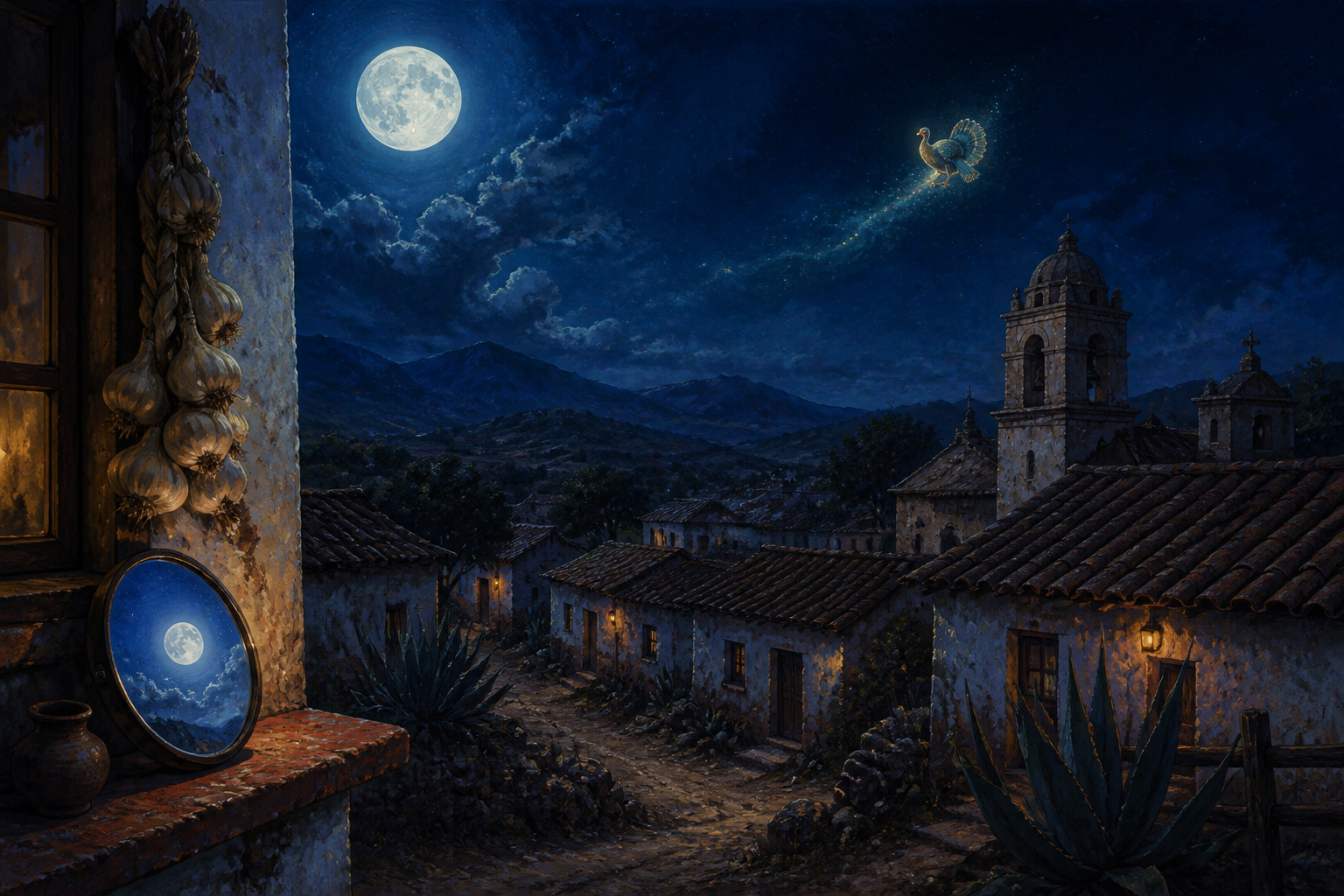
The gods of any mythology aren’t arbitrary — they’re a direct map of what a society considered most powerful, most unpredictable, and most worth appeasing. Spend enough time with any pantheon and you’ll understand more about the culture that created it than almost any other source. What strikes me every time I dig into a legendary world like this one is how the guardian figures — the threshold protectors, the ones you have to face before you reach the sacred center — are almost never simple villains; in Mesopotamian myth, in Celtic tradition, in the great hero cycles of Mesoamerica, the being standing between the hero and the prize is usually wounded, carrying a grief the world gave them before the hero ever arrived. Captain Cactus, presiding over what the lore frames as a Crystal Oasis — a classic liminal space, a place of impossible abundance at the edge of a wasteland — fits squarely into that archetype of the sorrowful sentinel, the guardian whose hostility is really a disguised cry for someone to finally see them clearly. That’s not a game mechanic or a narrative convenience; that’s one of the oldest storytelling structures humans have ever produced, and it’s worth slowing down to appreciate exactly why it still hits so hard.

“Ready?” Biscuit whispered beside me. She had her backpack clasped shut, her lucky button right on top where she could reach it. She’d been carrying that button since Chapter Five without ever once using it sensibly, but tonight I noticed her fingers weren’t even hovering over it nervously. She looked calm. Decided.

I nodded. “I have a plan,” I said.

Biscuit’s jaw dropped so far it nearly hit the sandstone floor. “You have — I’m writing this down —”

“Biscuit.”

“Right. Yes. Let’s go.”

Ollie and Biscuit — Chapter 16, scene 1

This post contains affiliate links. As an Amazon Associate, I earn from qualifying purchases at no extra cost to you. If Chapter 16 had you dreaming about building your own Crystal Oasis at home, the TerraGreen Creations Succulent Planter Kit is honestly the perfect place to start. It comes with everything — succulent soil, gravel, pebbles, and moss — so you can layer up a tiny desert world that looks like it was pulled straight out of this chapter. I love that it’s beginner-friendly but still feels like a real crafting quest with multiple materials to work with.

Read more

Chapter 15: Captain Cactus Hears a Song

Ollie and Biscuit — Chapter 15, scene 1

Legendary races and peoples — whether in ancient texts or richly constructed fantasy worlds — always reflect something real about how the culture that created them thought about difference, hierarchy, and belonging. That’s what makes studying them so rewarding: you’re always reading two things at once. In Chapter 15, as our narrator and Captain Cactus move through the interior of a vast, obsessively ordered fortress — shelves of diamonds sorted by size, wool by colour, iron stacked with almost ritualistic precision — we’re not just watching a heist unfold; we’re stepping into a space that feels genuinely mythic, the kind of hoard-hall that echoes through legendary traditions from the treasure-mountains of Norse dwarves to the catalogued riches of dragon lairs in medieval romance. The song Captain Cactus hears in this chapter matters precisely because of where it’s heard: inside a place built on theft and enforced order, a song represents exactly the kind of disruption that legends have always used to signal that something deeper — something destabilizing and true — is about to surface. This is the chapter where the world-building stops being backdrop and starts being argument, and I think it’s worth slowing down to appreciate just how much is happening here.

“The vault has to be deeper in,” Biscuit murmured, consulting the list she’d started writing the moment we entered. It was already three pages long. “The shade crystals we collected should help mask our heat signatures from the Sand Minions, but we need more time. Significantly more time.” She looked at me in a way that meant she had seventeen plans but none of them were quite right yet.

That’s when we heard him.

Ollie and Biscuit — Chapter 15, scene 1

This post contains affiliate links. As an Amazon Associate, I earn from qualifying purchases at no extra cost to you. If Captain Cactus has officially stolen your heart, you NEED the Aurora® Palm Pals™ Prickles Cactus™ Stuffed Animal sitting on your desk while you read. This tiny 3.5-inch green buddy is basically a miniature Captain Cactus — small enough to fit in your pocket on adventures, collectible enough to display proudly on a shelf. I love recommending Palm Pals because they’re genuinely well-made and ridiculously cute. Perfect for any young fan who wants their own prickly sidekick.

Read more

Chapter 14: Grumbleton’s Very Bad Day

Ollie and Biscuit — Chapter 14, scene 1

In every culture I’ve studied, the question of who has access to special knowledge — who can perform rituals, speak to the gods, manipulate the forces of nature — is never purely theological. It’s always about social structure, legitimacy, and the control of meaning. Magic systems, in that sense, are political documents. What makes Grumbleton’s Very Bad Day so fascinating to dig into is that the moment a disorienting wall of spinning orange sand swallows our protagonist whole — alongside a companion who reads the world through scent and crystal-memory — we’re dropped straight into one of mythology’s oldest and most loaded archetypes: the threshold crossing, the involuntary initiation, the point where ordinary knowledge suddenly becomes useless and a different kind of knowing takes over. From the whirlwind that answers Job to the sandstorms that spirits ride in Saharan Tuareg tradition, cultures have long used the sudden, consuming storm as shorthand for the moment the rules change — and whoever controls that storm, or survives it, walks out the other side with a claim to something the rest of the world doesn’t have.

I tumbled sideways. Then backward. Then sideways again, which I was pretty sure wasn’t physically possible, but the desert didn’t seem to care about physics. The tornado spun me around three times, made a sound like a very large sneeze, and then dropped me face-first into a sand dune that was unfortunately not soft at all.

“I meant to do that,” I said automatically, into the sand.

The dune did not respond.

I sat up and looked around. The sky was pale yellow and blazing hot. The Champion’s Crown — still glowing with its three villain-victories worth of warm light — had somehow ended up on backwards during the spin. I fixed it. Three separate dunes stretched in three separate directions, and Biscuit was absolutely nowhere.

“BISCUIT!”

Silence. Then, very faintly, from somewhere behind the tallest dune: “I’M FINE. I HAVE PLANS. SEVERAL PLANS. HOW MANY DO YOU NEED?”

Ollie and Biscuit — Chapter 14, scene 1

This post contains affiliate links. As an Amazon Associate, I earn from qualifying purchases at no extra cost to you. If Grumbleton’s very bad day has you in the mood for something grumpy AND monstrous, you need this Care Bears Universal Monsters Fun Size Plush – Grumpy Bear as Frankenstein (Black & White) in your life immediately. It’s basically Grumbleton’s spirit animal — equal parts grouchy and endearingly monstrous. The black-and-white colorway gives it this awesome classic horror film vibe, and honestly it’s small enough to sit on your desk and silently judge you while you read.

Read more

Chapter 13: Sand in Every Pocket and Zero Good Directions

Ollie and Biscuit — Chapter 13, scene 1

Founding myths are among the most revealing documents a society produces — they tell you exactly what that society considered worth celebrating, what origins they wanted to claim, and what values they wanted to install at the root of their identity. No origin story is accidental. That lens becomes fascinating when you apply it to a hero mid-legend, still assembling their myth in real time — because what our protagonist is living through right now, chasing down the final two villains with a crown literally keeping score, is essentially a condensed heroic origin cycle, the kind of narrative scaffolding you see in everything from the labors of Heracles to the Arthurian quest structure, where each trial isn’t just a plot beat but a credential, a stone laid in the foundation of who this person will be remembered as. The desert setting baked into this chapter’s title is no accident either — from the wandering of Moses to Gilgamesh’s grief-driven crossing of the scorched wilderness, sand has always been mythology’s favorite backdrop for the part of the journey where the hero is most lost and therefore closest to transformation. So let’s dig into what’s happening here, because under the surface of a buzzing crown and a very good piece of toast, there’s an ancient story architecture doing some serious structural work.

“It’s pointing southwest,” Biscuit said without looking up from her notebook. She had seven lists open simultaneously, which I know because she’d numbered them. “Specifically toward the Desert Sea. Specifically urgently.”

“How do you know it’s urgent?”

“It’s buzzing.” She finally looked up. “Also your hair is standing up even more than usual, and that only happens when something important is about to occur.”

I touched my head. She wasn’t wrong.

We packed up camp quickly. Biscuit had the Sunstone Map spread on a flat boulder, and even I could see the problem — the golden lines that traced the path across the Desert Sea were going faint at the edges, like ink left out in the rain. The Crystal Oasis glimmered at the map’s center, still bright, but the route to reach it was disappearing one sand dune at a time.

“How long do we have?” I asked.

Biscuit sniffed the map. “Smells like warm sandstone and something slightly panicked,” she said. “Maybe half a day before the path markings fade completely.”

I picked up my pack. Then I looked at Biscuit. Then — and this was the part that would have surprised the old me, the Chapter One me who fell into fountains and charged forward without a single thought in my head — I said, “What’s the plan?”

Biscuit stared at me for a full three seconds. Her mouth did something complicated.

“Did you just ask me for a plan before running toward something?”

“I might have.”

“Before falling into anything?”

“Nothing has come up to fall into yet.”

She pressed her lips together very firmly, but I could see her trying not to look absolutely delighted. She cleared her throat. “Right. Yes. I have four plans. Plan One involves the shade crystals shown on the map — we collect them along the route to stay cool and also to mark our path as we go. Plan Two involves—”

“Plan One sounds excellent,” I said. “Let’s do Plan One.”

Biscuit wrote Ollie asked for plan. Personal triumph. Note for records in her notebook and snapped it shut.

Ollie and Biscuit — Chapter 13, scene 1

This post contains affiliate links. As an Amazon Associate, I earn from qualifying purchases at no extra cost to you. If this chapter’s chaos of sand and zero useful directions gave you serious survival vibes, you NEED to check out Forbidden Desert. It’s a cooperative board game where you and your crew are stranded in a shifting desert, racing against a sandstorm that literally buries the board as you play. No one wins alone — which honestly feels very on-brand for every mythology hero who ever ignored good advice and ended up neck-deep in sand.

Read more

Chapter 12: The Most Accidentally Elegant Build in History

Ollie and Biscuit — Chapter 12, scene 1

Sacred sites and legendary places hold a special interest for me because they exist at the intersection of physical geography and cultural meaning — real locations transformed by story into something mythological. Everywhere humans have lived, they’ve done this, and the consistency of the impulse is remarkable. What fascinates me is how accidental beauty so often becomes the most enduring kind — the shrine that was never planned as a shrine, the monument that grew from pure necessity into something transcendent, the structure whose elegance no single architect intended. Across cultures, from the organic sprawl of ancient Delphi to the improvised sacred geometries of folk traditions, the most mythologically resonant places are frequently the ones that emerged through survival, adaptation, and happy accident rather than deliberate design. That tension between intention and emergence is exactly what makes the build we’re examining in this chapter so worth unpacking — because it turns out the ancient world had a great deal to say about what happens when something accidentally becomes sacred.

“Forty-two minutes when we started,” Biscuit announced, consulting the little hourglass she’d pulled from her bag, “which means we now have eleven minutes and — oh no.”

“Eleven minutes is great!” I said, only partially believing it.

The Elegance Duel platform was enormous — a flat stretch of endstone as wide as Sproutville’s entire square, glowing faintly purple in the dim End sky. Two building zones were marked out with thin lines of amethyst dust: one on the left, one on the right. The Ender Earl was already in his zone, working in absolute silence. His structure was breathtaking. A symmetrical tower of purpur blocks, each one perfectly aligned, rising in neat identical tiers. Sea lanterns placed at exact intervals. Everything level. Everything square.

It was the most organized thing I had ever seen. I hated it a little bit.

I stepped into my zone, set all the materials in a careful pile, and immediately tripped over the pile.

Ollie and Biscuit — Chapter 12, scene 1

This post contains affiliate links. As an Amazon Associate, I earn from qualifying purchases at no extra cost to you. If Chapter 12 got your Greek mythology gears turning, you NEED to check out Ravensburger Horrified: Greek Monsters. This cooperative strategy game throws you and up to four friends straight into the chaos of facing Medusa, the Minotaur, and more — basically everything we talk about on this blog, but now you’re actually in it. The teamwork mechanic means your whole squad has to think critically together, which honestly makes it feel like you’re building your own accidentally elegant strategy in real time.

Read more

Chapter 11: Blocks Everywhere, Plans Mostly Intact

Ollie and Biscuit — Chapter 11, scene 1

I’ve always treated great fantasy chronicles the same way I treat historical texts — as documents that reveal something true about the people and values that created them, even when the events themselves are fictional. The best legends work that way: the “accuracy” is never the point. What draws me to a chapter like this one — with its telling title of blocks everywhere, plans mostly intact — is that it echoes something deeply familiar from the historical record: the moment when a hero’s grand design collides with the chaotic, indifferent resistance of the world, and we learn far more about their character from how they adapt than we ever could from watching them simply succeed. It’s the same tension we see in the campaigns of Alexander, in the wandering ordeals of Odysseus, in every mythic journey where the obstacles aren’t just plot mechanics but moral crucibles dressed up as inconvenience. That’s exactly why this chapter deserves more than a casual read-through — because underneath the surface-level setbacks, there’s a story being told about resilience, strategy, and what it actually means to hold a vision together when reality keeps pushing back.

Not a warm, friendly smile. The kind of smile that means someone has already read the last page of the book and knows exactly how it ends. He tucked his golden clipboard under one arm, pushed his glowing violet glasses up his pale lavender nose, and called out in a voice like someone announcing a very important weather event.

“Endermites! SCATTER PROTOCOL SEVEN!”

For exactly one second, nothing happened. Then the courtyard exploded with tiny purple shapes.

They poured out of cracks in the endstone walls, out from under purpur pillars, out of gaps I was absolutely certain hadn’t existed a moment ago. Hundreds of them — no, thousands — each one the size of a bread roll and twice as wiggly. And every single one of them was carrying something. A bundle of rainbow wool here. A glowing sea lantern there. Chunks of amethyst tucked under what I can only describe as their front bits.

“The blocks!” Biscuit gasped, grabbing my sleeve. “Ollie, they’ve got ALL the blocks!”

She was right. In roughly eleven seconds, every material we needed for the Elegance Duel — the same materials the Ender Earl had smugly offered as the riddle prize — vanished into a purple, wriggling tide. The Endermites scattered in every direction, teleporting in little bursts of violet light, and when the last one blinked away, I could see five small dark islands floating in the void around the courtyard, each one lit up faintly with the glow of scattered materials.

The Ender Earl straightened his purpur crown with one finger and made a small tick on his clipboard.

“This dimension is MINE,” he announced, “and I have it in writing. You had your riddle contest. You have — ” he checked his clipboard, ” — approximately forty-two minutes before sunrise disqualifies you from the Elegance Duel entirely. Good luck navigating five islands with no map. Toodle-oo.”

Then he walked inside, shut the endstone door, and I heard the very precise sound of seventeen locks clicking into place.

Ollie and Biscuit — Chapter 11, scene 1

This post contains affiliate links. As an Amazon Associate, I earn from qualifying purchases at no extra cost to you. If today’s block-filled chaos spoke to your soul, then the LEGO Minecraft The Nether Lava Battle Playset is basically this chapter in physical form. You get Alex squaring off against a Wither Skeleton and Blaze in the most gloriously dangerous biome in the game — lava included. It’s the perfect set for anyone who wants to recreate their own blocky survival stories on the coffee table instead of just reading about mine.

Read more

Chapter 9: Purple Footprints and a Very Organized Villain

Ollie and Biscuit — Chapter 9, scene 1

Iconography and symbolism are where mythology gets genuinely dense — every object, animal, color, and gesture carries accumulated meaning that can take years to fully unpack. That layering is exactly what I find most compelling about diving deep into any mythological tradition. Purple, for instance, is never just a color in legendary and historical traditions — it’s royalty, it’s the divine, it’s the uncanny threshold between the mortal and the otherworldly, a shade so costly and rare in the ancient world that its appearance alone signaled that something significant was at work. So when we encounter a villain in an epic narrative who leaves behind perfectly ordered purple footprints, that’s not a quirky visual detail — that’s a deliberate symbolic vocabulary being spoken fluently, one that draws on millennia of mythological association between chromatic identity and cosmic authority. The organizational precision here matters just as much as the color, because across countless legendary traditions, chaos belongs to mortals and order belongs to forces far older and far more dangerous.

“Biscuit,” I said. “Come look at this.”

Biscuit emerged from the shelter with her backpack already on and a cereal bar already half-eaten, because Biscuit had probably been awake for an hour making lists. She took one look at the footprints, crouched down, and sniffed.

“Purple chalk dust,” she said immediately. “And something else.” She sniffed again. “Endstone. Definitely endstone. Which smells exactly like cold metal and slightly disappointed dreams.”

I had no idea what disappointed dreams smelled like, but I trusted Biscuit’s nose the way I trusted my own two feet — completely, even when they led me somewhere unexpected. Usually into a hole.

Ollie and Biscuit — Chapter 9, scene 1

This post contains affiliate links. As an Amazon Associate, I earn from qualifying purchases at no extra cost to you. If Chapter 9 had you hyped about the mythology behind our very organized villain, you’re going to want the Treasury of Greek Mythology: Classic Stories of Gods, Goddesses, Heroes & Monsters on your shelf immediately. National Geographic packed this thing with stunning artwork and deep dives into the gods, heroes, and monsters we keep referencing in this series. I personally use it as my go-to fact-check when I’m planning chapters — it’s the kind of book that makes you feel like a mythology expert after one sitting.

Read more

Chapter 8: The Day the Sunrise Came Back

Ollie and Biscuit — Chapter 8, scene 1

Some of the most interesting historical material is the stuff that almost didn’t survive — the fragmentary records, the suppressed traditions, the oral histories that only made it into writing centuries later. There’s something powerful about recovering those threads and understanding what they meant to the people who carried them. And that’s exactly what makes the mythology of returning light so compelling to dig into: across dozens of cultures — Norse, Egyptian, Japanese, Mesoamerican — the moment when the sun comes back isn’t just a calendar event, it’s a cosmic reckoning, a story that communities told themselves about survival, about whether the world would keep its promises. What we’re exploring in this chapter sits right at the intersection of those ancient traditions and the kind of legendary world-building that takes them seriously, tracing how figures like Biscuit carry the weight of that archetypal moment — the desperate, almost irrational act of trusting that the light will return — even when every rational instinct says it won’t. This is the chapter where the stakes stop being abstract, and I think once you see how deep the historical roots of this narrative go, you’ll feel the full force of what’s actually happening here.

“About forty percent of one,” I whispered back. She nodded like that was completely acceptable, which honestly made me feel great.

The fog maze was behind us now. We’d found our way out by following the smell Biscuit had been tracking — something she described as “burnt toffee mixed with gray crayon and a very sad Tuesday” — which turned out to be the base of Sky Tower, a tall, crooked structure of dark stone that floated just above the treeline like it had forgotten to come back down. A rickety staircase spiraled up its outside, and at the very top, through the haze, I could just barely see the glow of hundreds of glass jars.

Stolen sunrises. Stolen auroras. All of them trapped up there while the rest of us lived under a flat gray sky that smelled, according to Biscuit, of old socks and sadness.

And somewhere in that tower: the stolen hats.

Ollie and Biscuit — Chapter 8, scene 1

This post contains affiliate links. As an Amazon Associate, I earn from qualifying purchases at no extra cost to you. If Chapter 8 had you totally hooked on the idea of the sun returning to the sky, then you NEED the Treasury of Greek Mythology: Classic Stories of Gods, Goddesses, Heroes & Monsters on your shelf. National Geographic packed this thing with stunning full-color artwork and rich storytelling that brings solar myths, sky gods, and legendary heroes to life in a way that actually makes you feel like you’re *there*. It’s the perfect companion read for anyone who wants to go deeper into the mythological world we’re exploring in this chapter series.

Read more