What Were Dionysus’ Worshippers Called? Maenads, Bacchants, and the Thiasus
Few things get me more excited as a history buff than digging into the stranger, wilder corners of ancient religion — and nothing in the Greek world is stranger or wilder than the cult of Dionysus. If you’ve ever wondered exactly what Dionysus’ worshippers were called and what on earth they were actually doing out on those mountainsides, you’ve landed in exactly the right place.
The short answer is that Dionysus’ worshippers went by several names depending on context and role. The most famous were the maenads (also spelled mainades), the frenzied female devotees whose ecstatic worship became legendary. A broader term, bacchants or bacchae, encompassed all ecstatic followers — male and female alike — named after Bacchus, Dionysus’ Roman and alternate Greek name. Mythologically, the god’s retinue also included the satyrs and sileni, his half-animal male companions. And collectively, the entire sacred procession and community of worshippers was known as the thiasus. Each of these groups played a distinct role in one of antiquity’s most fascinating religious movements. Let’s break them down one by one.
The Maenads (Mainades): The Raving Ones
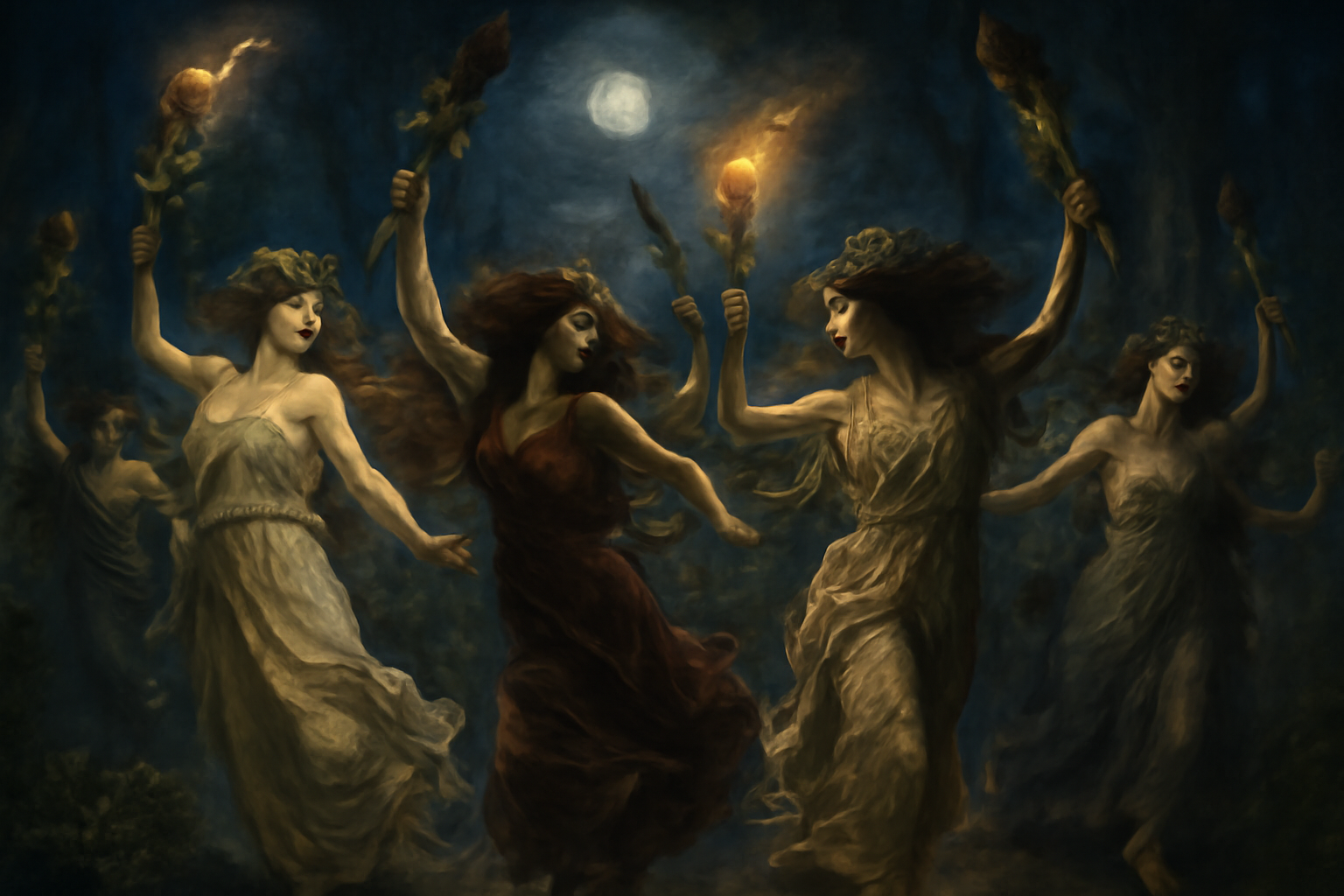
The word maenad comes from the Greek mainesthai, meaning “to rage” or “to be mad.” These were the raving ones — and the name was entirely intentional. Maenads were the female devotees of Dionysus who became the most iconic, most feared, and most mythologized members of his following. In ancient sources, they are depicted as ordinary women — wives, daughters, mothers — who abandoned their domestic roles and fled to the mountains in a state of divine possession.
The most thorough and dramatic account of maenad behavior comes from Euripides’ Bacchae, written around 405 BCE. In that tragedy, the women of Thebes are driven into a frenzy by Dionysus himself as punishment for the city’s refusal to acknowledge his divinity. Euripides describes them nursing wolf cubs, causing springs of wine and milk to flow from the earth, and, most disturbingly, tearing animals apart with their bare hands — a ritual act known as sparagmos, or “rending.” This was sometimes followed by omophagia, the eating of raw flesh, symbolizing the consumption of the god himself through his animal manifestations.
One of the most extraordinary details about maenads in mythology is their supposed invulnerability during their frenzy. Euripides describes them as immune to fire and weapons while in Dionysus’ grip. Soldiers sent to subdue them reportedly found that their swords made no wound. Whether or not any of this reflects real ritual practice, it powerfully communicates the ancient Greek understanding of divine possession — a complete suspension of ordinary human limitation.
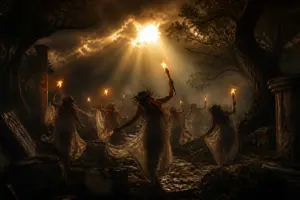
In their rites, maenads wore the nebris, a fawn skin draped over the body, symbolizing wildness and the sacred hunt. They carried the thyrsus, a fennel staff topped with a pine cone, which served as the emblematic ritual object of Dionysian worship. They danced the oreibasia — literally “mountain dancing” — a nocturnal, ecstatic ritual performed on peaks and in wilderness spaces deliberately removed from civilized life. Archaeological evidence supports at least some form of organized women’s mountain rites: inscriptions from Miletus dating to the third century BCE record official regulations for a female Dionysian cult, and similar evidence survives from Magnesia and other Greek cities.
It’s worth noting that the line between mythological maenads and real historical female worshippers is intentionally blurry in ancient sources. Real women participated in Dionysian rites, and those rites were genuinely ecstatic. But the full sparagmos as Euripides describes it almost certainly belongs more to myth and dramatic imagination than to documented ritual practice.
The Bacchants and Bacchae: All the Ecstatic Faithful
While “maenad” specifically described female devotees, the term bacchant (or bacchante for women, plural bacchae) was a broader designation used for all ecstatic worshippers of Dionysus — regardless of gender. The name derives from Bacchus, one of Dionysus’ most common epithets and the name by which the Romans primarily knew him. Euripides himself titled his great play The Bacchae, using this more inclusive term for the chorus of frenzied worshippers.
The Roman festivals known as the Bacchanalia take their name from this same root. These were festivals of Bacchus that spread through the Italian peninsula during the second century BCE, eventually causing significant alarm to Roman authorities. In 186 BCE, the Roman Senate issued the Senatus consultum de Bacchanalibus, a decree attempting to suppress the Bacchanalian rites, which had reportedly grown into secret nocturnal meetings involving thousands of participants. The Roman historian Livy describes the scandal in dramatic terms — accusations of orgiastic behavior, criminal conspiracy, and the corruption of Roman youth. Scholars debate how much of Livy’s account reflects genuine practice versus moral panic, but the Senate’s extreme reaction confirms that the cult had become genuinely threatening to Roman social order.
Male bacchants participated in rituals just as women did, wearing the nebris, carrying the thyrsus, and engaging in ecstatic dancing and wine rites. In Ovid’s Metamorphoses, male worshippers of Bacchus appear repeatedly, and Ovid treats the cult’s rituals with a mixture of fascination and irony. The initiation process for male participants in the Dionysian mysteries likely involved specific rites of symbolic death and rebirth — a pattern common across Mediterranean mystery religions.
The Satyrs and Sileni: The Mythological Male Companions
Dionysus’ mythological retinue wasn’t limited to human women. The god’s procession also included the satyrs and sileni, male nature spirits who occupied a permanent place in Dionysian iconography. Satyrs were depicted as half-human, half-animal creatures — typically with the ears, tail, and sometimes legs of a goat or horse — associated with fertility, drunkenness, and uninhibited sexuality. In early Greek art they appear with horse features; by the classical period, the goat-like satyr became more common, a form that heavily influenced later depictions of the devil in Christian iconography.
The Sileni were older, more grotesque versions of satyrs — pot-bellied, snub-nosed, and perpetually drunk. Their leader, Silenus, holds a particularly special place in the mythology as the tutor and companion of Dionysus himself. Often depicted riding a donkey because he was too drunk to walk, Silenus was nevertheless considered wise — a paradox that ancient authors found endlessly useful. In Plato’s Symposium, Alcibiades famously compares Socrates to a Silenus figure: ugly and ridiculous on the outside, containing divine wisdom within.
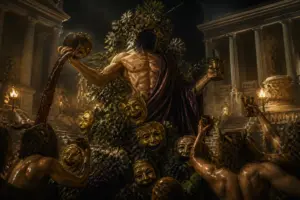
Satyrs appear abundantly in Greek vase painting accompanying Dionysus in his thiasus, carrying wine vessels, dancing with maenads, and playing musical instruments — particularly the aulos, the double flute that became synonymous with Dionysian rites. The satyr play, a comedic dramatic form performed after tragic trilogies at Athenian festivals, featured a chorus of satyrs and kept these figures at the center of Greek theatrical culture.
The Thiasus: The Sacred Procession
If maenads and bacchants describe the individual worshippers, the thiasus describes the organized collective — the sacred retinue or processional company of Dionysus as a whole. The word encompasses both the mythological entourage of the god (maenads, satyrs, sileni, and Dionysus himself moving through the world) and the structured religious associations that real worshippers formed in Greek cities.
In its historical sense, a thiasus was essentially a religious club or association dedicated to Dionysian worship. These organizations held regular meetings, maintained their own funds, elected officers, honored deceased members, and performed collective rites. They were among the earliest forms of voluntary religious association in the Greek world, and they served important social functions — providing community, mutual support, and a shared sacred identity for their members.
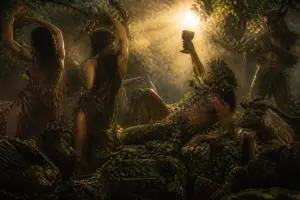
Iconographically, the thiasus is one of the most recognizable scenes in all of Greek art. Painted on countless vases, carved on sarcophagi, and rendered in mosaic, the Dionysiac thiasus typically shows the god reclining on a cart or riding a panther, surrounded by dancing maenads, drunken satyrs playing music, and Silenus stumbling along at the edges. This image became one of antiquity’s great artistic tropes — joyful, chaotic, and divine all at once.
Historical Worshippers: Real People in the Dionysian Mysteries
Beyond mythology and dramatic poetry, Dionysus had a vast and well-documented following of real historical people. The Dionysia — both the City Dionysia and the Rural Dionysia — were major official Athenian festivals that drew thousands of participants. The City Dionysia in particular was the civic occasion at which Greek tragedy and comedy were performed, meaning that Athenian theatrical culture was inseparable from Dionysian worship. Every audience member who watched Sophocles or Aristophanes was, in a formal sense, participating in a religious festival of Dionysus.
More secretive were the participants in the Dionysian mystery cult, known as mystai (initiates). Mystery religions in antiquity required formal initiation and promised their participants special knowledge, divine favor, and often a better fate in the afterlife. Dionysian mystery initiates underwent rites whose full details were never written down — deliberately kept secret — but gold tablets found in graves across Greece and southern Italy from the fifth century BCE onward give us tantalizing glimpses. These so-called Orphic-Dionysian tablets contain instructions for the soul’s journey after death, identifying the deceased as a member of Dionysus’ sacred company and promising divine reunion with the god.
Archaeological evidence from across the Mediterranean confirms the cult’s extraordinary reach. Dionysian imagery appears in elite Roman villas, in Egyptian papyri, on jewelry, on household objects, and in burial contexts throughout the ancient world. This was not a fringe religion — it was one of antiquity’s great spiritual forces, with worshippers in every walk of life, from slaves to emperors.
Frequently Asked Questions
What is the difference between a maenad and a bacchant?
A maenad specifically refers to the female devotees of Dionysus known for their wild, ecstatic behavior — the name comes from the Greek word for “raving.” A bacchant (or bacchante) is a broader term used for all ecstatic followers of the god, male or female, derived from his name Bacchus. All maenads are bacchants, but not all bacchants are maenads.
Were Dionysian rites actually as wild as ancient sources suggest?
Ancient sources — especially dramatic poetry like Euripides’ Bacchae — certainly exaggerate for theatrical effect. However, historical evidence confirms that real Dionysian rites did involve ecstatic dancing, wine, nocturnal mountain ceremonies, and states of ritual possession. The more extreme elements like sparagmos (ritual animal tearing) may reflect genuine archaic practices or may be largely literary inventions. Roman-era Bacchanalian scandals, documented by Livy, suggest that some Dionysian gatherings genuinely alarmed civil authorities.
Did men participate in Dionysian worship?
Absolutely. While female worshippers (maenads) are the most iconic, men participated fully in Dionysian religion. The Dionysia festivals were public civic events attended by all citizens. Mystery initiation was open to men, women, and even slaves. Male bacchants appear in ancient art and literature throughout antiquity, and Dionysian religious associations (the thiasus) typically included both men and women among their membership.
The Figurine That Captures Dionysus in Bronze
After learning about the wild ecstasy and ritual intensity of the maenads and bacchants, having a visual representation of Dionysus himself on your desk or shelf makes the god feel real—not just a name in ancient texts. This hand-painted bronze figurine brings the god of wine and theater into your everyday space.
What works
- Hand-painted detail captures the artistic tradition that made Dionysus a central figure in Greek art and pottery
- Compact size (3 3/8 inches) makes it perfect for display next to your mythology books or research notes without demanding shelf space
- Bronze finish evokes the classical period when Dionysian cults were at their most influential, grounding you in historical context
What doesn’t
- A figurine shows you what Dionysus looked like to ancient artists, but it won’t help you understand the thiasus or read primary sources like Euripides’ Bacchae
- Resin construction means it’s decorative rather than durable for frequent handling or outdoor display
If you’re looking for deep scholarly analysis of Dionysian worship practices, you’ll want to pair this with academic texts—the figurine works best as a visual companion to your reading, not a substitute for it. Veronese Design 3 3/8 Dionysus Greek God of Wine Resin Miniature Figurine Hand Painted Bronze Finish
About This Article

Written by Elias Blackwood. Elias Blackwood has spent 25 years as an obsessive collector of world mythology and folklore, from Greek and Norse epics to Japanese yokai and West African trickster tales — entirely self-taught, for the love of it. His reading draws on comparative mythology, cultural anthropology, and a personal library of translations most people have never heard of. More about this site.
Verify this against a primary source
Specifics change, and your situation may differ from the one described here. These are the authorities worth checking directly:
- Theoi Project — Greek mythology texts with primary source citations
- Perseus Digital Library — classical texts in the original and in translation
- Encyclopaedia Britannica — edited reference for figures and traditions