
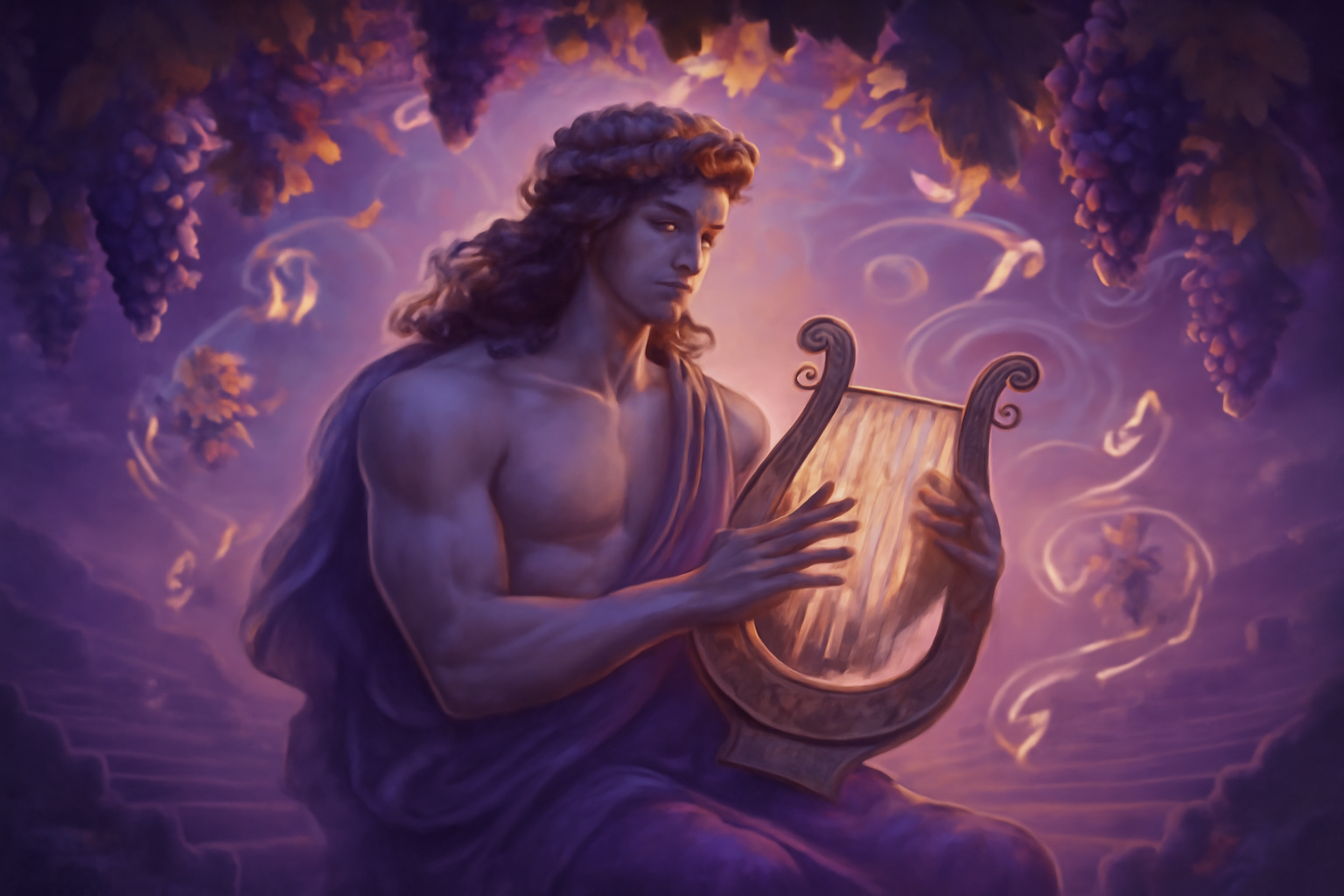
The Cult of Dionysus: How a Synth-Pop Banger Channeled an Ancient Greek God
There are songs that get stuck in your head, and then there are songs that feel like they were written by the gods themselves — or at least in their honor. “The Cult of Dionysus” by The Orion Experience falls firmly into the second category. From the moment those glittering synth melodies kick in, something ancient stirs beneath the surface of what sounds, on first listen, like an irresistibly fun pop track. It’s the kind of song that makes you want to dance, let loose, and throw your responsibilities to the wind — which, as it turns out, is exactly how the original followers of Dionysus felt about their god.
As someone who spends a lot of time thinking about mythology and how it bleeds into modern culture, I find this song genuinely fascinating. It’s not just a clever name drop. The Orion Experience built something that captures the actual spirit of Dionysian worship — the ecstasy, the abandon, the sense that regular life is something you can briefly, gloriously escape. Whether you found the track through TikTok, a playlist algorithm, or a very specific midnight YouTube rabbit hole, you’ve stumbled onto something that connects the ancient world to the contemporary in a way that feels almost magical. Let’s dig into it.
What Genre Is “The Cult of Dionysus”?
If you’ve ever searched “the cult of dionysus genre” after hearing the track for the first time, you’re not alone. It has a sound that’s immediately recognizable yet surprisingly hard to pin down, which is part of what makes it so compelling. The Orion Experience released the song in 2020, and it sits comfortably at the intersection of several musical worlds without fully belonging to any single one.
At its core, the cult of dionysus genre is best described as synth-pop with strong indie pop sensibilities and theatrical glam rock influences. The production is bright, polished, and unabashedly retro in the best possible way. You’ll hear shimmering synthesizer lines that owe a clear debt to the 1980s, vocals that lean into the dramatic and the performative, and a chorus hook so infectious it borders on weaponized. The Orion Experience, led by songwriter and producer Corey Hatch, has always had a knack for this kind of maximalist, feel-good pop, and this track represents the style at its most fully realized.
Depending on where you find it cataloged, the cult of dionysus genre gets tagged in a few different ways:
- Synth-pop: The dominant sonic identity, with lush electronic textures driving the whole track forward
- Indie pop: The playful, self-aware songwriting approach and the band’s independent artistic voice
- New wave revival: The retro aesthetic and the nod to acts like Duran Duran or early Pet Shop Boys
- Dance-pop: The BPM and structure are built to move bodies, not just ears
- Indie rock: Some categorizations lean here based on the band’s broader discography
What makes this genre blending so satisfying is how perfectly it suits the subject matter. Dionysus was never a god of restraint or categorization. He was the god of ecstasy, of breaking boundaries, of wild joy that refuses to be contained by neat definitions. A song about the cult of dionysus that defied tidy genre labels? That feels entirely appropriate.
The Mythological Meaning Behind the Song
Once you start listening to the lyrics of “the cult of dionysus” with your mythology goggles on, the connections become impossible to ignore. The song is essentially a modern invocation — a call to join something bigger than yourself, to surrender to pleasure and collective euphoria, and to step outside the boundaries that ordinary life imposes.
The chorus functions almost like a chant, the kind of repetitive, hypnotic refrain that wouldn’t have been out of place in an ancient Dionysian ritual. There’s an intentionality to the invitation embedded in the lyrics: come, join, lose yourself, belong to something ecstatic and free. This mirrors the actual appeal of Dionysian worship in ancient Greece, where the rituals were partly about achieving a state of ekstasis — literally “standing outside oneself” — in which the everyday self dissolved into something larger and more transcendent.
The thematic core of the song hits the major Dionysian notes with impressive precision:
- Liberation: The song’s energy is fundamentally about freedom — from routine, from inhibition, from social performance
- Pleasure as a spiritual act: Dionysus didn’t separate bodily joy from divine experience; neither does this song
- Collective belonging: The “cult” framing is key — this isn’t a solo journey but a communal one
- Breaking social norms: The theatrical, gender-fluid aesthetic of The Orion Experience as a band echoes Dionysus’s role as a deity who defied conventional boundaries
Whether The Orion Experience intended every one of these parallels or simply created something that organically channeled the Dionysian archetype, the result is a pop song that functions as genuine mythological tribute.
Who Was Dionysus and Why Did He Have a Cult?
For those who need a quick mythology primer — welcome, you’re in the right place. Dionysus was one of the most complex and culturally significant deities in the ancient Greek pantheon. He was the god of wine, theatre, ecstasy, fertility, and ritual madness. Son of Zeus and the mortal Semele, his birth was itself dramatic: Semele was tricked into asking Zeus to appear in his full divine glory, which incinerated her, and Zeus had to sew the infant Dionysus into his own thigh to complete the gestation. The god literally came into the world through an unconventional path — a fitting origin for a deity who would spend eternity overturning convention.
The actual Cult of Dionysus — the ancient religious movement that worshipped him — was one of the most widespread and enduring mystery cults in the ancient world. Its practices included:
- Ecstatic ritual and dance: Followers, particularly the Maenads (his female devotees), would enter trance-like states through music, movement, and wine
- Mystery rites: Initiates underwent secret ceremonies that promised spiritual transformation and a more intimate relationship with the divine
- Temporary inversion of social hierarchies: Slaves and free citizens, men and women, could participate together in ways that their ordinary social world would never permit
- Connection to theatre: Greek drama itself grew out of Dionysian festivals — tragedy and comedy were both sacred to him
The Cult of Dionysus was so appealing precisely because it offered something that structured Greek society rarely did: a legitimate, spiritually sanctioned escape from the rigidity of everyday roles. When you understand that, the modern resonance of the song becomes even sharper. The desire to join a cult of dionysus — metaphorically speaking — isn’t some ancient quirk. It’s a human constant.
Why Dionysus Keeps Appearing in Modern Music and Art
Dionysus has never really left the cultural conversation. From Friedrich Nietzsche’s famous analysis of the Dionysian versus Apollonian impulse in art, to the countercultural movements of the 1960s, to contemporary pop music, the god keeps showing up wherever humans are wrestling with the tension between order and liberation.
In music specifically, the Dionysian archetype has animated some of the most vital and transgressive work of the modern era:
- The raw, cathartic energy of rock and roll from its earliest days was described by critics using almost exactly the language ancient Greeks used for Dionysian ritual
- Jim Morrison famously identified with Dionysus and built much of The Doors’ artistic identity around that mythology
- Glam rock — the very tradition that “the cult of dionysus genre” draws from — was deeply Dionysian in its celebration of excess, theatricality, and gender fluidity
- Rave culture and electronic dance music communities have been analyzed by scholars as modern expressions of the same collective ecstasy that Dionysian ritual provided
What makes The Orion Experience’s approach interesting is how conscious and celebratory it is. Rather than just channeling Dionysian energy unconsciously, they named it directly, creating a song that functions as both a pop banger and a knowing cultural reference. It’s an invitation to know what you’re joining when you press play.
The enduring appeal of Dionysus in contemporary art isn’t hard to explain. We live in highly structured, productivity-obsessed, image-conscious societies. The Dionysian promise — that there is something sacred in letting go, in pleasure, in collective euphoria, in being briefly ungovernable — is just as radical and necessary now as it was in ancient Athens. Every generation finds its own way back to that particular god.
The Ancient and the Modern, Dancing Together
What I love most about “The Cult of Dionysus” is that it proves mythology isn’t a relic. It’s a living language that artists keep reaching for because it gives names to things human beings have always felt. The Orion Experience took the cult of dionysus genre — that shimmery, theatrical, liberating corner of synth-pop — and used it to create something that genuinely honors an ancient tradition of ecstatic freedom. You can enjoy the song entirely on its surface level and have a fantastic time. But knowing the mythology underneath it adds a dimension that makes it resonate at a completely different frequency.
The next time it comes up on shuffle and you feel that irresistible urge to turn up the volume and forget your troubles for three and a half minutes — that’s not just a pop song working its magic. That’s something much older. That’s Dionysus, doing what he’s always done.