
This post contains affiliate links. As an Amazon Associate I earn from qualifying purchases.
I still remember the moment I realized how badly most people misunderstand Dionysus. I was sitting in a graduate seminar on Greek religion — this was back in the late 1990s — when a classmate confidently declared that Dionysus was essentially “the party god,” a divine mascot for wine and excess. The professor, a formidable woman who had spent decades working with Homeric texts, just looked at him over her glasses and said, quietly, “You might want to revisit that.” It took me another five years of serious reading before I fully understood what she meant.
After more than 25 years of studying Greek mythology, ancient religious traditions, and the primary sources behind both, I can tell you that the Dionysus myth Greek god traditions present is one of the most misrepresented bodies of material in all of classical studies. The pop-culture version — a cheerful, slightly disheveled god of booze — strips out almost everything that made Dionysus genuinely dangerous, theologically interesting, and central to the ancient Greek worldview.
Let me correct the record.
The “God of Wine and Parties” Problem
Yes, Dionysus is associated with wine. I am not going to pretend otherwise. But reducing him to that association is like describing Zeus as “the lightning bolt guy.” It is technically accurate and almost entirely misleading.
In the ancient sources — Euripides’ Bacchae, Hesiod’s Theogony, the Homeric Hymns, and later in Pausanias and Diodorus Siculus — Dionysus is first and foremost a god of transformation, altered consciousness, and the dissolution of boundaries. Wine was the vehicle for that experience, not the point of it. The Greeks understood alcohol not as recreational but as sacramental. Drinking wine at a symposium was a ritual act. The god was present in the cup.
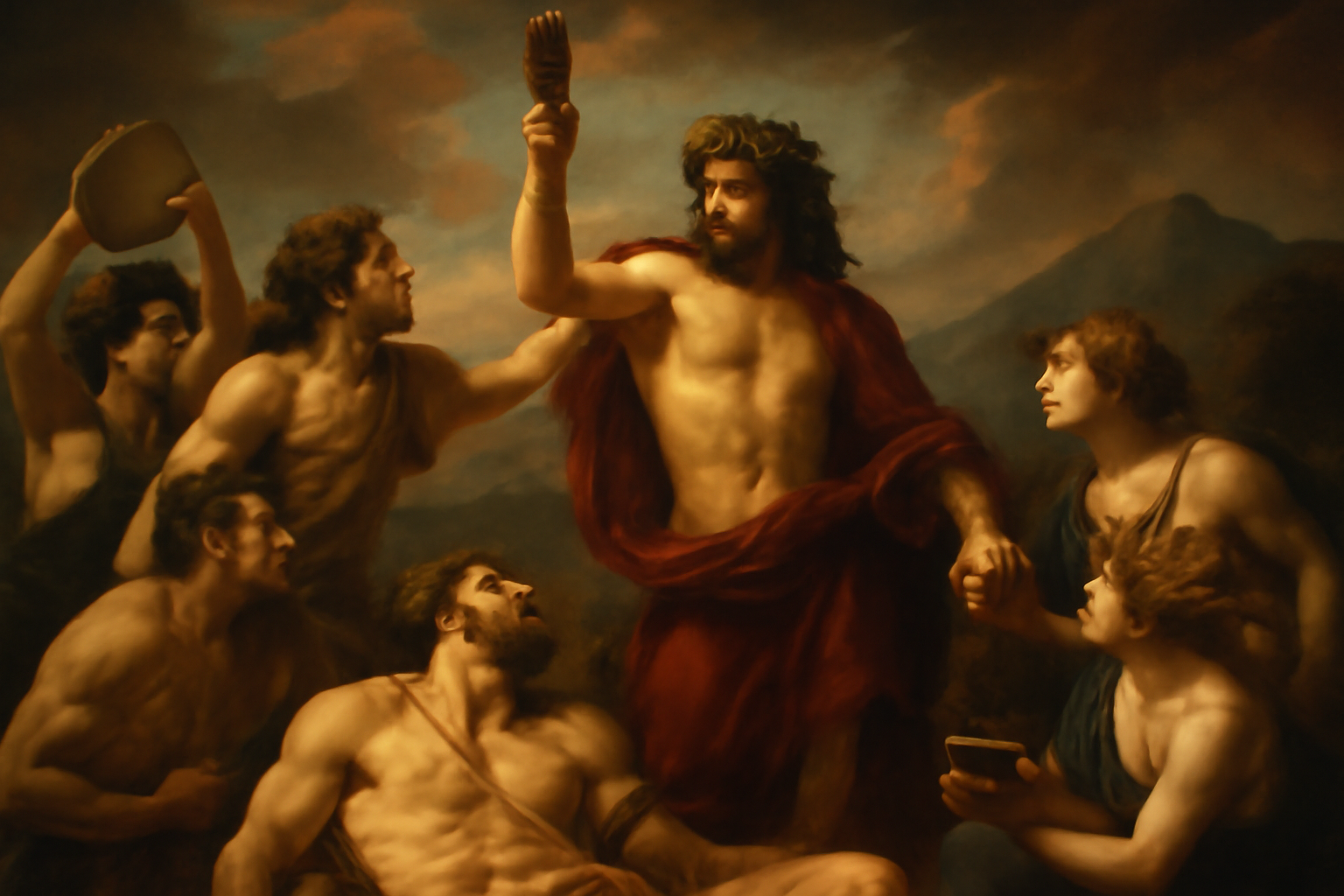
More importantly, Dionysus was the god of what scholars call enthusiasmos — literally, being filled with the god. The Maenads, his female followers depicted in vase paintings and described in terrifying detail in the Bacchae, were not simply drunk women running through the woods. They were in an altered state understood by ancient Greeks as divine possession. Euripides shows us what happens when that force is denied or mocked: it turns catastrophic.
The Birth Myths Are More Complex Than You Think
Most people know the basic story: Dionysus was born from the thigh of Zeus after his mother Semele was destroyed by seeing Zeus in his full divine form. This is accurate, but it leaves out two crucial pieces.
First, there is the Orphic tradition, which gives us a radically different account. In Orphic texts — fragments surviving from roughly the 5th century BCE onward — Dionysus is identified with Zagreus, the divine child of Zeus and Persephone. The Titans, smeared with white chalk (a detail that has occupied classical scholars for generations), lure the child with toys, tear him apart, and consume him. Athena saves his heart. Zeus swallows it, or gives it to Semele, and Dionysus is reborn. This is not a party myth. This is a myth about death, dismemberment, and resurrection — and it directly influenced later mystery cult traditions, including, many scholars argue, early Christian theology.
Second, there is a geographic complexity that tends to get smoothed over. Ancient sources debate whether Dionysus came from Thrace, from Phrygia, from Lydia, or was native to Greece at all. Herodotus treats him with some suspicion as a foreign import. Linear B tablets from Mycenaean Pylos — dating to around 1200 BCE — appear to reference a figure whose name may be connected to Dionysus, which pushes his presence in Greek religion back much further than the classical period usually credited. The scholarship here is genuinely contested, and I want to be honest: there is no clean consensus on when or how the Dionysus tradition entered the Greek religious mainstream. Anyone who tells you otherwise is oversimplifying.
Dionysus and the Theater: The Connection Most People Miss Entirely
Here is the one that genuinely surprises people when I mention it in talks or lectures. Athenian tragedy — the plays of Aeschylus, Sophocles, and Euripides — was performed at a religious festival called the City Dionysia. Plays were performed in the theater of Dionysus, on the south slope of the Acropolis. A priest of Dionysus had a special seat of honor at every performance.
Theater was not entertainment that happened to be associated with Dionysus. It was a religious ritual dedicated to Dionysus. The Greek word theatron — the place of seeing — was built around the act of witnessing transformation. Actors wore masks. They became other people. The audience underwent catharsis, Aristotle’s famous term for the emotional purging that tragedy produced. All of this is Dionysian. The mask, the transformation of identity, the release of suppressed emotion — these are the god’s domain.
When you understand this, the Bacchae becomes something else entirely. It is not just a play about a god who punishes a disbelieving king. It is a play performed at a festival to that god, in which that god appears as a character, essentially daring the audience to deny his power. The theological audacity of that is staggering, and you cannot see it at all if you think Dionysus is just about wine.
The Dual Nature: Ecstasy and Terror
The most honest thing I can say about Dionysus after all these years of reading is this: he is a god who cannot be safely categorized. The Greeks understood this. Walter Otto, in his 1933 study Dionysus: Myth and Cult — still one of the most important books on the subject despite its age — described Dionysus as the god of the “most blessed and the most terrible.” That paradox is the heart of it.
He brings wine, which brings joy. He also brings madness. He is the liberator — Eleutherios was one of his actual cult titles. He is also the destroyer. In the Bacchae, his own mother Agave, in a state of divine possession, tears her son Pentheus apart with her bare hands, believing him to be a mountain lion. Dionysus causes this. The text does not frame him as a villain for it. The Greeks understood this violence as the consequence of refusing the divine, of trying to maintain rational control over something fundamentally beyond reason.
That is not a party god. That is something far older, stranger, and more unsettling.
What I Recommend for Going Deeper
If you want to move beyond the surface-level summaries and actually engage with the Dionysus myth Greek god tradition offers, I suggest starting with good, well-illustrated introductory material before tackling the primary sources directly. Here are three books I regularly recommend:
- Greek Mythology: The Gods, Goddesses, and Heroes Handbook — Part of the World Mythology and Folklore Series, this is a solid profile-based reference that covers the major figures clearly and accurately. Good for getting your bearings on who’s who before diving into the messier, more complex primary accounts.
- Mythology: Timeless Tales of Gods and Heroes (75th Anniversary Illustrated Edition) — Edith Hamilton’s classic, now in a beautiful illustrated edition. Hamilton has her critics in academic circles, and I share some of those reservations, but as an entry point into Greek myth this remains one of the most readable introductions available.
- Ancient Greece: The Definitive Visual History (DK Classic History) — If you want the cultural and historical context for why the myths developed the way they did, this DK volume provides an excellent visual grounding in the world that produced them. Understanding the City Dionysia, the symposium culture, and the mystery cults is impossible without that context.
After those, I would encourage you to read Euripides’ Bacchae in a good translation — the Seaford or the Kovacs for serious readers — and then come back to everything you thought you knew about Dionysus. You will see it differently.
The Takeaway
The Dionysus myth Greek god traditions preserve is not a simple story about a lovable wine deity. It is one of the most theologically complex figures in the ancient Greek pantheon — a god of transformation, madness, death, rebirth, theater, and the terrifying ecstasy of losing yourself in something larger than the rational mind can contain. The Greeks took him seriously enough to build their greatest art form around his worship.
We should probably take him at least a little more seriously than a drinking game.