
This post contains affiliate links. As an Amazon Associate I earn from qualifying purchases.
I remember sitting in a graduate seminar on classical literature — this was about 1999 — when a professor said something that has stayed with me for the better part of three decades: “The Greeks did not write tragedies to depress their audiences. They wrote them to train them.” I did not fully understand what he meant until I spent another twenty years reading these texts more carefully. Ancient myths were not cautionary tales in the simple sense we use today. They were structured psychological frameworks, passed down through oral tradition and ritual performance, designed to teach people how to fall without being destroyed by the falling.
That distinction matters enormously. And it is almost completely absent from the way mythology lessons about failure get discussed online today.
The Modern Misreading of Mythic Failure
When most people encounter figures like Icarus, Sisyphus, or Tantalus, they walk away with a bumper-sticker interpretation. Icarus flew too high, so don’t be ambitious. Sisyphus pushes a boulder forever, so life is suffering. These readings are not just shallow — they are wrong. They strip the myths of the very mechanism that made them useful to the people who told them.
Let me be direct about something: the ancient Greeks, Norse, and Celtic traditions did not agree with each other on every point about failure and resilience. I want to be honest about that limitation upfront, because there is a temptation in comparative mythology to smooth everything into a single universal message. The traditions are distinct, and sometimes they conflict. What I am drawing on here are the specific patterns that recur independently across multiple cultures — patterns significant enough to suggest they reflect something real about human psychology, not just cultural coincidence.
Sisyphus Was Not a Warning. He Was a Model.
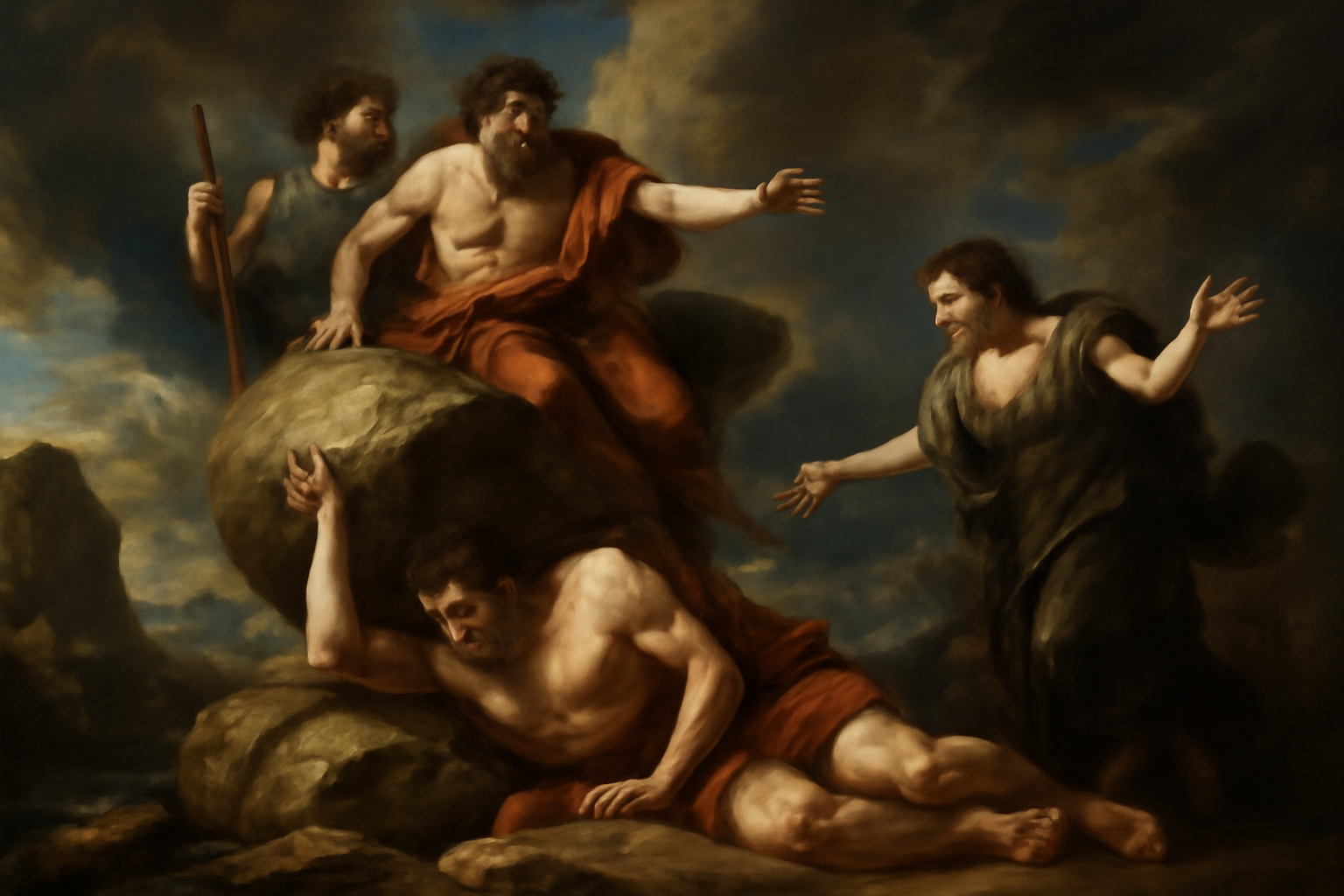
The Sisyphus myth as recorded in sources including Homer’s Odyssey (Book 11) and Pindar’s odes is almost always taught as punishment for hubris. Roll the boulder, watch it fall, repeat forever. End of lesson. But that reading ignores a critical feature of the myth: Sisyphus was considered the craftiest of men. He cheated death — twice. He outwitted Thanatos himself. The gods punished him not because he tried and failed, but because he succeeded in ways that threatened the cosmic order.
The deeper teaching is this: the punishment was the repetition, but the character of Sisyphus was defined by what he did with the repetition. The 20th-century philosopher Albert Camus famously argued that we must imagine Sisyphus happy, and while Camus was working from an existentialist framework rather than a strictly classical one, he was pointing at something the ancient Greeks embedded in the story structurally. The myth does not ask you to accept defeat. It asks you to examine what you do on the way back down the hill.
Norse Mythology and the Dignity of Inevitable Loss
If Greek mythology teaches anything about failure through cleverness and craft, Norse mythology teaches something altogether starker: how to fail on a cosmic scale and remain dignified doing it.
The concept of Ragnarök — the twilight of the gods — is one of the most psychologically sophisticated frameworks for dealing with failure that I have encountered in 25 years of reading primary sources. The gods in the Norse tradition, as recorded in the Prose Edda and the Poetic Edda, know that Ragnarök is coming. Odin consults the dead and the seers specifically to confirm what he already suspects: that he, Thor, Tyr, and nearly all the Æsir will die when the final battle comes. They know. And they prepare anyway.
This is not fatalism. The Norse distinction here is crucial. Fatalism says: it does not matter what you do, so do nothing. The Norse mythological framework says: you know the outcome, and you act with full commitment regardless. Tyr places his hand in the mouth of Fenrir knowing Fenrir will bite it off — because the binding of the wolf is necessary and someone must make the sacrifice. He loses the hand. The wolf is bound. Both things are true simultaneously.
What this taught the Norse peoples about failure in everyday life was something like this: the measure of a person is not whether they win or lose, but whether they show up with full effort when they know the odds are against them. The Old Norse term drengskapr — roughly translated as honorable conduct, or the quality of being a true warrior — was specifically tied to behavior in situations of probable defeat.
The Celtic Model: Failure as Transformation, Not Ending
Celtic mythology, particularly the Irish material preserved in texts like the Book of Invasions and the Ulster Cycle, approaches failure through a different but equally sophisticated lens: the idea of radical transformation following collapse.
The figure of Cú Chulainn is instructive here. His entire arc in the Ulster Cycle is structured around a man who is, in nearly every tactical sense, failing. He fights the armies of Connacht alone while the rest of Ulster is under a curse and cannot fight. He wins individual combats, but the war continues. He kills his best friend Ferdiad in single combat and is devastated by it. He makes choices that lead directly to his own death. And yet the tradition does not present him as a failure — it presents him as the exemplar of heroic humanity.
The Celtic framework seems to suggest that failure experienced with full emotional and moral engagement changes you into someone capable of things you could not have done before the failure. This is not the same as “what doesn’t kill you makes you stronger,” which is a fairly shallow reading. It is more precise than that: the specific grief and specific loss are what produce the specific transformation. Cú Chulainn without the death of Ferdiad is a lesser version of himself — not because suffering is inherently good, but because some kinds of depth only come through specific kinds of breaking.
What These Myths Actually Have in Common
Across three distinct traditions — Greek, Norse, and Celtic — I see three consistent mythology lessons about failure that are worth extracting:
- Failure is not the end of the story. In all three traditions, the characters who fail most dramatically are also the ones who continue. Sisyphus pushes again. Odin prepares for another age after Ragnarök. Cú Chulainn’s legend outlasts his death by millennia.
- The quality of your response to failure is itself a form of action. How you carry yourself after a loss is not passive waiting — it is a choice that defines character. This is what the ancient traditions were actually trying to teach.
- Failure teaches something that success structurally cannot. The myths do not celebrate failure. But they are deeply suspicious of people who have never encountered it. The greatest heroes and wisest figures in almost every tradition have been broken by something and rebuilt themselves from the pieces.
How I Work With These Ideas Personally
I want to be honest here: studying mythology for 25 years does not make you immune to the experience of failure. What it does, I think, is give you a richer set of frameworks for interpreting what failure means while you are inside it. That is not nothing.
I have found that Stoic philosophy — which is not mythology per se but draws heavily on the same Greek tradition that gave us the myths — offers some of the most immediately practical tools for this. I keep a set of the MindMint Daily Stoicism Affirmation Cards on my desk, and I use them the way an ancient practitioner might have used a hypomnemata — a personal notebook of philosophical reminders. They are not a substitute for reading the primary sources, but they function as a daily touchstone that keeps these ideas active rather than purely academic.
For a more sustained daily engagement with the Stoic tradition as it intersects with mythology and ancient philosophy, I consistently recommend 365 Days of Stoicism: One Page a Day Through Stoic Ideas, Texts, and Lives. The format respects your time while refusing to oversimplify — it engages with actual texts and actual historical figures rather than vague inspiration. For a broader collection of classical wisdom drawn from multiple traditions, the Book of Wisdom Volume 1 is worth keeping in your reference library alongside the primary sources.
Why This Matters More Than You Might Think
We live in a culture that is deeply uncomfortable with failure, which means we are also deeply bad at processing it. We either catastrophize it or paper over it with shallow positivity. Ancient mythology did neither. It looked at failure with absolute clarity and then asked: given that this happened, who will you be next?
That is a harder question than anything on a motivational poster. It is also, I think, the only question worth asking. The myths have been asking it for three thousand years. It is worth sitting with long enough to hear the answer.