
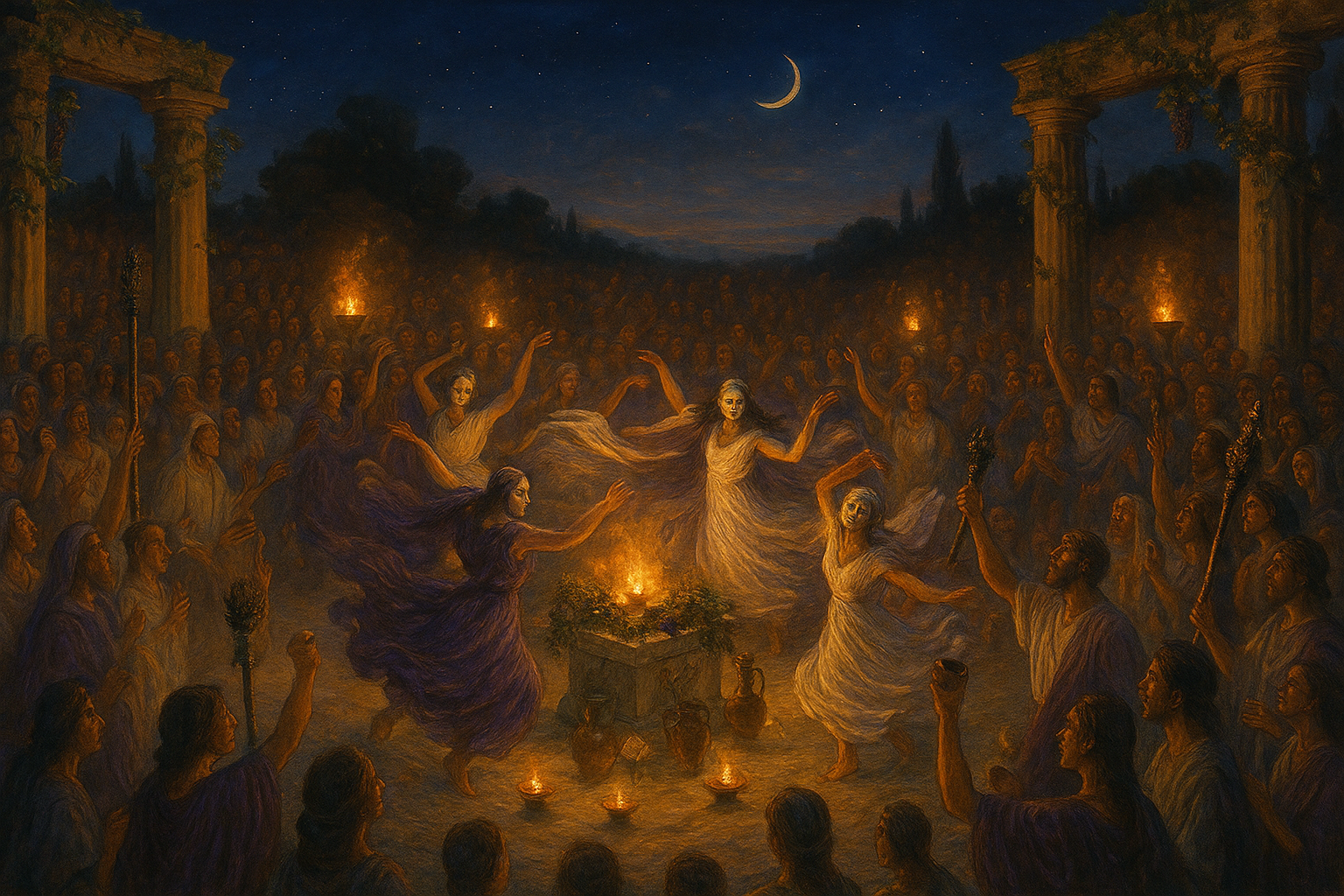
Ancient Greek mythology presents few figures as complex and fascinating as Dionysus, the god of wine, ecstasy, and divine madness. His journey from miraculous birth to divine recognition weaves through some of mythology’s most captivating tales. Moreover, these stories reveal profound themes about transformation, acceptance, and the struggle between civilization and wild nature.
The Miraculous Birth of Dionysus
Dionysus entered the world through extraordinary circumstances that set him apart from other Olympic deities. Zeus fell deeply in love with Semele, a mortal princess of Thebes who possessed remarkable beauty. However, Hera discovered this affair and devised a cunning plan for revenge.
The jealous goddess disguised herself as an elderly woman and befriended Semele. Subsequently, she convinced the princess to ask Zeus to appear before her in his true divine form. Zeus had promised to grant Semele any wish, and consequently, he reluctantly revealed himself as the god of thunder and lightning.
Driven by Hera’s insidious manipulation, Semele had foolishly demanded to witness Zeus in his true, divine form. Bound by an unbreakable oath on the River Styx, Zeus had no choice but to comply. When the King of the Gods unveiled his true essence, it was not merely a bright light, but an overwhelming, cataclysmic display of raw, cosmic power:
- Blinding flashes of lightning tore through the air, illuminating the palace with terrifying brilliance.
- Deafening thunderclaps reverberated, shaking the very foundations of the earth.
- An incinerating inferno erupted, a direct manifestation of Zeus’s unbridled divinity.
Semele, a mere mortal, was instantly overwhelmed. Her body, unable to withstand such immense and unshielded power, was tragically consumed by the divine flames, reduced to ash in a heartbeat. It was a brutal testament to the fatal consequences of witnessing true godhood without divine protection.
Yet, amidst this devastating spectacle, Zeus’s paternal instincts surged with astonishing speed and resolve. Even as the inferno raged, his focus shifted to the precious, nascent life within Semele. The child, though prematurely expelled from the shock and destruction, was miraculously still alive.
Zeus, demonstrating an unparalleled act of divine intervention, swiftly undertook a series of extraordinary measures to preserve his son:
- Emergency Extraction: With a combination of gentle precision and immense power, Zeus carefully retrieved the tiny, vulnerable infant from the smoldering remains of Semele. This was no ordinary birth; it was a desperate, immediate rescue to snatch life from the jaws of death.
- The Divine Incubator: Recognizing that the child was not yet fully developed and required further gestation, Zeus performed an unprecedented act. He created a temporary, living incubator within his own body. He made an incision in his thigh, specifically the fleshy part, and carefully placed the infant inside.
- Completion of Gestation: The wound then miraculously closed, effectively sewing the baby into Zeus’s body. Here, nestled within the very essence of the King of the Gods, Dionysus remained for the remainder of his natural term. This unique “thigh-womb” provided the necessary warmth, protection, and divine energy for the child to fully develop, completing what would have been Semele’s pregnancy.
This remarkable origin story is why Dionysus is famously referred to as “twice-born” or “born from fire and thunder.” His first “birth” was his premature expulsion from Semele’s womb, and his second, more complete and miraculous birth, was from the thigh of Zeus. This extraordinary genesis imbued Dionysus with a profound dual nature: a connection to the mortal world through his mother and an intimate, direct connection to the divine through his father, having literally been nurtured within him. It set him apart as a god intimately familiar with both destruction and rebirth, life and death, chaos and ecstatic revelry.
This extraordinary origin story of Dionysus, often invoked by his epithet “twice-born” (or dithyrambos in some contexts), is more than just a dramatic tale. It is the foundational myth that profoundly shapes our understanding of his complex nature and his unique role within the Greek pantheon.
The Significance of Being “Twice-Born”
The narrative of his birth — first from the mortal princess Semele, who was consumed by Zeus’s divine fire, and then from Zeus’s own thigh, where he completed his gestation — isn’t merely a curiosity. It imbues Dionysus with several crucial characteristics:
- A Bridge Between Worlds: Unlike the other Olympians, who are purely divine, Dionysus is born from both mortal and immortal parentage. His “twice-born” status symbolizes his unique position as a liminal deity, existing on the threshold between the human and divine, the earthly and the celestial.
- Symbol of Rebirth and Regeneration: The cycle of destruction (Semele’s death) and subsequent rebirth (from Zeus’s thigh) directly mirrors the natural cycles over which he presides – the death and revival of the vine, the changing seasons, and the very processes of life, death, and renewal.
- An Initiate’s Journey: This transformative birth can also be seen as a metaphor for initiation. It suggests a profound, often painful, journey of death and resurrection that leads to a higher state of being, a concept central to the mystery cults associated with Dionysus.
The Foreshadowing of Duality
More importantly, this singular birth event serves as a potent foreshadowing of the profound dualities that would become the very essence of Dionysus’s character and influence throughout Greek mythology and religious practice. His nature is a tapestry woven from seemingly contradictory threads, making him one of the most dynamic and enigmatic gods.
Consider the following core dualities inherent in the “twice-born” god:
- Joy vs. Frenzy:
- He is the god of wine, revelry, ecstasy, and the joyful liberation found in celebration.
- Yet, he also embodies mania, uncontrolled passion, madness, and the terrifying loss of self that can lead to violence and destruction. Think of the wild maenads in their ecstatic rites.
- Life vs. Death:
- As a fertility god, he represents lush growth, abundant harvests, and the vibrant force of nature’s life-giving power.
- Simultaneously, he is linked to themes of dismemberment (sparagmos), sacrifice, and a journey into the underworld, often associated with the cycle of dying and rising gods.
- Order vs. Chaos:
- Dionysus is the patron of theater, a highly structured art form with defined roles and narratives, representing a form of civic order.
- Conversely, his cults often involved breaking societal norms, abandoning inhibitions, and embracing the untamed, primal forces of nature and the subconscious, leading to a blissful or terrifying chaos.
- Civilized vs. Wild:
- He brings the gift of wine, a symbol of culture, communal feasting, and the refinement of civilization.
- However, he is frequently depicted in wild, untamed landscapes, surrounded by satyrs and maenads, embodying the raw, untamed wilderness that lies beyond human control.
- Presence vs. Absence:
- His cults celebrated his sudden, powerful epiphany or arrival, bringing transformation and divine presence.
- Yet, he is also a god of withdrawal and mystery, often depicted as a wanderer whose presence is felt even in his absence, creating a longing for his return.
These inherent contradictions, born from the very fabric of his origin, define Dionysus not as a god of simple categories, but as a powerful, transformative force who challenges boundaries and embodies the full spectrum of human experience.
Early Years in Exile
After his birth, Dionysus faced continued persecution from Hera’s wrath. Zeus entrusted the infant to various guardians to ensure his safety. First, he gave the child to Hermes, who delivered him to Semele’s sister Ino and her husband Athamas.
However, Hera’s vengeance extended to these foster parents as well. She drove them to madness, forcing Zeus to seek alternative arrangements. The king of the gods then transformed Dionysus into a kid goat to disguise him from Hera’s watchful eyes.
Eventually, Zeus transported the young god to Mount Nysa, where nymphs raised him in secret. These divine caretakers taught Dionysus about nature’s mysteries and the cultivation of grapes. Additionally, they introduced him to the intoxicating properties of wine, which would become his primary domain.
The mountain sanctuary provided Dionysus with protection and education. There, he learned to harness his divine powers while developing his distinctive personality. Moreover, this period of exile instilled in him empathy for outcasts and marginalized individuals.
The Journey to Establish Divinity
The young god, now fully embodying his potent divine essence, embarked on an epic, globe-spanning pilgrimage. This wasn’t merely a journey; it was a deliberate, often dramatic, campaign to introduce and solidify his unique form of worship across the known world. Unlike many Olympian deities whose domains were largely fixed, Dionysus was a missionary god, actively seeking converts and demanding recognition for his transformative powers.
His travels were legendary, a grand tour that stretched the imagination of the ancient Greeks:
- Across the East: His path first led him through the vibrant, mystical lands of Asia Minor. Here, he encountered diverse cultures and existing ecstatic cults, often finding common ground or transforming local practices. Regions like Phrygia and Lydia were among the first to experience his intoxicating presence, where he was sometimes associated with the Great Mother goddess Cybele.
- Into the Far Reaches of India: Perhaps the most astonishing leg of his odyssey took him even further east, to the fabled land of India. This journey underscored his universal appeal and the exotic, boundary-breaking nature of his divinity. He wasn’t confined to the Hellenic world; his influence transcended geographical and cultural borders.
- The Return to Greece: After years of establishing his cult in foreign lands, Dionysus eventually circled back to his homeland, Greece, where his ultimate test awaited. It was here, among his own people, that he faced some of his most formidable challenges.
Throughout this extensive propagation of his cult, Dionysus rarely found an easy path. His arrival often sparked controversy and outright hostility. The reasons for this significant resistance were multifaceted:
- Challenge to Order: His worship, characterized by ecstasy, wine, music, and a temporary blurring of social distinctions, was seen as a radical departure from the structured, rational order favored by many Greek city-states. It threatened established authority and traditional religious practices.
- Foreign Origins: Despite being born of Zeus, Dionysus was often perceived as “the outsider” or “the foreign god” due to his upbringing and the exotic nature of his initial followers – his wild retinue of maenads (frenzied female devotees) and satyrs (half-human, half-goat companions).
- Denial of Divinity: Many rulers and conservative elements simply refused to acknowledge his divine status, viewing him as a charlatan or a dangerous cult leader rather than an Olympian. They scoffed at his claims and dismissed his followers as mad or deluded.
This defiance often led to tragic, violent confrontations. Those who dared to imprison him or suppress his rites invariably faced dire consequences, typically in the form of divine madness or brutal retribution. Notable examples include:
- King Pentheus of Thebes: His refusal to accept Dionysus led to his horrific dismemberment by his own mother and aunts, driven to Dionysian frenzy.
- King Lycurgus of Thrace: He attempted to drive Dionysus out of his lands, only to be struck with madness, leading him to kill his own son and ultimately himself.
These dramatic encounters served as potent, terrifying lessons, demonstrating that the god of wine, revelry, and liberation demanded absolute recognition, and those who denied him risked not only their sanity but their very lives.
The god’s approach to spreading his cult differed markedly from other deities. Instead of demanding immediate recognition, he often arrived in disguise to test mortals’ hospitality and openness. Those who welcomed him received blessings of fertility, abundance, and spiritual ecstasy. Conversely, those who rejected him faced terrible punishments.
Dionysus’s followers, known as Maenads, accompanied him on these journeys. These women abandoned conventional social roles to embrace wild, ecstatic worship. They demonstrated the transformative power of the god’s influence and served as living examples of his divine authority.
The god’s travels were not merely about establishing worship but also about proving his legitimacy among the Olympic pantheon. Each successful conversion of a city or region strengthened his claim to divinity and expanded his influence.
The Encounter with Pirates
One of Dionysus’s most famous adventures occurred during his travels across the Mediterranean Sea. Pirates spotted the young god standing alone on a cliff and mistook him for a wealthy prince who could be sold into slavery. Consequently, they kidnapped him and brought him aboard their ship.
The very air around their captive began to hum with an unnatural energy, a subtle tremor that preceded the impossible. What started as a faint, almost imperceptible shift in the ship’s timbers quickly escalated into a full-blown botanical invasion, leaving the hardened seafarers bewildered and then terrified.
The Ship Transformed: A Living, Breathing Grove
- Rapid, Vigorous Growth: Without warning, thick, woody grapevines erupted from the deck planks, snaking their way upwards with astonishing speed. They didn’t merely grow; they surged, tendrils reaching out like sentient limbs.
- Within moments, lush, vibrant green leaves unfurled, followed by nascent clusters of dark, ripe grapes, defying the salty sea air and the lack of soil.
- These powerful vines coiled around the ship’s sturdy masts, binding them in an emerald embrace. They wove through the intricate rigging, transforming ropes into verdant chains and sails into leafy canopies, effectively immobilizing the vessel.
- Ubiquitous Ivy: Simultaneously, a dense carpet of ivy burst forth from every conceivable surface.
- It cascaded down the ship’s railings, cloaking the rough wood in a cool, dark green.
- It crept along the deck, climbed the walls of the cabins, and even began to entwine itself around the pirates’ discarded weapons and personal effects.
- The ship, once a stark vessel of wood and canvas, rapidly became a verdant, living grove, permeated by the earthy scent of damp foliage and ripening fruit.
An Unseen Orchestra: The Sounds of the Divine
Alongside this botanical marvel, the atmosphere underwent an equally profound shift, filling with an ethereal, disorienting symphony.
- Invisible Melody: The soft, reedy sound of flutes wasn’t just singular but multiplied, as if an entire chorus of unseen musicians had joined the ship.
- These weren’t the simple tunes of human making; they were wild, haunting melodies that seemed to echo from the very heart of the sea and sky, weaving a hypnotic spell.
- Bacchic Chorus: Soon, other instruments joined the otherworldly ensemble:
- The rhythmic thrum of drums beat a primal pulse, resonating deep within the pirates’ chests.
- The clashing of cymbals punctuated the air with sharp, metallic bursts.
- The reedy wail of panpipes added a melancholic yet intoxicating layer, blending with the flutes to create a soundscape both alluring and deeply unsettling.
The ship, once a place of human ambition and greed, was now utterly subsumed by the divine presence of its captive. It had become a floating thiasus—a sacred, wild space where the boundaries between nature and man, and mortal and god, dissolved into an intoxicating, terrifying spectacle. The pirates, witnessing their vessel transform from a tool of their trade into a living manifestation of uncontrollable power, felt a cold dread settle in their hearts, realizing they had captured not a man, but a force of nature itself.
The Divine Transformation: Terror on the High Seas
The moment Dionysus revealed his true nature, the atmosphere aboard the pirate vessel shifted from confident criminality to supernatural horror. The god’s metamorphosis was not merely a change of appearance—it was a complete manifestation of divine wrath that defied every law of nature the sailors understood.
The Lion’s Terrifying Presence
As the transformation began, witnesses described phenomena that went beyond simple shapeshifting:
- Bone-deep roars that seemed to emanate from the very depths of the underworld
- Golden eyes that blazed with an otherworldly fire, paralyzing those who dared to meet his gaze
- Massive claws that scraped against the wooden deck, leaving gouges that smoked and hissed
- A mane that rippled with an unnatural wind, despite the still air surrounding the ship
The divine lion was no ordinary predator. This was Dionysus in his most primal aspect—the god of wild nature unleashed, representing the untamed forces that civilization attempts to control but can never truly master.
Chaos and Desperation Among the Crew
The pirates’ reaction revealed the profound difference between mortal fear and divine terror:
- Initial Disbelief: Seasoned criminals who had faced storms, rival ships, and armed merchants stood frozen in incomprehension
- Escalating Panic: As the reality of their situation became undeniable, rational thought abandoned them entirely
- Desperate Flight: The ocean, normally a pirate’s greatest ally, suddenly seemed like their only refuge from the supernatural predator stalking their deck
The crew’s decision to leap overboard demonstrated how complete their terror had become—experienced sailors choosing the uncertainty of deep waters over facing the god’s wrath.
The Dolphins: A Merciful Transformation
Dionysus’s punishment carried layers of meaning that reflected his complex nature:
- Physical Transformation: The pirates’ human forms dissolved into sleek, intelligent marine mammals
- Symbolic Justice: Those who had lived by preying upon others became creatures known for rescuing drowning sailors
- Eternal Service: Their new forms bound them to a life of aiding rather than harming travelers
This metamorphosis represented divine mercy wrapped in justice—the pirates retained their lives and gained a chance for redemption through service to others.
The Helmsman’s Wisdom and Reward
The lone sailor who escaped punishment embodied several crucial virtues:
Recognition of Divinity: Unlike his crewmates, he possessed the spiritual insight to perceive Dionysus’s true nature beneath his youthful disguise.
Moral Courage: Despite being outnumbered by his fellow pirates, he chose to defend the apparent victim rather than participate in the crime.
Protective Instinct: His actions demonstrated that even among criminals, individuals could choose righteousness when confronted with moral clarity.
The helmsman’s salvation illustrated a fundamental principle in Greek mythology: the gods reward those who show proper reverence and moral courage, regardless of their past associations or circumstances.
The Transformative Power of Divine Recognition
The mythology surrounding Dionysus reveals profound lessons about the nature of divinity and human perception that extend far beyond ancient Greek storytelling. These narratives serve as powerful metaphors for understanding how we encounter the sacred in our everyday lives.
The Dual Nature of Divine Transformation
Dionysian myths showcase transformation as a fundamental force of existence:
- Physical metamorphosis: Mortals become dolphins, vines sprout from ships, and water turns to wine
- Psychological transformation: Characters experience madness, ecstasy, or profound spiritual awakening
- Social upheaval: Established hierarchies crumble when divine presence disrupts conventional order
This transformative power operates on multiple levels simultaneously. When King Lycurgus opposed Dionysus, entire landscapes shifted—mountains trembled, forests came alive, and the very fabric of reality bent to the god’s will. Such stories remind us that divine encounters fundamentally alter everything they touch.
The Paradox of Divine Justice
The god’s approach to justice embodies a complex moral framework that defies simple categorization:
Merciful Interventions:
- Rescuing abandoned Ariadne on Naxos
- Elevating loyal followers to divine status
- Offering redemption to those who acknowledge their errors
Terrible Retributions:
- Driving the daughters of King Minyas to madness for rejecting his festivals
- Transforming Tyrrhenian pirates into dolphins for their attempted kidnapping
- Inflicting devastating plagues on cities that refuse his worship
This duality reflects the unpredictable nature of the sacred—neither purely benevolent nor malevolent, but responding to human actions with proportionate intensity.
Hidden Divinity in Plain Sight
Perhaps most significantly, these tales explore how divine presence often manifests in disguise:
- A seemingly ordinary young man boarding a pirate ship
- A wandering stranger requesting hospitality
- An unconventional teacher challenging religious orthodoxy
The consistent message across these narratives warns against judging by appearances alone. Those who recognize divinity despite its humble or unexpected packaging receive blessings, while those who dismiss or mock what they don’t understand face consequences that reshape their entire existence.
This theme resonates beyond mythology, suggesting that moments of profound significance often arrive wrapped in ordinary circumstances, requiring spiritual discernment to recognize their true nature.
The Descent to the Underworld
Among Dionysus’s most emotionally significant adventures was his journey to the Underworld to retrieve his mother Semele. Despite never knowing her in life, the god felt compelled to rescue her from the realm of the dead. This quest demonstrated his loyalty and love for family, even across the boundary between life and death.
Dionysus’s foray into the Underworld was a monumental undertaking, diverging sharply from the typical heroic descent. Unlike mortals such as Odysseus seeking prophecy or Heracles performing a labor, Dionysus, a powerful Olympian god, found himself in the unprecedented position of having to negotiate with the rulers of the dead, rather than command.
This wasn’t a simple passage; it was a profound challenge to the very fabric of cosmic order.
The Unwritten Rules of the Realm of the Dead
For a god accustomed to the vibrant revelry of the mortal world and the celestial heights of Olympus, the Underworld presented a stark contrast. Here, the usual rules of divine authority were superseded by the ancient, immutable laws of death.
- Divine Power vs. Chthonic Law: While Dionysus possessed immense power, in Hades’s domain, Hades was sovereign. His divine status, usually a source of advantage, could be seen as an imposition or even a challenge to the established order of the dead.
- The Inviolability of Death: Greek mythology held that once a soul crossed the River Styx and entered the Underworld, its stay was permanent. Releasing a soul was an act of cosmic defiance, something rarely, if ever, granted.
- Navigating the Barriers: Even for a god, the journey likely involved confronting the traditional guardians:
- Charon, the ferryman, who demanded payment for passage. Would Dionysus, a god, pay the obol?
- Cerberus, the three-headed hound, guarding the gates, whose ferocity was legendary. Would Dionysus charm him with music, wine, or simply overpower him?
A Plea for a Soul: Convincing the Unyielding Rulers
The most formidable obstacle was not the journey itself, but the delicate and perilous task of persuading Hades, the stern and unyielding king of the dead, and his queen, Persephone, to break one of their most sacred laws.
- The Identity of the Soul: The soul Dionysus sought was deeply personal: his own mother, Semele. Her death was not natural but a tragic accident, tricked by Hera into witnessing Zeus’s full divine glory, which incinerated her. This distinction – dying “before her time” and by divine machination – was crucial. It wasn’t a soul condemned for wickedness or reaching its natural end.
- The Art of Divine Persuasion: Dionysus couldn’t simply demand Semele’s release. He had to appeal to the unique sensibilities of the Underworld monarchs:
- Hades: Known for his strict adherence to rules and his unyielding nature. A direct appeal to compassion might be futile. Dionysus might have needed to offer a significant bargain, a promise, or demonstrate the profound injustice of Semele’s fate.
- Persephone: Having spent time in the mortal world and experiencing the pain of separation from her mother, Demeter, she might have been more empathetic to a plea for reunion or the reversal of an unjust death. Her influence could be key.
- A Precedent-Setting Act: Granting Dionysus’s request would set an extraordinary precedent, potentially disrupting the careful balance between the living and the dead. This made the negotiation incredibly sensitive, demanding not just power, but profound diplomacy and perhaps even a unique offering that resonated with the Chthonic deities. Dionysus’s success in this unprecedented mission truly cemented his status as a god of liberation and resurrection, capable of even defying death itself.
Dionysus successfully negotiated Semele’s release, though the exact terms of their agreement vary in different versions of the myth. Source Some accounts suggest he offered something precious in exchange, while others indicate his divine authority compelled the underworld rulers to comply.
After rescuing his mother, Dionysus renamed her Thyone and brought her to Mount Olympus. There, she achieved immortality and took her place among the divine beings. This reunion completed Dionysus’s family circle and validated his divine heritage through his mother’s elevation.
The underworld journey also symbolized Dionysus’s role as a god of death and rebirth. His ability to move between worlds reflected the cyclical nature of vegetation, wine-making, and spiritual transformation that characterized his worship.
The Romance with Ariadne
This pivotal moment in Ariadne’s story marks a profound turning point, transforming her from a tragic figure of abandonment into an immortal bride.
**The Depth of Ariadne’s Despair**
Before encountering the god, Ariadne’s situation was dire, amplifying the eventual solace she found:
- A Betrayal of Epic Proportions: Ariadne, princess of Knossos, had made an unimaginable sacrifice for love. She had not only betrayed her formidable father, King Minos, but also her homeland, providing Theseus with the crucial thread and sword that allowed him to navigate the Labyrinth and slay her monstrous half-brother, the Minotaur. Her actions were driven by a deep, unwavering devotion to the Athenian hero.
- The Desolation of Naxos: Washed ashore on the barren island of Naxos (or Dia, as it was sometimes called), Ariadne faced utter solitude. The bustling palace life of Crete, the thrill of her daring escape, and the promise of a future with Theseus had all evaporated. Her heart, already raw from the betrayal of her family, was now shattered by the hero’s callous desertion. She was left without allies, without purpose, and without hope, vulnerable to the elements and her own crushing grief.
**Dionysus’s Divine Intervention**
It was in this state of profound vulnerability and heartbreak that Dionysus appeared, not as a conquering hero, but as a source of unexpected comfort and liberation:
- A Vision of Ecstasy: The god of wine, revelry, and divine madness typically traveled with a vibrant, boisterous retinue of maenads (female followers driven by ecstatic frenzy) and satyrs (lustful, often drunken woodland spirits). His arrival would have been a stark contrast to Ariadne’s quiet despair, a vibrant burst of life and sound on a desolate shore.
- Compassion and Recognition: Unlike Theseus, who saw Ariadne as a means to an end, Dionysus recognized her inherent worth and profound suffering. He was drawn to her beauty and her sorrow, seeing beyond her immediate pain to the potential for joy and transformation. His very presence offered a different kind of freedom—freedom from sorrow, from mortal constraints, and from the painful memories of betrayal.
- An Offer of Immortality: Dionysus didn’t merely offer a new relationship; he offered a new existence. He fell deeply in love with Ariadne, proposing marriage and promising her a place among the gods. This was an unprecedented act of divine grace, elevating her from a discarded mortal princess to an immortal goddess, his beloved consort.
**The Dawn of a New Love Story**
Their union blossomed into one of the most celebrated and enduring divine marriages in Greek mythology:
- The Bridal Crown: As a wedding gift, Dionysus presented Ariadne with a magnificent golden crown, crafted by Hephaestus. Upon her eventual death (or directly upon her apotheosis, depending on the myth version), this crown was cast into the heavens, becoming the constellation Corona Borealis (the Northern Crown), a lasting symbol of their eternal bond and her divine status.
- A Partnership of Passion and Plenty: Their marriage was characterized by deep love, passion, and the fertility associated with Dionysus’s domain. They had several children, including Oenopion, Thoas, Staphylus, and Peparethus, all figures associated with viticulture and winemaking.
- Redemption and Apotheosis: Ariadne’s story became a powerful narrative of redemption and apotheosis. Abandoned and heartbroken, she found true love and immortality with a god who understood the depths of human emotion and offered liberation from suffering. Her journey from mortal despair to divine joy encapsulates the transformative power of Dionysian love and the promise of new beginnings even after profound loss.
Dionysus found Ariadne weeping on the beach and was immediately struck by her beauty and tragic circumstances. He comforted her and gradually won her heart through his gentle nature and divine charisma. Their romance blossomed quickly, leading to a wedding celebrated by gods and nymphs alike.
A Divine Romance That Transcended Mortality
The passionate bond between Dionysus and Ariadne became one of mythology’s most celebrated examples of how love could elevate a mortal to divine status. Their relationship evolved far beyond a simple rescue story, developing into a partnership that would influence both the heavens and earth for generations.
Ariadne’s Transformation from Princess to Goddess
When Dionysus discovered the abandoned Ariadne on the shores of Naxos, he didn’t merely offer comfort—he recognized her inherent worth and potential for greatness. Under his influence, she underwent a remarkable metamorphosis:
- Enhanced wisdom and intuition that complemented Dionysus’s wild, instinctive nature
- Mastery over fertility and harvest rituals, becoming a patron of women’s mysteries
- Divine immortality granted through their sacred marriage ceremony
- Authority over wine-making and celebration, sharing dominion over her husband’s primary domains
Their Adventures Across the Ancient World
As equal partners in divine mischief, Dionysus and Ariadne traveled extensively throughout the Mediterranean, spreading the cult of wine and ecstatic worship:
- Establishing Mystery Schools in Thrace and Asia Minor
- Converting entire cities to their combined worship through miraculous demonstrations
- Mentoring mortal followers in the arts of winemaking, theater, and sacred dance
- Confronting those who denied their divinity with spectacular punishments and rewards
The Divine Offspring of Wine and Wisdom
Their union produced children who embodied the perfect fusion of Dionysus’s untamed creativity and Ariadne’s strategic intelligence:
Oenopion (“Wine-Face”)
- Became the legendary king of Chios
- Inherited his father’s mastery over viticulture
- Known for creating the first vintage wines with complex flavors
Thoas (“Swift One”)
- Ruled as king of Lemnos with exceptional wisdom
- Combined his mother’s tactical brilliance with his father’s charismatic leadership
- Established trade routes that spread wine culture across the Aegean
Staphylus (“Grape Cluster”)
- Discovered the process of grape fermentation
- Founded several wine-producing regions in ancient Greece
- Served as a bridge between mortal vintners and divine wine mysteries
A Partnership That Redefined Divine Marriage
Unlike many Greek mythological couples plagued by jealousy and conflict, Dionysus and Ariadne maintained mutual respect and collaboration. Their relationship demonstrated how two powerful beings could enhance rather than diminish each other’s strengths, creating a legacy that influenced both mortal celebrations and divine hierarchies for centuries to come.
Following the tragic loss of Ariadne, the goddess of labyrinths and mazes, Dionysus’s grief manifested in an extraordinary act of cosmic tribute. He didn’t merely mourn; he fundamentally altered the celestial tapestry to ensure her enduring legacy.
**The Celestial Crown: A Divine Act of Remembrance**
The crown Ariadne wore, a gift from Dionysus himself upon their marriage, was not just a symbol of their union but became a beacon of his profound affection. Upon her passing, Dionysus took this very diadem and cast it into the heavens, where it transformed into the shimmering constellation Corona Borealis, the Northern Crown.
- A Beacon in the Night: This constellation, recognizable for its distinct semi-circular arc of stars, serves as a permanent celestial monument. It’s a visible, tangible reminder, etched into the fabric of the cosmos for all eternity.
- Divine Power in Action: The ability to elevate a mortal object, imbued with personal significance, into a celestial body speaks volumes about Dionysus’s immense divine power and his unique connection to the natural and supernatural worlds. It wasn’t just a wish; it was a cosmic decree.
- Beyond Mortal Grief: This act transcends human expressions of sorrow. It’s an apotheosis – a deification through remembrance, granting Ariadne a form of immortality that few mortals ever achieve. Her memory isn’t confined to stories or monuments on Earth; it shines among the stars.
**A Love Etched in the Heavens: Depth of Devotion**
This grand gesture unequivocally demonstrated a depth of love and commitment that offered a stark contrast to some of Dionysus’s more commonly depicted characteristics.
- More Than Fleeting Passion: While Dionysus is often associated with fleeting ecstasies and transient revelries, his relationship with Ariadne, culminating in this celestial tribute, reveals a capacity for deep, enduring love that defied even death. It was a bond strong enough to leave a permanent mark on the universe.
- Eternal Remembrance: By placing her crown among the stars, Dionysus ensured that Ariadne would be remembered not just by mortals, but by the gods themselves, and by every generation gazing upon the night sky. Her story became literally interwoven with the cosmos, a testament to a love that was truly everlasting.
**Dionysus: The God of Profound Contradictions**
This episode with Ariadne profoundly reshapes our understanding of Dionysus, revealing a complex deity capable of both wild abandon and unwavering fidelity.
- Challenging the Wild Reputation: Dionysus is famously the god of wine, ecstasy, madness, and uninhibited revelry. His retinue of maenads and satyrs often embody a primal, untamed energy. This image often suggests a god prone to impulsive desires rather than lasting commitments.
- A Precedent for Steadfastness: However, the story of Ariadne and Corona Borealis establishes a crucial precedent: Dionysus, beneath the layers of his frenzied cults and intoxicating influence, possesses a profound capacity for lasting devotion. It showcases:
- Loyalty Beyond Life: His commitment extended beyond Ariadne’s mortal existence.
- Emotional Depth: It revealed a powerful emotional core capable of immense grief and an equally immense desire to honor.
- A Multifaceted Deity: It illustrates that even the gods of chaos and liberation can embody unwavering love and a profound sense of responsibility towards those they cherish.
Ultimately, the constellation Corona Borealis stands as a luminous testament to Dionysus’s enduring love for Ariadne, forever challenging simplistic perceptions of his character and highlighting the profound emotional complexity inherent even in the wildest of the Olympian gods.
The poignant narrative of Ariadne and Dionysus beautifully encapsulates the god’s profound empathy for the dispossessed. Stranded on the desolate shores of Naxos, heartbroken, betrayed, and utterly alone, Ariadne represented the ultimate picture of abandonment. She had saved Theseus’s life, helped him conquer the Minotaur, and fled her home with him, only to be cruelly cast aside by the hero she loved. Her future, once promised to glory, now seemed a bleak expanse of despair.
It was in this moment of profound vulnerability that Dionysus appeared, not as a judge or a conqueror, but as a redeemer. He saw not her abandonment, but her inherent worth, her courage, and her profound suffering. His gaze was one of understanding, perhaps even kinship, recognizing a kindred spirit in her marginalization. His offer was not merely solace, but a complete reversal of fortune:
- He proposed marriage, elevating her from a discarded princess to his divine consort.
- He bestowed upon her immortality, granting her eternal life among the gods.
- He crowned her with the radiant Corona Borealis, a lasting celestial symbol of their union and her newfound glory.
- He provided unconditional love and belonging, a sanctuary from the harsh realities of mortal betrayal and societal judgment.
This act was no random benevolence; it was deeply ingrained in Dionysus’s very essence. Having himself been born under extraordinary circumstances (from Zeus’s thigh) and perpetually pursued by Hera’s wrath, he intimately understood the pain of being an outsider, of being hunted, rejected, and forced to wander. His own journey was one of overcoming marginalization and finding his rightful place, often through challenging established norms.
This compassion for the marginalized extends far beyond his relationship with Ariadne, forming a cornerstone of his cult’s appeal.
- His followers often included women, slaves, and foreigners – those frequently excluded from the rigid social and political structures of ancient Greek society.
- His rites offered a space where societal hierarchies could be momentarily suspended, where the oppressed could find release, ecstasy, and a powerful sense of community.
- The maenads and satyrs, his wild, ecstatic retinue, embody this spirit of liberation, existing on the fringes and finding profound freedom in his embrace.
Dionysus, therefore, stands as a powerful symbol of redemption and inclusion. He is the god who actively seeks out those cast adrift, offering them not just comfort, but a profound sense of belonging and empowerment. His narrative with Ariadne serves as a poignant testament to his unique role: a divine champion for the abandoned, the forgotten, and the disenfranchised, transforming their despair into divine joy and eternal glory.
Conflicts with Mortal Rulers
Dionysus’s journey across the ancient world was not merely a grand procession; it was a profound test of faith and a demonstration of divine power. Time and again, he encountered mortal rulers, kings, and city leaders whose hubris led them to deny his sacred lineage and forbid the ecstatic worship he embodied. These acts of defiance were met with swift, often horrifying, retribution, serving as chilling parables for any who dared to challenge the burgeoning god.
**Fatal Encounters: Rulers Who Challenged the God**
The tales of Dionysus’s vengeful justice are among the most vivid in Greek mythology, each one a testament to the peril of denying the divine:
- King Pentheus of Thebes: Perhaps the most infamous example, Pentheus, a cousin of Dionysus, vehemently refused to acknowledge the god’s divinity and outlawed his rites in Thebes. He mocked the Bacchantes and even imprisoned Dionysus himself (disguised). His punishment was agonizingly personal: driven by divine madness, his own mother, Agave, and her sisters, torn him limb from limb, believing him to be a wild animal, in a brutal act of sparagmos.
- King Lycurgus of Thrace: This king imprisoned Dionysus’s female followers, the Maenads, and attempted to drive Dionysus from his lands. The god’s response was swift and terrible: Lycurgus was afflicted with madness, leading him to kill his own son, Dryas, mistaking him for a vine. His people, horrified by his sacrilege, eventually had him torn apart by horses to appease the angered deity.
- The Minyades (Daughters of Minyas) of Orchomenus: These three sisters – Leucippe, Arsippe, and Alcathoe – scorned Dionysus’s rites, preferring to weave and spin at home rather than join the ecstatic revelry. As punishment, they were driven to insanity, developing an insatiable craving for human flesh. In their delirium, Leucippe sacrificed her own son, Hippasus, tearing him apart. Ultimately, the sisters were transformed into bats, forever bound to the shadows.
- The Tyrrhenian Pirates: These sailors captured Dionysus, believing him to be a wealthy prince they could ransom. Unaware of his true identity, they mocked him. Dionysus revealed his divinity by transforming their ship: vines grew from the mast, wine flowed freely, and wild beasts appeared. Terrified, the pirates jumped overboard, only to be instantly transformed into dolphins, forever swimming the seas they once plundered.
**The Nature of Dionysian Punishment**
The punishments inflicted by Dionysus were not arbitrary; they mirrored his domains and served to underscore his power over the mind, nature, and the boundaries of civilization:
- Divine Madness (Mania): This was a recurring theme. Those who denied Dionysus often found their minds shattered, leading them to commit unspeakable acts against their loved ones or themselves. This reflected Dionysus’s control over ecstasy, frenzy, and the breakdown of rational thought.
- Transformation: Whether into animals (dolphins, bats) or monstrous forms, transformation stripped mortals of their humanity, symbolizing their descent into a primal state for failing to respect the god of wilderness and instinct.
- Ritual Disintegration (Sparagmos): Being torn apart, often by frenzied women, was a gruesome and deeply symbolic punishment. It mirrored the tearing of sacrificial animals in some ancient rites and emphasized the primal, untamed power of Dionysian worship.
- Blindness to Truth: The inability to perceive Dionysus’s divinity, despite overwhelming evidence, was itself a form of punishment, leading mortals to their doom through ignorance and arrogance.
These dramatic confrontations served as potent warnings throughout the Greek world. They reinforced the necessity of acknowledging the divine, particularly a god like Dionysus who embodied the wild, the ecstatic, and the untamed aspects of existence. His punishments were not just acts of vengeance; they were profound lessons in humility, demonstrating that even the most powerful mortal ruler was ultimately subservient to the gods and that denying the primal forces of nature and ecstasy came at an unimaginable cost.
King Pentheus of Thebes provides the most famous example of such opposition. As Dionysus’s cousin through Semele, Pentheus should have welcomed the god’s return to his ancestral city. Instead, he viewed the new religion as a threat to social order and attempted to arrest Dionysus and his followers.
The conflict escalated when Pentheus disguised himself to spy on the Bacchanalian rituals. His mother Agave, driven to divine madness, failed to recognize her son and led the Maenads in tearing him apart. This tragic outcome demonstrated the terrible consequences of denying Dionysus’s divine nature.
Similarly, King Lycurgus of Thrace opposed the god’s worship and imprisoned his followers. Dionysus responded by driving the king mad, leading to Lycurgus killing his own son with an axe. The land became barren until the people overthrew their king, restoring divine favor.
The Cultural Significance of Dionysiac Myths
The tales surrounding Dionysus and his divine retribution functioned as sophisticated educational tools that shaped ancient Greek society on multiple levels. These narratives weren’t merely entertainment—they were carefully crafted moral compasses that guided behavior and understanding.
Warning Against Divine Defiance
The myths served as powerful cautionary tales about the consequences of challenging the gods:
- King Lycurgus of Thrace was driven to madness and killed his own son after opposing Dionysus’s cult
- The daughters of King Minyas were transformed into bats when they refused to participate in Dionysian festivals
- Pentheus of Thebes was torn apart by his own mother during a Bacchanalian frenzy after denying the god’s divinity
These stories reinforced the Greek concept of sophrosyne (moderation) and warned that excessive pride or hubris would inevitably lead to divine punishment. Citizens understood that questioning established religious order wasn’t just socially unacceptable—it was cosmically dangerous.
Explaining Life’s Unpredictable Forces
Ancient Greeks used Dionysiac mythology as a framework for understanding chaos in their world:
Agricultural Disasters
- Crop failures were attributed to communities neglecting proper wine festivals
- Vineyard diseases signaled the god’s displeasure with inadequate sacrifices
- Unusual weather patterns during harvest season reflected divine intervention
Social and Political Upheaval
- Civil unrest was often interpreted as Dionysus stirring up the masses
- Unexpected reversals of fortune among the elite were seen as the god’s leveling influence
- Mass hysteria or collective behavioral changes were attributed to Dionysian possession
The Psychology of Divine Explanation
These mythological explanations provided psychological comfort in an unpredictable world. Rather than accepting random misfortune, Greeks could:
- Identify specific causes for their suffering through religious lens
- Take corrective action by increasing devotion or making amends
- Restore community cohesion through shared religious observance
- Maintain social order by reinforcing collective beliefs and practices
The stories essentially transformed chaos into cosmos—giving meaning and structure to experiences that might otherwise seem senseless or overwhelming.
Divine Recognition and Olympic Status
Dionysus’s eventual acceptance into the Olympic pantheon marked the culmination of his mythological journey. Unlike the other major gods who were born into their positions, he had to earn his place through demonstration of power and widespread worship.
His inclusion among the twelve Olympians required displacing another deity, traditionally said to be Hestia, goddess of the hearth. This transition symbolized the evolution of Greek religious practices and the growing importance of Dionysian worship in ancient society.
The god’s unique position as both divine and partially mortal gave him special insight into human nature. He understood suffering, rejection, and the need for acceptance in ways that other gods could not. Consequently, his worship appealed to those seeking transformation and spiritual liberation.
Dionysus brought distinctive qualities to the Olympic council. His association with wine, theater, and religious ecstasy introduced elements of creativity and emotional release into the divine hierarchy. Moreover, his emphasis on breaking social boundaries challenged traditional power structures.
The god’s festivals became central to Greek cultural life, combining religious devotion with artistic expression. The Great Dionysia in Athens, for example, featured dramatic competitions that produced some of history’s greatest tragedies and comedies.
Legacy and Symbolic Significance
The myths of Dionysus continue to resonate because they address fundamental human experiences and desires. His story represents the eternal struggle between order and chaos, civilization and nature, sobriety and intoxication. These tensions remain relevant in contemporary discussions about social norms and individual freedom.
The Transformative Power of Dionysus
Dionysus stands as one of the most complex deities in the Greek pantheon, representing far more than simple revelry and intoxication. His divine essence captures the fundamental forces that drive both nature and human experience through perpetual cycles of change.
Nature’s Eternal Dance of Death and Rebirth
The god’s deep connection to agricultural transformation reveals profound spiritual truths:
- Seasonal metamorphosis: Grapevines must die back each winter, appearing lifeless and barren, only to burst forth with new growth in spring
- Fermentation mysteries: The transformation of sweet grape juice into wine mirrors the alchemical process of decay becoming something greater
- Harvest rituals: Ancient festivals celebrating Dionysus marked crucial transition points in the agricultural year, acknowledging both endings and beginnings
This cyclical nature extends beyond vineyards into broader natural phenomena. Dionysus governs all forms of organic transformation – from the decomposition of fallen leaves enriching soil to the metamorphosis of caterpillars into butterflies.
Theater as Sacred Transformation
The god’s patronage of dramatic arts reveals his role as facilitator of human psychological renewal:
- Cathartic release: Greek tragedies performed at Dionysiac festivals allowed audiences to experience intense emotions safely, purging psychological tensions
- Identity exploration: Actors literally transformed into different characters, embodying the god’s shape-shifting nature
- Community healing: Shared theatrical experiences created collective emotional processing, strengthening social bonds
Personal Metamorphosis Through Divine Madness
Dionysus offers liberation from rigid social constraints through what the Greeks called “divine madness”:
- Breaking boundaries: His followers experienced temporary freedom from conventional roles and expectations
- Ecstatic transformation: Ritual practices induced altered states of consciousness, allowing personal reinvention
- Shadow integration: The god encouraged acknowledgment of humanity’s wilder, more primal aspects
This transformative power remains relevant today, as modern psychology recognizes the importance of integrating all aspects of human nature for psychological wholeness and authentic self-expression.
The Divine Advocate for the Forgotten
Dionysus stands as perhaps the most revolutionary figure in the Greek pantheon, serving as a powerful symbol for those who exist on society’s periphery. His mythology consistently portrays him as the champion of individuals whom mainstream society has cast aside, forgotten, or actively persecuted.
Historical Parallels of Transformation
The god’s own narrative arc demonstrates a remarkable pattern that echoes throughout human history:
- Initial Rejection: Like many transformative movements, Dionysus faced fierce opposition from established religious and political authorities
- Underground Growth: His worship spread through marginalized communities – slaves, women, foreigners, and social outcasts
- Gradual Recognition: Over time, his influence became impossible to ignore, forcing society to acknowledge his legitimacy
- Full Integration: Eventually, Dionysus earned his place among the twelve Olympians, achieving complete acceptance
The Psychology of Belonging
What makes Dionysus particularly compelling is his innate understanding of the outsider experience. His followers weren’t recruited from the elite or powerful; instead, he sought out:
- The Disenfranchised: Those without political voice or social standing
- The Misunderstood: Individuals whose differences made them targets of suspicion
- The Broken: People carrying trauma, addiction, or mental anguish
- The Seeking: Souls hungry for authentic spiritual connection beyond conventional religion
Modern Resonance
This ancient pattern continues to manifest in contemporary social movements. The Dionysian model of transformation – from persecution to acceptance – can be observed in:
- Civil rights movements that began with grassroots organizing among the oppressed
- LGBTQ+ advocacy that transformed from underground communities to mainstream recognition
- Mental health awareness campaigns that destigmatized conditions once considered shameful
- Artistic and cultural movements that challenged conservative values before gaining widespread appreciation
The Alchemy of Redemption
Perhaps most profound is Dionysus’s ability to perform what can only be described as social alchemy – transforming society’s “waste” into its most passionate advocates. His gift wasn’t merely tolerance; it was the power to reveal hidden worth and unleash untapped potential in those whom others had written off as hopeless or worthless.
This divine capacity for redemption suggests that marginalization often conceals tremendous strength, creativity, and wisdom that mainstream society desperately needs but fails to recognize until forced to confront its own limitations.
Jungian Analysis and the Dionysian Archetype
Carl Jung’s groundbreaking work in analytical psychology identified Dionysus as a powerful archetypal figure representing the collective unconscious. Jung viewed the god’s mythology as a roadmap for understanding the human psyche’s most challenging aspects:
- The Shadow Integration Process: Dionysus embodies the parts of ourselves we often reject or suppress
- Anima/Animus Dynamics: His androgynous nature reflects the balance between masculine and feminine psychological elements
- Transformation Through Chaos: The god’s destructive episodes mirror necessary psychological breakdowns that precede growth
Contemporary Therapeutic Applications
Modern therapists have developed specific methodologies based on Dionysian principles:
- Expressive Arts Therapy: Using dance, music, and creative expression to access repressed emotions
- Somatic Psychology: Connecting with bodily sensations and instinctual responses
- Depth Psychology: Exploring the unconscious through ritual and symbolic work
The Creator-Destroyer Paradox in Human Development
Dionysus’s dual nature offers profound insights into personality development and mental health:
Destructive Aspects:
- Represents necessary ego dissolution
- Symbolizes the breakdown of rigid psychological structures
- Embodies the chaos that precedes transformation
Creative Aspects:
- Facilitates rebirth and renewal
- Enables authentic self-expression
- Promotes psychological flexibility and adaptation
Clinical Observations and Case Studies
Mental health professionals have documented how Dionysian themes appear in various psychological conditions:
- Bipolar disorder patients often resonate with his extreme emotional swings
- Addiction recovery programs utilize his mythology to understand the relationship between destruction and healing
- Creative blocks can be addressed through understanding his role as patron of artistic inspiration
This psychological framework helps individuals embrace their complete emotional spectrum rather than fragmenting themselves into socially acceptable pieces.
Furthermore, Dionysus’s emphasis on ecstatic experience and altered consciousness has influenced contemporary spiritual movements and therapeutic practices. His mythology provides a framework for understanding the role of non-rational experiences in human development.
Conclusion
From the very genesis of his existence, Dionysus defied convention, born not once, but twice – a miraculous event that immediately set him apart from the Olympian pantheon.
- The Fiery Birth: His conception involved Zeus and the mortal princess Semele. Hera’s jealous machinations led Semele to demand Zeus reveal himself in his full divine glory, a sight no mortal could survive. Semele was consumed by fire, but Zeus, ever resourceful, snatched the unborn infant from her womb and sewed him into his own thigh, bringing him to term. This extraordinary “twice-born” origin foreshadowed his later association with themes of death, rebirth, and profound transformation.
- A Childhood of Concealment and Persecution: Even after his birth from Zeus’s thigh, Hera’s relentless wrath pursued him. To protect him, he was often disguised, sometimes as a girl, sometimes as a goat, and fostered by various nymphs or even the satyr Silenus. This early life of hiding and being raised outside the traditional Olympian structure instilled in him a unique perspective, a deep understanding of the outsider’s experience and the vulnerability of the marginalized.
These formative experiences—his unique birth and the constant threat of persecution—forged a deity profoundly empathetic to the human condition. Unlike many gods who observed humanity from a detached distance, Dionysus had walked among mortals, experienced fear, and understood the longing for release and belonging.
- Empathy Through Experience: His own struggles with madness, famously inflicted by Hera, allowed him to comprehend the fragile line between sanity and delusion, providing solace and understanding to those experiencing mental anguish or seeking ecstatic liberation. He became the god who offered a path to transcendence through ritual, wine, and dramatic performance, allowing mortals to temporarily shed their earthly burdens and connect with something primal and divine.
- The God of Transformation: His very being embodies change and metamorphosis. This power was not merely symbolic; it manifested dramatically in his interactions:
- The Pirates of Tyrrhenia: When a group of sailors attempted to kidnap and enslave him, mistaking him for a mere mortal, Dionysus unleashed his divine fury. He transformed the ship’s mast into a flourishing vine, the oars into writhing snakes, and the pirates themselves into dolphins, forever condemning them to the sea. This epic tale vividly illustrates his divine retribution and the terrifying consequences of underestimating his power, yet also his inherent justice.
- Journey to the Underworld: In a profound act of filial devotion, Dionysus bravely descended into Hades, not to conquer or rule, but to retrieve his mother, Semele. He successfully brought her back, elevating her to Olympus as the goddess Thyone. This journey highlights his unique ability to bridge the realms of life and death, linking him intrinsically to the cycles of nature and the mysteries of rebirth, making him a central figure in mystery cults.
- Conflicts with Mortal Rulers: Dionysus often clashed with kings and rulers who denied his divinity or suppressed his worship, demonstrating the peril of resisting the wild, untamed forces he represented.
- King Pentheus of Thebes: Perhaps the most famous example, Pentheus refused to acknowledge Dionysus, forbidding his citizens from participating in the ecstatic rites. Dionysus, in turn, drove Pentheus’s mother, Agave, and her sisters into a Bacchic frenzy, leading them to tragically dismember Pentheus, believing him to be a wild animal. This chilling narrative serves as a stark warning against hubris and the dangers of denying the irrational, primal aspects of human nature.
- King Lycurgus of Thrace: Another ruler who opposed Dionysus was driven mad, often killing his own family or being destroyed by his own people.
Through these compelling myths, Dionysus emerges as a complex deity: a god of immense divine power capable of both wondrous creation and terrifying destruction, yet also profoundly empathetic, offering liberation and ecstasy to those who embraced his transformative spirit. He is the ultimate embodiment of life’s intoxicating contradictions, where joy and suffering, order and chaos, are inextricably linked.
His romance with Ariadne revealed his capacity for enduring love, while his rescue of Semele showed his devotion to family. These personal relationships humanized a god whose worship often emphasized wild, ecstatic experiences. The balance between his divine authority and emotional accessibility made him particularly appealing to ancient worshippers.
Ultimately, Dionysus’s myths explore timeless themes of acceptance, transformation, and the integration of opposing forces. His story reminds us that divinity can emerge from the most unlikely circumstances and that true power often lies in embracing rather than rejecting life’s complexities. The enduring appeal of these ancient tales testifies to their continued relevance in understanding both divine nature and human experience.