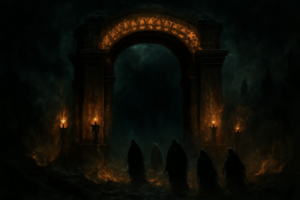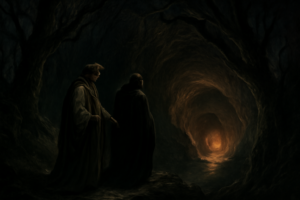
Dante Alighieri’s Inferno is many things: visionary epic, theological argument, political revenge fantasy. But its true genius lies in a single organizing principle—one that transforms the entire poem into a work of profound moral imagination. That principle is contrapasso.
The word comes from Latin: “contra” (against) and “patior” (to suffer). Contrapasso means this: each sinner’s eternal punishment mirrors, echoes, or inverts their sin. In Dante’s hands, Hell becomes a place where the punishment is the sin, revealed in its truest form. Nothing is random. Nothing is arbitrary cruelty. Instead, every torment unfolds with poetic inevitability.
Why Contrapasso Matters
Most medieval Hell literature was straightforward. Sinners received generic torture—fire, chains, demons with pitchforks. Dante rejected this approach entirely. For him, punishment wasn’t inflicted upon the sinner from outside. Rather, punishment flows from the sin itself.
This was revolutionary. It meant that divine justice wasn’t arbitrary punishment. Instead, it revealed how sin corrupts the soul. The punishment shows us what the sin actually is. Understanding contrapasso transforms how we read the entire Inferno—from the first circles of passion to the frozen wastes of final betrayal.
The Lustful: Slaves to Passion
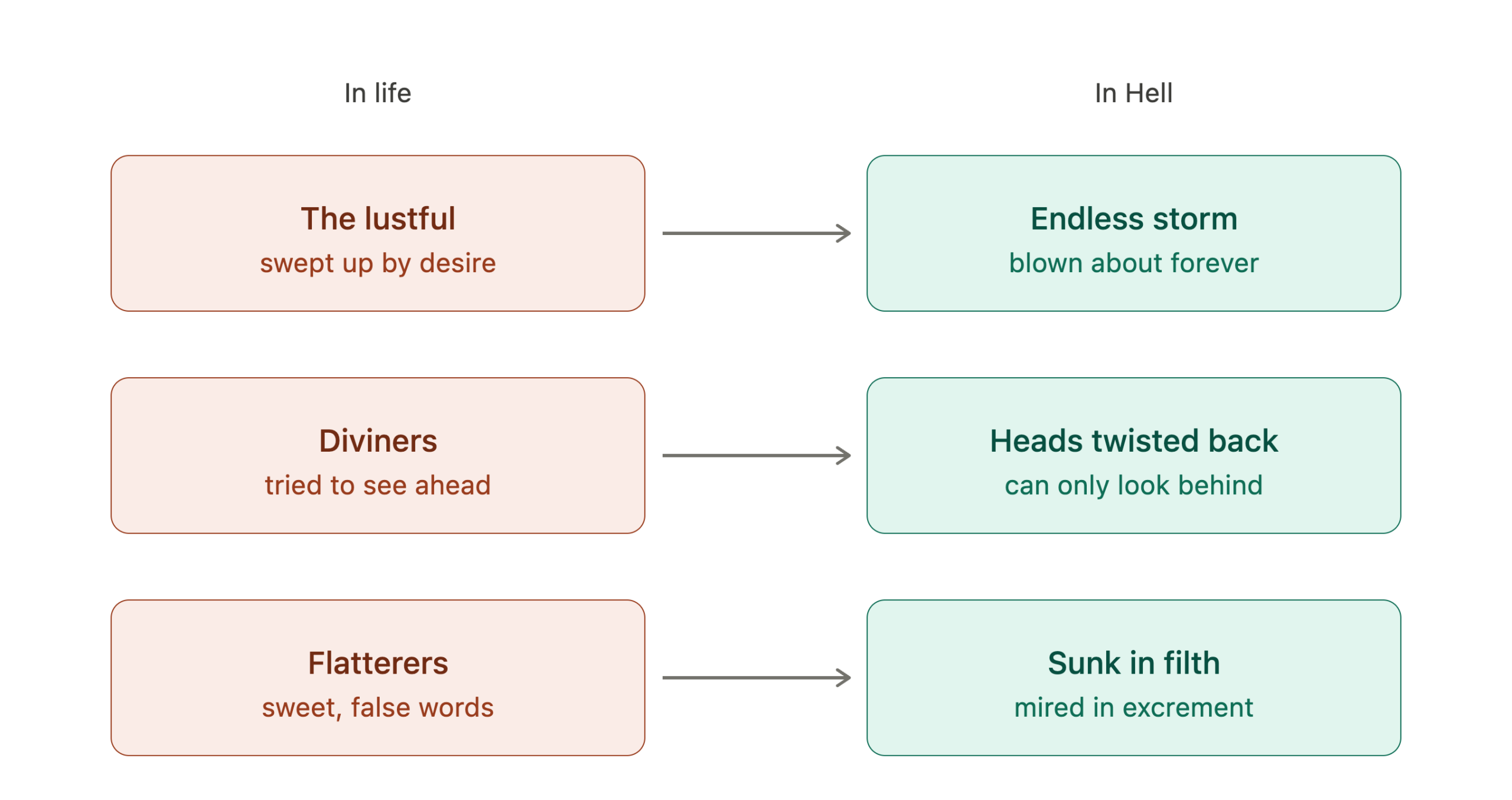
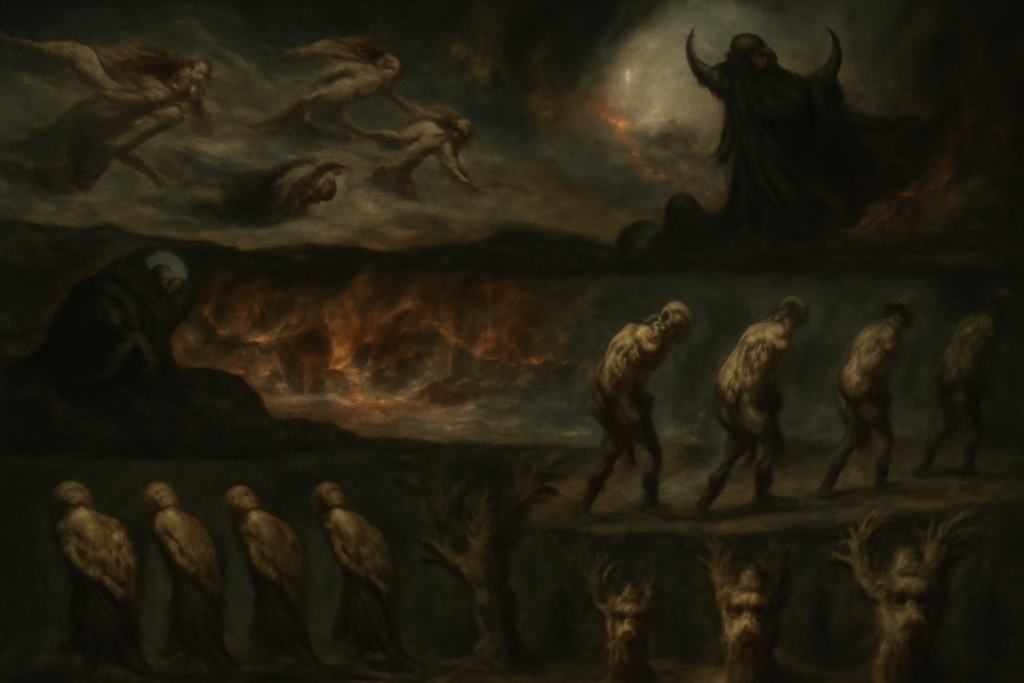
Begin with Circle 2, where the lustful suffer their eternal fate. These souls are blown endlessly by violent winds. They tumble through darkness, helpless and spinning. There is no rest. There is no stillness.
The punishment is exquisite precisely because it mirrors the sin. In life, these lovers were “blown about” by their passions. Lust, by definition, means losing control—being swept away by desire beyond reason. Dante shows us what that actually looks like stretched into eternity: perpetual tumbling, perpetual loss of agency.
Notable sinners suffer here: Francesca da Rimini and Paolo. Their famous love affair became the subject of centuries of romantic literature. Yet in Dante’s vision, their romance reveals itself as spiritual disaster. Beautiful passion became destructive obsession. The winds make this literal.
The Gluttons: Refined Appetites Degraded
Circle 3 holds the gluttons. In life, they indulged refined appetites—the best foods, wines, delicacies. Now they lie in filthy slush. Freezing rain falls perpetually. A stench rises from the muck.
The poetic reversal is stunning. Those who elevated eating into an art form now wallow in garbage. Their refined desires are now surrounded by corruption. In fact, Cerberus—the three-headed guard dog—slobbers over them constantly.
This punishment teaches a crucial lesson: gluttons mistook physical pleasure for spiritual nourishment. They fed their bodies while starving their souls. The slush and filth reveal gluttony’s true nature—base appetite, stripped of pretense. What seemed refined was always merely animal.
Hoarders and Spenders: Fighting Over Nothing
Circle 4 offers something different. Here Dante places hoarders and spenders together. Both groups wasted their lives obsessing over wealth. Now they push enormous weights against each other. Back and forth. Forever.
The punishment is elegant. In life, these sinners fought over money—hoarding it, squandering it, destroying themselves through financial obsession. Now they literally fight each other, pushing heavy weights for eternity. Their conflict achieves nothing. It merely repeats.
Specifically, the hoarders and spenders are united in their sin: both wasted their lives. They simply wasted differently. Now united in punishment, pushing forever, they discover the truth—their conflict was always meaningless. The weights they push represent all the money they fought over. Now those riches are literally weightless except as instruments of torment.
The Wrathful and Sullen: Anger Expressed and Suppressed
Circle 5 contains two expressions of anger. On the surface of the River Styx, the wrathful fight each other perpetually. They strike and claw. They scream and rage.
Beneath the surface, the sullen gurgle. They stifled their anger in life. Now they’re literally submerged, bubbling beneath the surface, unable to express themselves. The punishment manifests the sin with terrible clarity. Rage must go somewhere.
Those who expressed anger violently now express it forever. Those who suppressed it are now suppressed—literally pushed below the surface. Both groups remain trapped by anger that never resolves. In fact, there is no redemption here. That’s the true horror. Wrath becomes eternal because it defines them completely.
The Heretics: Sealed in Burning Tombs
Circle 6 holds heretics—those who denied Christian doctrine, particularly the soul’s immortality. Dante traps them in burning tombs. The tombs are sealed. The fire burns eternally.
The punishment crystallizes their sin perfectly. These souls denied that their souls could be eternal. Now Dante makes them literally eternal—trapped forever in burning sepulchers. They are sealed in death because they denied the soul’s deathlessness.
This reveals something profound about Dante’s moral vision. The punishment isn’t arbitrary. It’s not God saying, “You denied immortality, so I’ll torture you.” Rather, Dante shows how the sin itself generates the punishment. Deny the eternal soul? Then you experience only eternal separation, eternal enclosure, eternal darkness.
The Suicides: Trees Without Humanity
Circle 7, Ring 2 contains one of Dante’s most haunting punishments: the suicides. These souls rejected their human bodies. Now Dante strips them of human form entirely. They become gnarled trees.
Yet the punishment goes further. These tree-souls can only speak when a branch breaks. When speech comes, blood flows from the wound. They can communicate only through self-inflicted injury.
The dark irony is devastating. In life, these sinners destroyed their own bodies. Now they cannot keep physical form. They are scattered, twisted, trapped in wood and bark. To be heard, they must wound themselves again and again. Their original suicide becomes eternal and cyclical.
On the other hand, Dante treats these souls with unusual compassion. One tree—the suicide Pier della Vigna—tells his story at length. Dante listens. He shows that even in deepest Hell, humanity persists. Yet that humanity persists only through constant self-destruction.
The Fortune-Tellers: Seeing Backward
Circle 8 contains fraud and malice. Bolgia 4 holds fortune-tellers—those who tried to see the future. Dante twists their heads backward on their bodies. Their heads rotate. They can see only behind them.
The punishment is almost unbearably cruel. These sinners tried to pierce God’s secret knowledge. They wanted to see what lay hidden. Now they can see nothing ahead. They can only see behind. They walk forward while staring backward.
Notably, Dante weeps at this punishment. Virgil actually scolds him—telling him not to waste pity here. This moment is crucial. It shows that even Dante, creating these punishments, feels their weight. The reader should too. The punishment reveals the sin’s nature so starkly that compassion itself becomes problematic.
The Hypocrites: Gold-Plated Burden
Bolgia 6 contains hypocrites. In life, they presented beautiful exteriors while hiding corruption. Now they wear gilded lead cloaks. Beautiful on the surface. Crushingly heavy underneath.
This punishment is almost unbearably elegant. The hypocrite’s defining sin becomes visible. The shining exterior—the false presentation of righteousness—becomes a literally unbearable weight. What looked like advantage becomes agony.
Specifically, Dante places biblical hypocrites here alongside contemporary Florentine ones. A Pharisee walks beside a medieval friar. The punishment transcends time. As a result, we see that hypocrisy is always the same sin, regardless of era or context.
The Thieves: Losing Identity Itself
Bolgia 7 shows thieves endlessly bitten by serpents. As serpents bite, their bodies merge and transform. Their identities blur. They become something neither fully human nor fully beast.
The punishment cuts to the heart of theft. Thieves stole others’ property. But Dante makes the punishment stranger: they can no longer keep even their own bodies. Their physical form is constantly violated. They merge with serpents. They lose coherent identity.
This teaches that theft damages the self most of all. By taking what wasn’t theirs, thieves lose what is theirs—their very identity. The punishment makes this metaphysical reality literal and visible. A thief becomes unrecognizable, even to themselves.
The Sowers of Discord: Divided Forever
Bolgia 9 contains perhaps the most brutal punishment: sowers of discord. These sinners divided communities. They turned families against each other. They sparked wars. Now a demon hacks them apart with a sword.
The demon cuts them down. They begin to heal. Then the demon cuts again. This cycle repeats eternally. The punishment is direct and devastating: they are divided because they divided others.
In fact, Muhammad appears in this bolgia in Dante’s version. This reflects medieval Christian views of Islam as a schism. Whether we accept this theology today, the contrapasso principle remains clear: those who split Christ’s community must themselves be eternally split. The punishment embodies the sin’s consequence.
The Traitors: Frozen Betrayal
Circle 9, the final circle, freezes in ice. Here the greatest traitors suffer. They are literally frozen solid. They were cold-hearted. Now they are cold.
The punishment is almost spare in its simplicity. Betrayal is coldness. Traitors betray love, loyalty, trust. They freeze the warmth of relationship. So they are frozen. The contrapasso achieves its most direct expression.
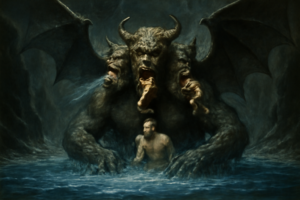
At the center lies Lucifer himself, a traitor to God. He is half-buried in ice. His three mouths chew the three greatest traitors: Judas, Brutus, and Cassius. Even in the center of Hell, even in God’s enemy himself, the principle holds. Betrayal brought betrayal. Cold brought cold.
Why Contrapasso Transforms Everything
What makes contrapasso brilliant isn’t just creative cruelty. Rather, it’s the theological insight underneath. Dante argues something radical: sin IS its own punishment. We don’t suffer because God imposes arbitrary torture. We suffer because we are who we’ve become.
The punishment reveals the sin’s true nature. A lustful soul blown by winds finally understands what lust meant—loss of control, surrender to appetite, perpetual tumbling without direction. A hypocrite crushed by golden weight finally sees what their sin was—beautiful exterior hiding unbearable corruption.
For a classical scholar, this echoes ancient ideas about justice. Oedipus blinds himself. Arachne becomes a spider. Niobe weeps eternally for her children. Greek punishment transforms the sinner according to their crime. Dante resurrects this principle for Christianity. He argues that divine justice isn’t alien to human nature. It’s the fulfillment of what we’ve already chosen.
This has profound implications. It means that Hell isn’t a place God sends us to. It’s where we go. The punishment isn’t imposed on the sinner from outside. It flows from the sin itself. As a result, Hell becomes less about divine cruelty and more about profound consequence. The sinner experiences literally what they chose spiritually.
Understanding contrapasso changes how we read Inferno entirely. We stop seeing torture chambers. We start seeing a world where action and consequence align perfectly. Where sin becomes visible. Where the soul’s corruption manifests in physical form. That’s the organizing genius of Dante’s entire vision—punishment so perfectly matched to sin that it becomes indistinguishable from revelation.