Most readers approach Dante Alighieri’s Inferno as a medieval compendium of torment—a lurid ledger of suffering inflicted on the damned. This reading fundamentally distorts the poem’s inner logic. The Inferno functions not as Dante’s endpoint but as his clinical assessment. Like any rigorous diagnosis, it brings pain before healing begins.
The spiritual architecture of Dante’s Inferno grips modern audiences—believers and skeptics alike—precisely because it offers no consolation. The poem does not soothe the conscience or grant swift forgiveness. Rather, it traces the mechanics of human self-delusion with anatomical exactitude. Grasping this mapping unlocks both Dante’s reason for entering Hell and its theological significance.
Across more than two decades of examining how ancient faith systems and medieval Christian thought structure narrative, a singular principle emerges from The Divine Comedy: not retribution for retribution’s sake, but a vision of spiritual rebirth so demanding that it necessitates traveling first through humanity’s darkest impulses. This contradiction—this impossibility that resolves itself—defines Dante’s achievement.
The Inferno Is Not Where the Soul Stops
A starting point: readers frequently isolate the Inferno as a freestanding text—a Gothic plunge into nightmare. Yet Dante envisioned it as the opening phase of one unbroken movement skyward toward the divine. The Divine Comedy constitutes a single poem articulated across three movements. Authentic spiritual elevation demands preceding descent into the totality of what one has become.
This represents theological substance, not mere literary flourish.
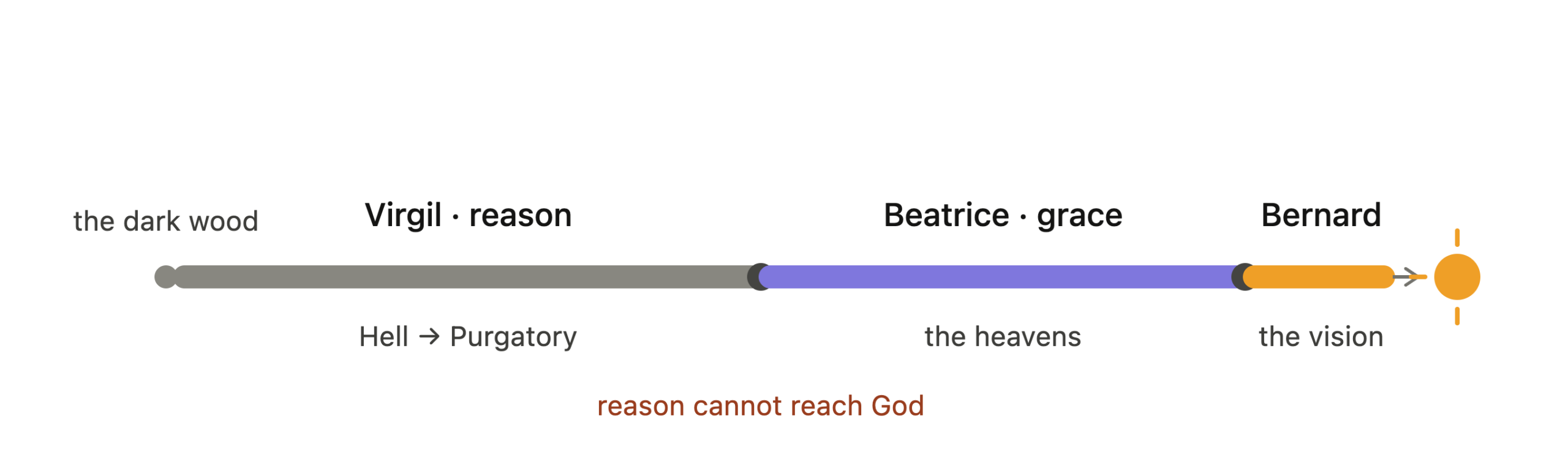
Dante—portrayed as humanity writ small—finds himself adrift spiritually, disoriented within a shadowed forest at life’s midpoint. Three animals block his passage: the beast of lust, the beast of pride, the beast of greed. He cannot overcome them unaided. Virgil materializes, the embodiment of human intellect. Their descent proceeds through Hell’s circles, through Purgatory’s slopes, until Virgil yields his role to Beatrice, who embodies divine grace, and she in turn cedes place to St. Bernard, representing mystical union.
Hell functions as terrain requiring traversal, survey, and integration—not a terminal condition but an essential passage. The poem’s lowest reaches contain the worst offenders against love and truth, certainly, yet they remain locked in place, immobilized, their capacity for change extinct. They have transformed their own desire into permanent idols. Such desolation is not the soul’s destination. It is the soul’s crucible from which it must emerge transformed.
This reframes the entire work. The Inferno delivers harsh medicine because unvarnished truth exacts a price. The poem does not minimize sin’s corrosive effect on the soul. Yet its function is not captivity. It is illumination of the passage outward.
Descent Before Ascent: The Paschal Pattern
Dante’s spiritual pilgrimage commences on Good Friday, April 8, 1300, concluding on Easter Sunday morning. This chronology is no coincidence—it mirrors Christianity’s supreme narrative: the God-man’s passage through death, the breaking of Hell’s gates, resurrection into new life. Dante shapes his own interior journey according to the paschal mystery, the rhythmic core of Christian faith itself.
The upward path requires traveling downward first. Such is the language of Christian contemplative tradition.
Within medieval Christian thought, humbling oneself precedes elevation. Pride functions as sin’s taproot because it resists the movement downward, denies reliance on the transcendent. Entry into radical acknowledgment of our capacity for wickedness—for treachery, deceit, cruelty, narcissism—becomes the prerequisite for genuine metamorphosis.
Purgatory, the middle section, depicts souls enduring cleansing torment willingly, having apprehended their genuine condition. Hell, by contrast, imprisons souls in obliviousness. They are bound by their depravity not through divine decree but through choosing depravity as their essence.
Dante’s calendar conveys a liberating message: the ascent remains accessible. No one falls beyond redemption’s reach. Even Dante, terrified and besieged by infernal legions, surfaces into resurrection morning. The narrative declares: your transgressions need not have the final say. Your inward journey, undertaken in transparency and companionship with intelligence and supernatural love, contains resurrection’s possibility.
The Hinge: Climbing Down Satan’s Body
The Inferno reaches its theological crescendo at creation’s absolute center. There, Dante beholds Satan—the rebel angel enclosed within an ice coffin at cosmos’s pit. Satan does not reign as a monarch wreathed in flame and dominion. He embodies pathetic entrapment: three-visaged, lachrymose, immobilized, his colossal wings thrashing only to intensify the glacial barrier that holds him fast.
Dante and Virgil scale downward along Satan’s titanic frame. At the fulcrum—traversing the universe’s gravitational heart—reality inverts. The downward trajectory transmutes into upward ascent. Upon crossing to the far side, they clamber skyward. Evil’s uttermost point becomes transformation’s hinge.
This reversal constitutes no mere ornament or authorial caprice. It articulates the poem’s chief spiritual revelation: traversing the whole domain of transgression, avoiding evasion and shortcut, the soul arrives at transformation’s threshold. Absolute malice becomes the pivot to absolute good. Complete immersion in darkness becomes the springboard to ascendancy.
Satan embodies the final outcome of unconditional self-absorption severed from transcendence. Isolation defines him. Impotence characterizes him. Imprisonment freezes him. His appendages generate only the ice that immobilizes him. His triple mouths perpetually devour the three supreme traitors—Judas, Brutus, Cassius—locked forever in the act of consuming those he destroyed. Satan possesses no strength; he represents the terminal weakness of a will that coronated itself and suffocated within that realm.
Sin as Severing Connection From Love
Dante’s infernal landscape derives from theology that predated him: the Augustinian-Thomistic framework identifying evil not as a substance but as deprivation—the way black space marks the withdrawal of illumination. Within the Inferno‘s verses, this conceptual distinction becomes geographical reality.
The Almighty resides at the summit as ultimate luminescence, ultimate warmth, ultimate affection. Movement away from divinity through deliberate transgression brings progressive chill and shadow. The deepest circles crystallize into eternal winter. Satan himself radiates cold, not conflagration. The cause? Transgression fundamentally rejects the fount of all radiance and fervor. The consequence emerges not as imposed penalty but as wrongdoing’s essence revealed.
Dante stratifies Hell according to the magnitude of each transgression. The shallower reaches confine the intemperate—those lacking mastery yet lacking malevolent nature. Lechery, gluttony, covetousness. Lower descents await the brutal. Deeper still, the fraudulent and treacherous writhe. Treachery occupies the nethermost reaches because it severs the very filaments of confidence and communion that replicate the transcendent bond itself.
Medieval divines designated this principle the contrapasso—the transgression reappears as its own recompense, rendered permanent and tangible. The lovers whirl ceaselessly without anchorage. The wrathful engage in unending combat. The deceiver freezes in solid ice. Hell grants the spirit its heart’s desire—existence sundered from the transcendent, rendered eternal and complete.
Dante’s theological precision endures because the poem transcends external penalty. What persists is the spiritual consequence of iterative selection. Elect separation from communion persistently, and you become the separate thing you chose. Elect it with finality, and that fracture becomes your unending being.
The Three Ways of Christian Mysticism
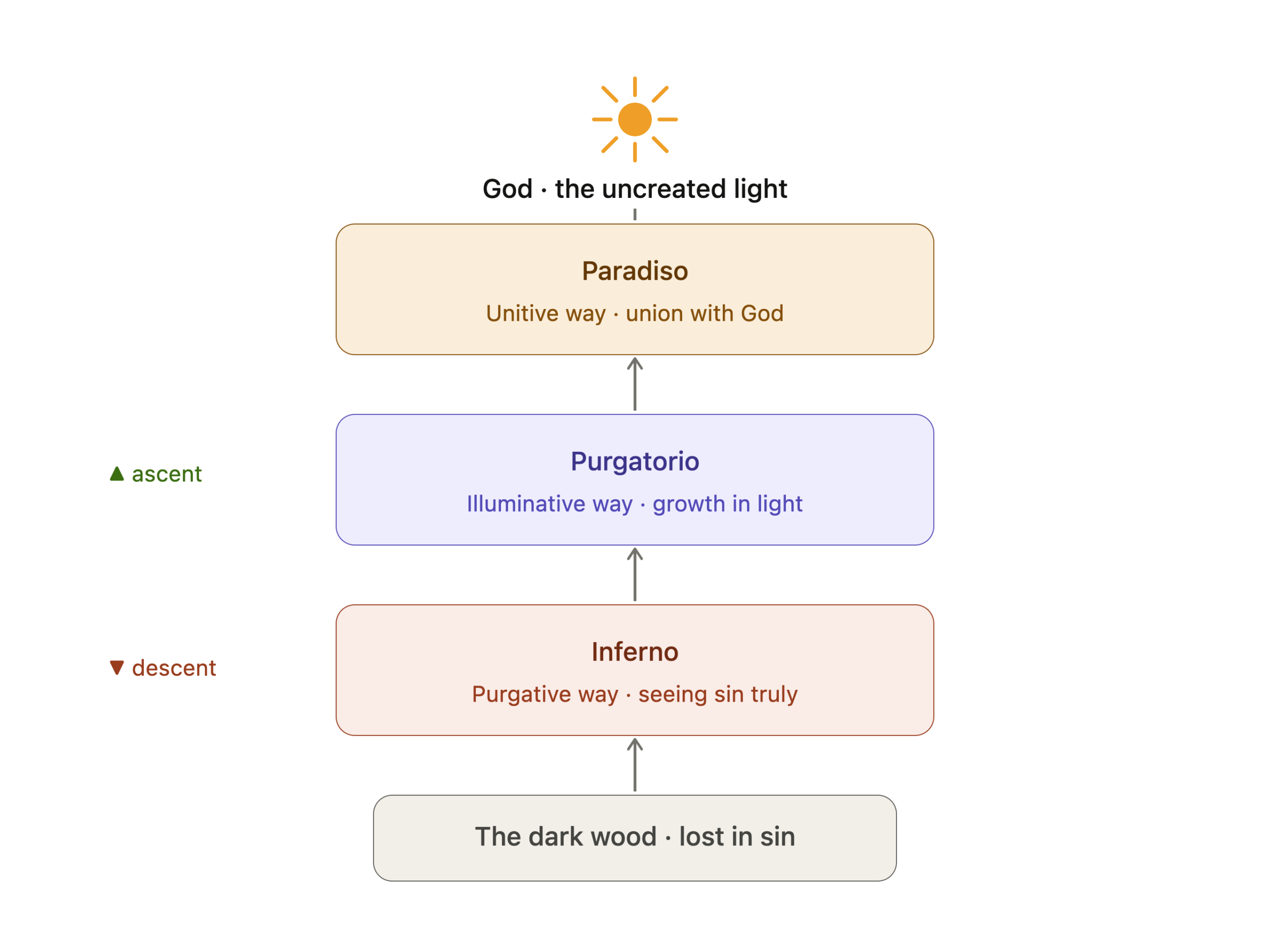
Medieval Christian contemplatives distinguished three sequential motions in the soul’s returning spiral toward transcendence: the Via Purgativa (the cleansing pathway), the Via Illuminativa (the enlightening pathway), and the Via Unitiva (the unifying pathway). Dante’s three sections correspond precisely to these phases.
Inferno aligns with the cleansing pathway—the soul’s unshrinking acknowledgment and expulsion of sin. It constitutes the phase of truthful appraisal, perceiving the unvarnished self. Purgatorio aligns with the enlightening pathway—the soul willingly undertakes inner renovation, apprehending goodness, pursuing healing. Paradiso aligns with the unifying pathway—the soul accomplishes its merger with transcendence, apprehending existence without distortion.
Though serviceable and subject to scholarly refinement, this framework holds firm directionally. We do not vault into paradise unmediated. We cannot possibly. A soul ascending to the transcendent must initially behold itself through sin’s warping. Subsequently it must labor deliberately to remedy that disfigurement. Thereafter union becomes conceivable.
Dante’s singularity emerges in his refusal to abbreviate Hell. A third of his composition unfolds within these circles. He heeds the damned’s testimonies. He weeps. His understanding fractures and scatters. Because genuine apprehension of transgression destabilizes. Confronting the extremes to which the human appetite extends bewilders. This constitutes the cleansing phase, and it cannot be expedited without hollow results.
Who Can Guide You, and How Far
Dante undertakes the journey neither friendless nor unattended. Virgil, the ancient versifier and manifestation of human rationality, escorts him through the infernal abyss and up Purgatory’s slopes. Virgil exhibits discernment, tenderness, and remarkable reach. Yet Virgil himself inhabits the borderlands of forgetfulness. Intellect possesses frontier. It cannot ascend into beatific vision.
As the uppermost circle of redemptive suffering comes into sight, Beatrice materializes. She signifies supernatural grace—transcendent affection drawing the soul heavenward. When intellect reaches its boundary, grace extends beyond it. Beatrice ushers Dante into paradise’s vistas. In paradise’s highest echelon, St. Bernard assumes the office, standing for contemplative fusion—immediate, unmediated apprehension of transcendent unity.
This gradation does not diminish intellect. Dante reveres Virgil with profound veneration. Yet the poem unflinchingly grasps intellect’s circumference. Reason equips us to perceive our own depravities, to schematize vice and virtue, to delineate transgression’s anatomy. But our own restored connection—our homecoming—calls for something intellect alone cannot furnish: grace, the transcendent affection descending to embrace us, transporting us past what mere cognition attains.
Your accompanying presence carries weight. The distance such presence may journey hinges on what substance it comprises. Here too the poem achieves theological precision via narrative.
What the Descent Is For
The Inferno‘s deeper import reveals itself through its ultimate operation: a comprehensive moral self-inventory cast upon the cosmos’s stage. Every concentric zone, every configured anguish, every imprisoned shade functions as a reflecting glass. Are you enthralled by appetite? Francesca stands before you. Seized by violence? Vanni Fucci inhabits your contemplation. Trapped in perfidy? Judas waits at the abyss’s heart.
Dante the craftsman occupied medieval Florence as a participating force. He experienced banishment, wielded political influence, harbored ferocities and resentments. The Divine Comedy emerges not from detachment’s safety but from the heart of struggle itself. Numerous damned inhabitants correspond to figures Dante encountered or to depravities he grasped within his own breast.
Hence the poem’s transtemporal magnetism, transcending its particular medieval-Catholic envelope. The Inferno demands not doctrinal subscription. It demands attendance within Hell itself. It prompts investigation: what constitutes transgression? For what cause do we perpetrate it? What manner of beings do we become upon selecting isolation over mutuality, the self-fashioned idol over affection, delusion over authenticity?
The passage inward serves the cause of naked honesty. The pilgrimage through damnation enacts the soul’s refusal of further self-deception. Not skirting what went amiss, but penetrating it. Not circumventing hard truths, but moving toward them with eyes wide. This dynamic explains Dante’s Easter emergence. Souls ascending with authentic renewal first descend into honest reckoning without escape.
Across twenty-five hundred years, audiences return to Dante because the trajectory he diagrams resists particularity. Specific transgressions alter through epochs. The fundamental sequence—unconsciousness, the demanding confrontation with reality, the capacity for authentic alteration—proves constant. The Inferno maintains its spiritual vitality because it furnishes not evasion from the human circumstance. It furnishes the difficult passage through it.
And that passage ascends.
—
About This Article

Written by Elias Blackwood. Elias Blackwood has spent 25 years as an obsessive collector of world mythology and folklore, from Greek and Norse epics to Japanese yokai and West African trickster tales — entirely self-taught, for the love of it. His reading draws on comparative mythology, cultural anthropology, and a personal library of translations most people have never heard of. More about this site.
Verify this against a primary source
Specifics change, and your situation may differ from the one described here. These are the authorities worth checking directly:
- Theoi Project — Greek mythology texts with primary source citations
- Perseus Digital Library — classical texts in the original and in translation
- Encyclopaedia Britannica — edited reference for figures and traditions