Twenty-six centuries separate our earliest written accounts of Medusa from the Roman retellings most people encounter today — and in those twenty-six centuries, her story transformed so completely that two entirely different mythological traditions now circulate under her name. That gap is where the real history lives, and it is where most modern readers stop looking.
The digital age has made ancient mythology more accessible than ever, which brings genuine benefits. But accessibility has a shadow side: it allows incomplete interpretations and contemporary readings to harden into unquestioned orthodoxy. I encounter these fossilized misreadings constantly, in conversations with enthusiasts and researchers who want to know why their sources contradict each other. This piece isolates five of the most persistent — and what careful attention to the actual ancient evidence reveals instead.
1. Medusa: Victim, Monster, or Something More Complicated?
The contemporary internet narrative favors this reading: Medusa as innocent prey, violated by Poseidon within Athena’s sacred space, then transformed by Athena as punishment — either from envy or displaced fury. Ovid’s Metamorphoses provides the textual backbone for this version, authored roughly 8 CE. But that Roman composition date carries a crucial implication: Ovid was writing in Latin, centuries after the foundational Greek mythological tradition had crystallized.
What complicates the matter considerably: Hesiod’s Theogony (approximately 700 BCE) introduces Medusa quite differently. She appears as one of three Gorgon siblings — the sole mortal among immortals — with no assault narrative present. She belongs to the chthonic realm, those liminal spaces connecting surface and underworld, and her petrifying gaze likely encoded ancient apotropaic principles. The gorgoneion — Medusa’s decapitated visage functioning as a protective emblem — graced Greek military shields, sanctuary walls, and ceramic vessels from the 7th century onward. Protection and terror were inseparable in her symbolic function.
Ovid’s victim account deserves engagement as legitimate source material — it remains ancient, regardless of its temporal distance from foundational Greek sources — yet framing it as singular or definitive erases seven centuries of alternative tradition. Medusa contains contradictions, and wrestling with those contradictions is what transforms her from a flat cultural reference into a meaningful object of study.
2. Hades: The Greek Devil Who Was Never Actually Evil
This particular conflation frustrates me more deeply than nearly any other distortion, because its Christian pedigree sits so obviously on the surface: a direct mapping of Hades — Greek custodian of the dead realm — onto Satan as cosmic malevolence represents pure post-Classical theological import, nothing more.
Homer’s Iliad and Odyssey depict Hades as formidable and isolate, resistant to human approach, yet fundamentally not corrupt. The epithet Plouton — “the rich one” — attached to his name signals something essential: his dominion encompasses subterranean wealth in all forms. Metals, gemstones, soil fertility, germinating seeds — these belonged to his governance. Agricultural societies recognized him as beneficent precisely for this reason, integrating him into fertility rites. Pausanias, documenting religious practices across the Hellenic world in the Description of Greece (2nd century CE), records an anomalous temple to Hades at Elis — unusual enough to merit historical notation, yet indicating genuine cultic reverence.
Hades does not harvest souls as an expression of malice. His function is to preserve cosmic equilibrium. Against the Olympian gods — creatures of whim and favoritism, constantly bending universal law for personal preference — Hades emerges as remarkably consistent, legalistic, bound by principle. Disney’s portrayal of Hades as a scheming, silver-tongued antagonist has inflicted measurable damage on how the general reader comprehends the classical figure.
3. Cassandra: The Problem Was Never That No One Listened
Cassandra of Troy has become shorthand for the experience of being unheeded or discounted — and that interpretation does capture an element of her mythological role. Yet the mechanism of her dismissal in the ancient sources operates quite differently from contemporary invocations might suggest.
Aeschylus’s Agamemnon (458 BCE) and subsequent textual traditions relay this sequence: Apollo bestowed upon Cassandra the capacity for accurate prophecy out of erotic desire. Her refusal of his advances triggered his retaliation — she would continue speaking truth, but exist in a state where belief would be ontologically impossible. This is not a generalized account of social underestimation. It describes punitive action by a deity against a mortal woman for sexual rejection, with the punishment woven into the metaphysical substrate of her being itself. Those who encountered her prophecies faced supernatural impediment to credence, not mere skepticism they might choose to overcome.
Recognizing this distinction proves vital for interpreting the Oresteia with any precision. Cassandra’s dialogues within Agamemnon represent some of Greek drama’s most formally intricate sequences, and they achieve their effect only when one fully grasps her curse’s precise nature — not by reducing it to a contemporary metaphor for gendered social exclusion.
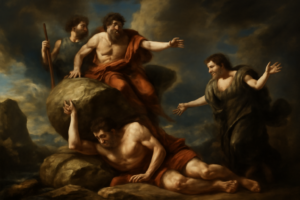
4. Prometheus: The Heroic Rebel Who Was Also Deeply Ambiguous
Prometheus’s acquisition of fire for mortal humanity constitutes one of Western civilization’s most-repeated narratives. He stands as the quintessential insurgent, the source of illumination, the one who challenged sovereign authority in service of the vulnerable. Shelley channeled him through an entire verse drama celebrating his defiance. Yet Greek sources approach him with considerably more philosophical hesitation.
Hesiod, whose Theogony and Works and Days represent our earliest textual strata, portrays Prometheus as fundamentally trickster — a figure whose benevolences arrive tangled with catastrophic consequences. Fire reaches humanity, true — but within the same mythic sequence, the fashioning of Pandora emerges directly from Prometheus’s overreach, and her subsequent opening of her jar unleashes suffering across the mortal world. Hesiod declines to frame this as heroic narrative. He presents it as cosmic exchange where mortals lost more than they gained through multiple simultaneous channels.
Aeschylus’s Prometheus Bound grants us the noble, uncompromising Prometheus we most recognize — but textual scholars have wrangled for generations over whether this standalone work represents the complete surviving portion of a trilogy whose missing components might have substantially complicated our hero’s stature. The factual truth resides in our ignorance: the later dramas have not survived. Anyone asserting that Prometheus embodies straightforward heroism without acknowledging this evidentiary gap is committing a simplification.
5. Circe: Villain, Witch, or Autonomous Divine Being?
Circe converts Odysseus’s crew into swine in the Odyssey, and contemporary retellings frequently treat that moment as summation — enchantress, dangerous seductress, a cultural warning about female magic. Yet engaging directly with Book 10 of the Odyssey substantially rewrites the picture.
Circe descends from Helios; Aeëtes counts among her siblings; divinity runs through her blood as immortal birthright. Her transmutation of Odysseus’s sailors carries motivation within its Homeric context — foreign men arriving uninvited upon a goddess’s dwelling and consuming her provisions without ceremonial permission constitutes transgression itself. When Odysseus encounters her properly — fortified by the protective moly Hermes provides and equipped with sufficient resolve to resist her enchantments — her demeanor shifts dramatically. She emerges as extraordinarily welcoming host, spiritual guide, paramour, and ultimately as the figure who directs him toward the underworld and furnishes him with knowledge necessary for surviving the trials ahead. Few characters throughout the epic provide Odysseus with more pragmatic counsel.
Sustaining the “Circe as antagonist” interpretation requires disregarding roughly eighty percent of her textual function.
What I Recommend for Going Deeper
Should this approach to source engagement resonate with you, I want to point toward three resources that have genuine merit, each suited to different degrees of preparation:
- Greek Myths: A New Retelling — A thoughtful modern retelling that stays closer to the original sources than most popular versions. Good for readers who want narrative accessibility without sacrificing complexity.
- Greeking Out: Epic Retellings of Classic Greek Myths — An engaging entry point particularly well-suited to younger readers or those new to Greek mythology who want to build a foundation before diving into primary sources.
- Mythology: An Illustrated Guide — A visually rich reference that covers a broad sweep of traditions. Useful for cross-referencing figures across multiple mythological systems, which is exactly the kind of comparative context that clarifies the distinctly Greek elements of these stories.
The Honest Caveat
I should clarify something essential: Greek mythology never functioned as a unified, doctrinally consistent body of teaching. Distinct regions, distinct eras, and distinct authors perpetually generated competing accounts of identical narratives, with no supreme arbiter to dissolve inherent contradictions. When I reference “what the ancient sources communicate to us,” I signify that the surviving evidence leans decisively in one direction — not that consensus exists or that scholarly disagreement has concluded. Mythology endures as perpetually generative tradition, and the most responsible path involves reading primary texts with care, preserving the tensions they contain, and resisting the urge to compress multivalence into reductive contemporary conclusions.
That irreducible complexity should not be lamented as a shortcoming. It is the very property that has kept these narratives alive across nearly three millennia.
The Retelling That Actually Reads the Sources
If this piece persuaded you that Greek mythology runs considerably deeper than surface-level familiarity suggests, Stephen Fry’s Greek Myths: A New Retelling performs the serious labor of demonstrating exactly why — without forcing you through ancient Greek dialects or Classical Latin translation.
What works
- Fry anchors his narrative directly to foundational texts (Hesiod, Homer, Ovid, Pindar, and others) while maintaining a voice that feels contemporary and direct, permitting you to perceive nuance without negotiating linguistic barriers.
- Each narrative receives treatment as a serious cultural artifact containing psychological sophistication and ethical ambiguity — precisely the counter-measure to reductive classifications.
- Textual annotations and source citations throughout enable you to trace material back toward original texts, sustaining the attentive reading this essay advocates for.
What doesn’t
- This is a narrative retelling, not academic analysis — should you seek rigorous scholarly disputation about textual authority across variant sources, supplementing this work with specialized journals becomes necessary.
- The two-volume set exceeds six hundred pages cumulatively, which means it functions as comprehensive examination rather than rapid reference tool when you need a single myth clarified swiftly.
If you’re already comfortable with Edith Hamilton or Circe-style retellings and you’re ready to see how the ancient sources actually inform modern understanding of these figures, this is your next step. Greek Myths: A New Retelling
About This Article

Written by Elias Blackwood. Elias Blackwood has spent 25 years as an obsessive collector of world mythology and folklore, from Greek and Norse epics to Japanese yokai and West African trickster tales — entirely self-taught, for the love of it. His reading draws on comparative mythology, cultural anthropology, and a personal library of translations most people have never heard of. More about this site.
Verify this against a primary source
Specifics change, and your situation may differ from the one described here. These are the authorities worth checking directly:
- Theoi Project — Greek mythology texts with primary source citations
- Perseus Digital Library — classical texts in the original and in translation
- Encyclopaedia Britannica — edited reference for figures and traditions