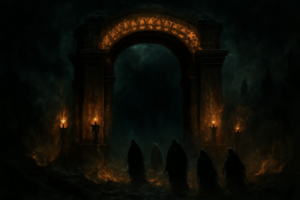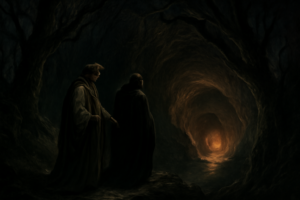
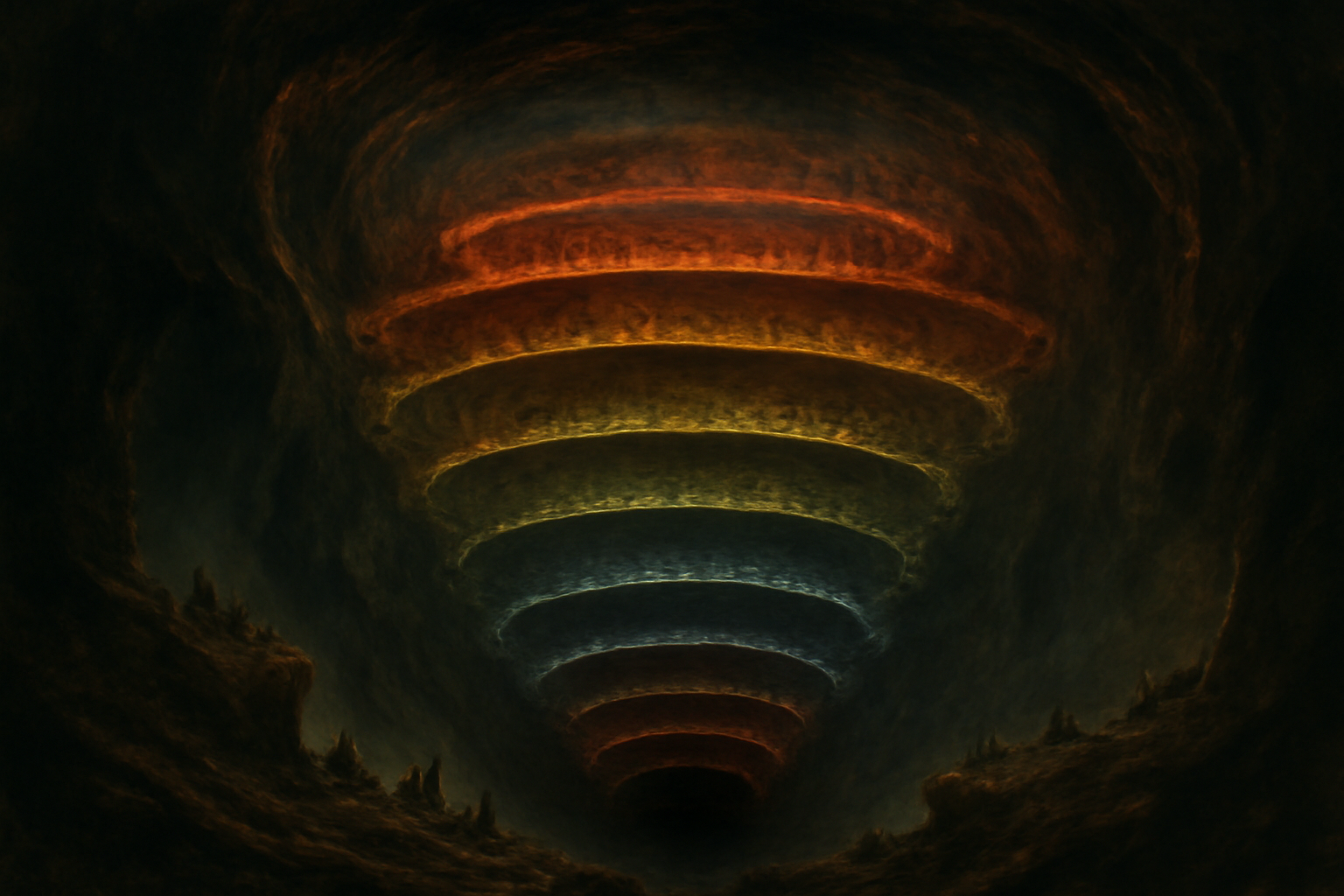
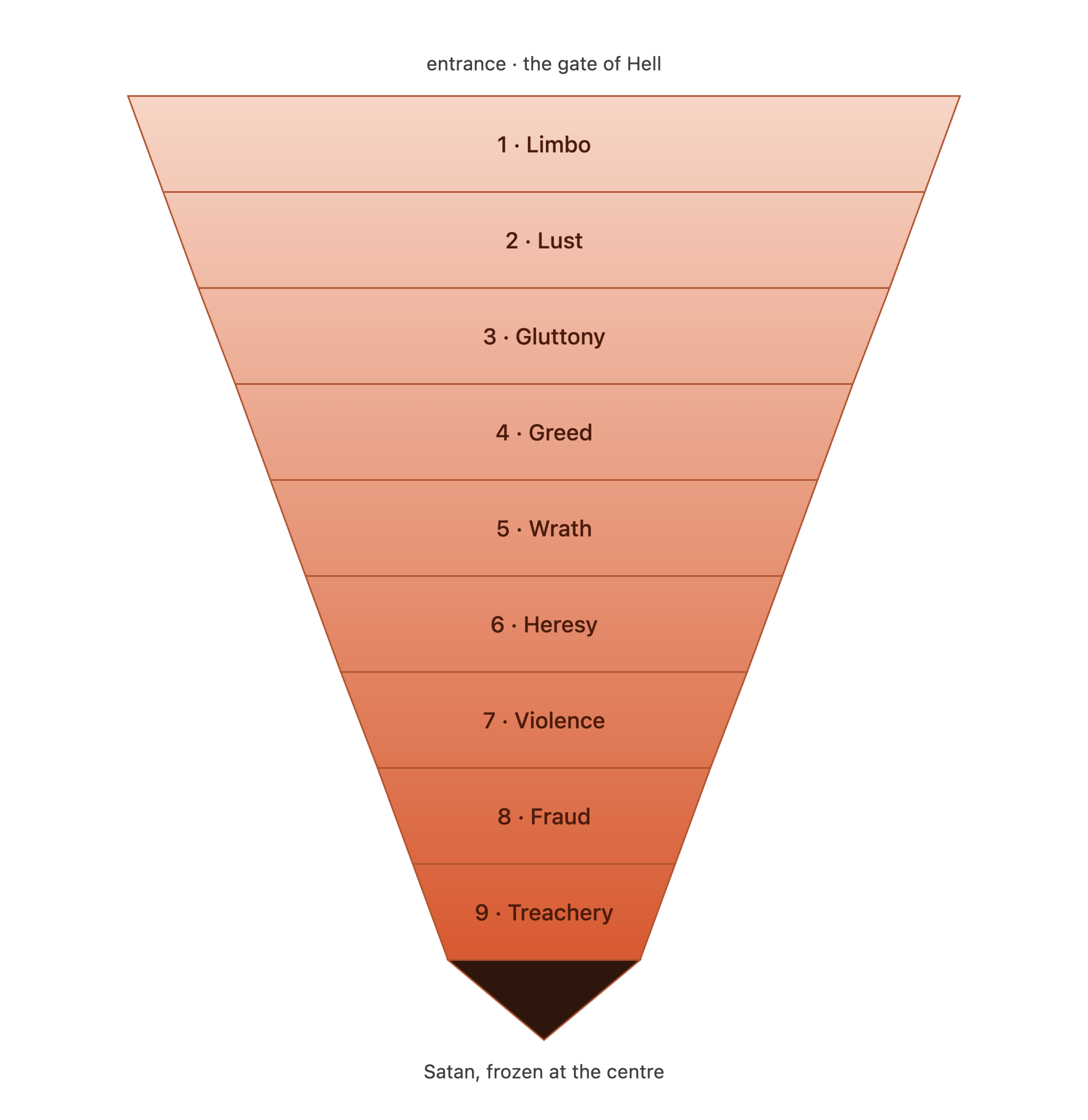
Dante Alighieri wrote the Inferno in the early 1300s. His medieval vision of Hell shaped how the West imagines damnation. Before Dante, Hell was abstract theology. After him, it became vivid, specific, and unforgettable. Every circle has its own logic, its own torment, and its own moral lesson. Understanding these nine circles means understanding one of literature’s most influential works.
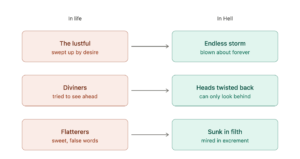
What makes Dante’s Hell so powerful? He wasn’t content with vague punishment. Instead, each sin receives a punishment that mirrors it perfectly. Medieval theologians called this contrapasso—the penalty fits the crime. The lustful are blown endlessly by wind. The gluttonous lie in filth. The violent are submerged in boiling blood. Dante didn’t invent morality here. He crystallized it.
The First Circle: Limbo
Limbo is the gentlest circle. Yet it breaks hearts. Here dwell virtuous pagans—those who lived well but were never baptized. They include Homer, Aristotle, Horace, and Ovid. Dante’s own guide, Virgil, resides here.
Their punishment isn’t fire or torment. Instead, they suffer a kind of noble sadness. They live in a beautiful castle bathed in light. They feast and talk. Yet one thing is forever denied them: the beatific vision of God. In Christian theology, this absence is the ultimate loss. No physical pain compares to spiritual separation.
Dante’s treatment of Limbo reveals his sophistication. These are good people. Some are his heroes. Yet they exist outside Christian salvation. This circle shows that in Dante’s system, morality alone isn’t enough. Right belief matters too. Modern readers often find this harsh. Medieval ones found it theologically consistent.
The Second Circle: Lust
Below Limbo lies the circle of lust. Here, sin becomes punishment. A terrible whirlwind eternally spins the lustful through darkness. They’re tossed helplessly, never finding rest.
Minos, the legendary judge of the dead, presides here. He’s not the fair arbiter of Greek myth. In Dante’s version, he’s twisted into a demon. His serpent tail wraps around his body, indicating each sinner’s depth of descent. One wrap equals the first circle. Two wraps, the second. And so on.
The most famous residents are Francesca da Rimini and Paolo Malatesta. Their story is heartbreaking. They were lovers who read Arthurian romance together. Literature kindled their passion. A jealous husband killed them both. Dante speaks with Francesca, who describes how they fell into sin together. Her language is so moving that Dante faints from pity. Even damnation has dignity when spoken of with such tenderness.
The Third Circle: Gluttony
Descending further, Dante reaches the circle of gluttony. Cerberus, the three-headed hound from Greek mythology, guards this realm. He threatens the living poet. Virgil hurls mud in his mouths to quiet him. Even in Hell, classical monsters have their roles.
Here it rains perpetually. The rain is filthy, cold, and disgusting. The gluttons lie in mud, eternally bloated and miserable. Their punishment reflects their sin: excess becomes revulsion. What they craved becomes repugnant.
Dante speaks with Ciacco, a Florentine shade. Ciacco prophesies about Florence’s future conflicts. In Dante’s scheme, even the damned possess knowledge. They see futures that the living cannot. Ciacco’s words are bitter—he foreknows his city’s bloodshed. Knowledge without power to change events compounds his torment.
The Fourth Circle: Greed
The fourth circle presents a grim image. The greedy are divided into two groups. Hoarders push great weights. Spenders oppose them, pushing back. They collide eternally, neither gaining ground. Their futile struggle mirrors earthly greed—the endless chase for more.
Plutus, the god of wealth, guards this circle. In classical sources, Plutus is blind—he distributes riches without wisdom. Dante keeps this imagery. Wealth without wisdom creates the chaos below.
Notably, Dante treats greed as equally punishable whether it takes the form of hoarding or spending. Both extremes are damned. This reflects medieval morality: virtue lies in the mean. Excess in any direction—toward accumulation or toward waste—constitutes sin. Contrapasso ensures that the greedy never rest, never achieve balance, never satisfy their desires.
The Fifth Circle: Wrath
Below greed lies the River Styx. This is the fifth circle, the realm of wrath. Two groups of angry shades inhabit this region. Above the water, the wrathful fight each other endlessly. They strike and maim with genuine fury.
Below the surface lies a more subtle punishment. The sullen gurgle beneath the mud, unable to speak. They choked on their anger in life. Now they choke eternally, submerged in the waters they resented. They who wouldn’t express their wrath clearly must now remain voiceless.
The River Styx itself is significant. In Greek mythology, it’s the boundary between worlds. Charon ferries the dead across it. Dante incorporates both the classical image and medieval theology. The damned souls must cross this river to descend further. Nothing passes between Hell’s circles without consequence.
The Sixth Circle: Heresy
The sixth circle marks a turning point. Here, Dante enters Dis—the lower Hell. The landscape becomes hellish in new ways. Burning tombs dot the terrain, glowing orange in the darkness. These are the punishment for heresy.
Heretics aren’t punished for cruelty or lust. They’re punished for false belief. In Dante’s worldview, this is gravely serious. To deny God’s truth is a fundamental rebellion. The flames that burn the heretics mirror the flames of divine truth they rejected.
Dante encounters Farinata degli Uberti, a Ghibelline leader from Florence. Farinata was an enemy of Dante’s faction. Yet Dante speaks with him respectfully. They discuss Florentine politics as the heretic burns in his tomb. This scene shows that even in Hell, Dante respects intellectual courage. Farinata was wrong, but he believed deeply.
The Seventh Circle: Violence
The seventh circle divides into three rings. Each accommodates a different type of violence. The structure itself teaches: Dante organizes Hell by logic, not chaos. Sin has anatomy.
The first ring punishes violence against others. Here, the Phlegethon river boils with blood. The violent are submerged in it, their depth determined by their crimes. Those who murdered minimally sink lower. Those who waged war stand higher, more exposed. They’re guarded by centaurs—half-men, half-beasts. Centaurs embody the conflict between reason and brutality that defines this sin.
The second ring contains those violent against themselves—suicides. They’re transformed into thorny trees. Birds nest in them and feed on their leaves. The trees bleed when broken. Suicide becomes literal self-harm in death as it was in life. There is no escape from the violence they chose.
The third ring, against God and nature, burns under a rain of fire. Blasphemers lie on hot sand. Usurers sit nearby. Both sins violate natural law. The punishment is elemental—fire and heat reflect their unnatural rebellion. Violence against God’s order receives cosmic punishment.
The Eighth Circle: Fraud
The eighth circle is vast. It contains Malebolge—ten evil ditches arranged like concentric rings. Each bolgia punishes a different form of fraud. In Dante’s morality, fraud is worse than violence. Why? Violence harms the body. Fraud corrupts trust itself.
In the first bolgia, seducers are whipped by demons. Their seduction becomes literal pain inflicted upon them. The second holds flatterers, who are submerged in excrement. Their false words, meant to seduce through praise, become literal filth.
The third bolgia contains simoniacs—those who sold church positions. Pope Nicholas III, entombed upside-down in a fiery hole, is the most famous resident here. His head burns while his feet stick upward. This inverted posture mocks his inversion of spiritual values.
In the fourth bolgia dwell sorcerers. They’re turned backward, walking eternally in the wrong direction. Those who tried to see the future now see only their own backs. In the fifth, grafters are submerged in boiling pitch. These officials who accepted bribes now stick in the tar of corruption.
The sixth bolgia holds hypocrites, wearing gilded cloaks that are actually lead. Their splendid appearance conceals terrible weight. In the seventh lurk thieves, tormented by snakes. These creatures wrap around them, bind them, and steal their human form itself.
The eighth bolgia contains false counselors. Here Dante places Ulysses, the clever hero of Homer’s Odyssey. Ulysses was condemned not for his travels, but for seducing Achilles to war. His eloquence led others astray. Now he’s trapped in flame, unable to lead anyone.
The ninth holds sowers of discord—those who caused schism and war. They’re constantly split open by a demon, their wounds reopening eternally. In the tenth, falsifiers suffer diseases. They’re twisted by plague, hunger, madness. Their false words become false flesh.
The Ninth Circle: Treachery
The lowest circle is frozen. Cocytus, a lake of ice, replaces the rivers and fires above. Here dwell traitors—those who betrayed those they should have loved. This is the worst sin. Treachery freezes the soul.
Cocytus has four zones. Caina punishes those who betrayed family. Antenora holds those who betrayed their country. Ptolemaea contains those who betrayed guests and hosts. Judecca, the deepest zone, punishes those who betrayed their masters.
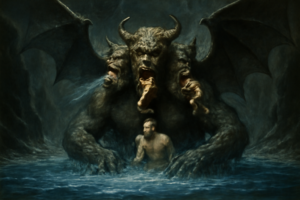
At the very bottom sits Satan himself. He’s massive, grotesque, frozen to his waist in ice. Three faces emerge from his head—parodies of the Trinity. In his three mouths, he eternally chews the three greatest traitors in Christian history: Judas Iscariot, Brutus, and Cassius.
Judas betrayed Christ for thirty pieces of silver. Brutus and Cassius betrayed Caesar, their friend and master. Satan chews them endlessly. Their blood flows down his chins. This is the core of Hell—not fire, but ice. Not noise, but frozen silence. Treachery is cold, isolating, final.
Climbing Toward Light
After witnessing Satan, Dante and Virgil must escape. They climb down Satan’s massive body—a counterintuitive journey. What seemed like descending actually becomes ascending. They emerge on the far side of the world.
The poem ends with a single perfect image. Dante sees stars again. He sees constellations invisible from the Northern Hemisphere. These are the stars of the Southern Hemisphere, visible only after traveling to Hell’s antipodes. Light returns. Hope returns. The journey through darkness has earned a glimpse of heaven.
Dante’s Inferno endures because it marries theology with humanity. The damned aren’t abstractions. They’re people. They think, speak, suffer, and teach. Yet their teachings are painful because they come too late. They cannot change. They can only warn. This paradox—vivid personhood combined with final hopelessness—creates the poem’s emotional power. The nine circles remain literature’s most detailed map of moral consequence.