A yellowed facsimile of Dante’s original manuscript sits behind museum glass in Florence, its medieval ink faded but still legible where his hand moved across vellum centuries ago. What strikes you, standing before it, is not the poetry’s beauty but its specificity—the obsessive precision with which Dante mapped each circle, each torment, each sinner’s eternal posture. He wasn’t writing abstract theology. He was constructing a moral architecture where every detail fit. That architecture rests on a single principle that transforms Inferno from vengeful fantasy into something far more unsettling: contrapasso.
Derived from Latin roots—”contra” meaning against, “patior” signifying to endure—contrapasso expresses a deceptively simple formula: the penalty experienced by each damned soul replicates, reverses, or mirrors the transgression that earned damnation. Through Dante’s hands, Hell metamorphoses into a realm where torment does not descend upon the condemned from without, but rather emanates directly from the sin itself. Every anguish unfolds with mathematical precision. Every torment carries inescapable logic.
Why Contrapasso Matters
Medieval literature abounded with Hell scenes that operated through a simple economy: deposit sin, receive generic suffering. Demons, flames, chains—the particulars barely varied between texts. Dante dismantled this approach entirely. For him, divine retribution wasn’t something applied to sinners like a brand. Instead, torment bubbles upward from the corrupted will itself.
This represented radical reimagining. Justice ceased to be punishment administered against the sinner. It became something the sinner embodies. The torment exposes what the transgression actually was at its deepest level. Reading Inferno through this lens—from the early rings of uncontrolled desire through to the ice-locked depths where the greatest betrayers writhe—reveals an entirely different work than the one most readers encounter.
The Lustful: Slaves to Passion
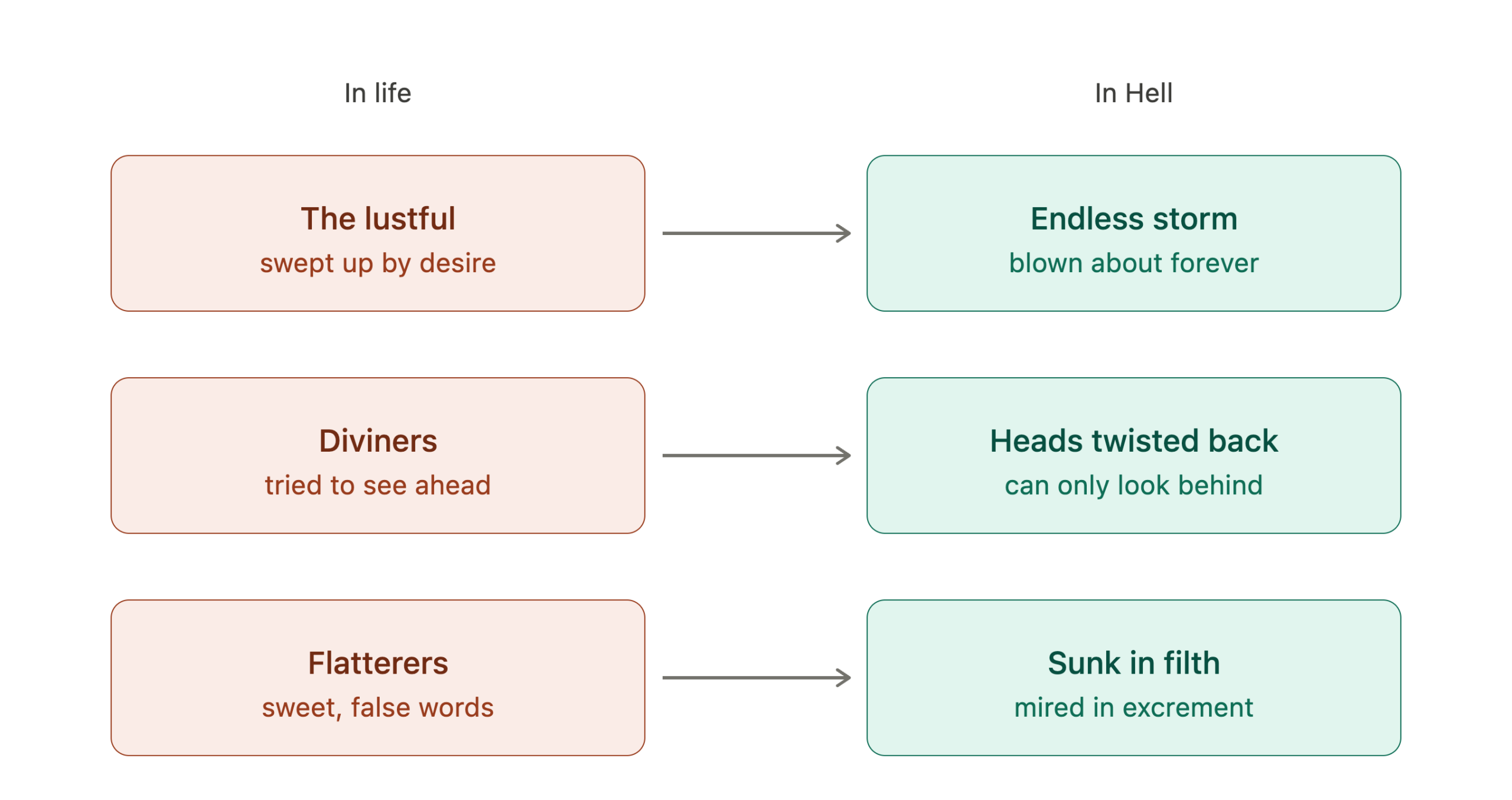
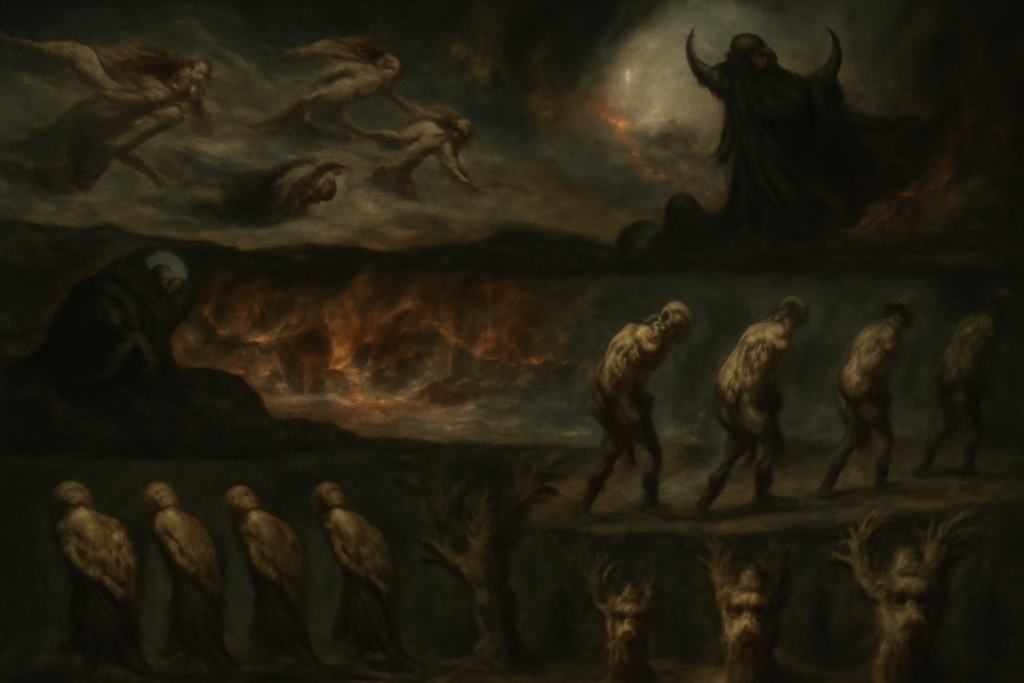
In Circle 2, those consumed by carnal desire face an eternity of helplessness. Powerful winds seize them. They spin. They tumble. Darkness surrounds them. There is nothing to hold onto. Stillness never comes.
The torment captures what lust actually means. During their earthly lives, these souls permitted appetite to control them entirely. Desire overrode reason. Impulse conquered will. The winds literalize this metaphorically understood condition: they experience physically the perpetual loss of mastery they enacted spiritually. Agency dissolved then; it dissolves now, forever.
Among those trapped here: Francesca da Rimini and Paolo, whose passionate affair spawned centuries of romantic retellings. In Dante’s accounting, however, that celebrated romance emerges not as transcendent love but as catastrophic spiritual collapse. What seemed beautiful became devouring. The winds make visible what beauty concealed.
The Gluttons: Refined Appetites Degraded
Circle 3’s occupants once pursued eating as sophisticated pleasure—sampling rare wines, seeking delicate foods, transforming consumption into connoisseurship. Their present condition mocks those vanished refinements. They lie submerged in filthy sludge. Rain falls, icy and relentless. Putrid odors rise continuously.
The irony cuts sharply. Those who elevated appetite into an art form now sink into baseness. Their former sophistication transforms into degradation. Cerberus, the legendary hound, looms above them, perpetually drooling upon their forms.
The lesson embedded in this torment runs deep: gluttons pursued sensory gratification while starving the soul. Physical sensation became their religion. The muck and stench unmask what they could not see—that appetite, stripped of spiritual purpose, is merely animal hunger. What claimed refinement revealed itself as purely bestial.
Hoarders and Spenders: Fighting Over Nothing
Circle 4 houses a paired damnation. Misers and profligates suffer together, unified by their shared waste of existence on financial obsession. They propel massive boulders against one another. Perpetually. This collision continues without cessation or purpose.
The symmetry of punishment mirrors the symmetry of sin. In mortality, these damned souls warred over wealth—accumulating obsessively or disbursing recklessly, each mode a form of self-destruction. Now they enact that conflict physically, forever locked in mutual opposition. The struggle generates nothing. It merely perpetuates itself.
Fundamentally, both groups squandered their one existence. Their methods diverged, but their essence remained identical. Now united in eternal punishment, pushing weights endlessly, they discover the futility they could not perceive before. The very riches they battled for have become nothing more than implements of their own torment.
The Wrathful and Sullen: Anger Expressed and Suppressed
Circle 5 separates anger into dual manifestations. The River Styx roils at its surface where violent temperaments clash eternally. They strike. They tear. They bellow. The combat never resolves.
Below the churning waters, a different anguish: those who choked down their rage in life now lie submerged and voiceless. Bubbles emerge from their mouths. They exist beneath the surface, throttled by their own suppression. The topography of punishment mirrors the topography of sin—rage seeking expression finds only eternal expression, while rage denied finds only eternal denial.
Both categories remain enslaved by wrath that consumes them entirely. Neither group accesses release or transformation. That absence of mercy comprises the actual horror. Anger becomes unending precisely because it has become their fundamental nature. The sin and the sinner have merged completely.
The Heretics: Sealed in Burning Tombs
Circle 6 confines those who rejected orthodox doctrine, particularly those who repudiated the soul’s capacity for eternal persistence. Dante encases them within sealed stone crypts. Flames burn ceaselessly within.
The retribution embodies their transgression with stunning exactitude. These damned denied their own souls’ deathlessness. Dante condemns them to endless existence—trapped forever within sepulchers of fire, experiencing precisely the eternal condition they insisted could not exist. They are locked in death because they denied that death was not final.
This disclosure illuminates Dante’s ethical framework profoundly. The retribution operates not as despotic imposition from above, but as the natural unfolding of the sin itself. The heretic who rejected the eternal soul encounters nothing but eternality—endless solitude, endless enclosure, endless darkness. The punishment doesn’t contradict their beliefs; it vindicates them.
The Suicides: Trees Without Humanity
Circle 7, Ring 2 contains what stands among Dante’s most disturbing inventions: those who destroyed themselves. These souls rejected the flesh they inhabited. Dante strips away their humanity entirely. They become contorted timber.
But the torment extends itself further still. Speech becomes possible only when bark splinters. Blood flows from the fracture. To communicate requires self-infliction. They achieve voice only through renewed wounding.
The desolation is complete. In life, these suicides demolished the bodies that housed them. Now corporeal integrity eludes them. They stand fragmented and knotted, imprisoned within wood. Communication demands perpetual self-harm. Their original act of violence against themselves becomes cyclical, never concluding, never resolving.
Yet Dante demonstrates unexpected gentleness toward these damned. One tree-form—Pier della Vigna—recounts his history extensively. Dante attends. He recognizes persistent humanity even in deepest damnation. Yet that persistence manifests solely through continuous self-destruction. Selfhood survives only through wound-making.
The Fortune-Tellers: Seeing Backward
Circle 8’s fourth bolgia punishes those who trafficked in divination—those who attempted to penetrate God’s concealed knowledge and glimpse what lay ahead. Their skulls twist backward on spinal columns. They can perceive only what lies behind.
The cruelty borders on unbearable. These sinners grasped toward forbidden knowledge. They sought to pierce mysteries God withheld. Now they navigate forward while their vision remains locked in the past. No future reveals itself to them. Only what has already occurred remains visible.
Notably, Dante himself weeps witnessing this punishment. Virgil actually reproaches him—cautioning that compassion squanders itself here. This moment carries weight. It demonstrates that the poet who devised these torments feels their magnitude nonetheless. Readers should experience that same discomfort. The punishment exposes the transgression so nakedly that sympathy itself becomes troubling.
The Hypocrites: Gold-Plated Burden
Bolgia 6 traps the false-hearted. These sinners cultivated polished exteriors beneath which corruption festered. Now they wear cloaks of gilded lead. The surface gleams resplendently. The interior weight crushes.
Few punishments achieve such poetic economy. The hypocrite’s fundamental transgression becomes made manifest. The attractive façade—that fraudulent display of righteousness—materializes as unbearable heaviness. What appeared advantageous becomes agony. The external beauty that concealed internal rot now causes only suffering.
Notably, Dante places ancient biblical deceivers alongside contemporary Florentine ones. A Pharisee walks beside a medieval ecclesiastic. The punishment transcends historical period. Consequently, we recognize that deception remains fundamentally the same crime across all eras and contexts.
The Thieves: Losing Identity Itself
Bolgia 7 exposes thieves to perpetual serpent assault. Fangs pierce them repeatedly. As serpents strike, bodies merge and shift. Individual identities blur. They become hybrid creatures—neither fully human nor fully reptilian.
The punishment’s genius lies in its metaphysical dimension. Thieves violated others’ possessions. Dante makes the violation stranger: they cannot even retain ownership of their own physical forms. Their bodies suffer constant transgression. Serpents colonize them. They fuse with beasts. Coherent selfhood disintegrates.
This enacts profound truth: theft damages the thief most acutely. By appropriating what belonged to others, these sinners forfeited what belonged to themselves—their very identity. The punishment manifests as literal reality what theft means spiritually. A thief becomes unrecognizable, even within their own consciousness.
The Sowers of Discord: Divided Forever
Bolgia 9 showcases one of Dante’s harshest inventions: those who fractured communities. These sinners severed family bonds. They fomenting conflict. They initiated bloodshed. A demonic executioner hacks them to pieces with repeated sword-strokes.
The daemon slashes. Their wounds begin mending. The blade descends again. The cycle perpetuates without terminus. The principle achieves stark clarity: they are themselves divided because they divided others.
Notably, Muhammad inhabits this bolgia in Dante’s schema. This reflects medieval Christian interpretations of Islam as schism. Regardless of whether contemporary readers accept that theology, the contrapasso logic stands unshakable: those who ruptured spiritual unity must themselves experience perpetual rupture. The torment manifests what their transgression engendered.
The Traitors: Frozen Betrayal
Circle 9, the nethermost sphere, encases everything in glacial stillness. The greatest traitors inhabit this frozen realm. Ice immobilizes them. They were emotionally frigid. Now they are frozen literally.
The punishment achieves almost austere simplicity. Betrayal emanates from emotional coldness. Traitors extinguish the warmth of trust, loyalty, and connection. They freeze relational bonds. Consequently, they themselves freeze. The contrapasso formula reaches its starkest expression.
At the abyss’s nadir stands Lucifer himself, the ultimate traitor to divinity. Ice imprisons him partially. His three mouths masticate continuously upon three supreme traitors: Judas Iscariot, Marcus Brutus, and Cassius Longinus. Even in Hell’s absolute depths, even within the demonic antagonist to God, the principle persists. Betrayal invited betrayal. Coldness summoned coldness.
Why Contrapasso Transforms Everything
Contrapasso’s brilliance transcends mere imaginative sadism. Underneath lies theological audacity: sin becomes punishment. We don’t languish because God applies arbitrary torment. We languish because we embody what we’ve willed ourselves to become.
The retribution discloses what transgression truly signifies. A carnal soul battered by tempests finally comprehends lust’s actual meaning—surrendering control, surrendering reason, perpetually spinning without destination. A deceiver crushed beneath ornamental lead finally perceives their sin’s reality—outer beauty concealing irredeemable inner rot.
For those versed in classical mythology, this echoes timeless principles about divine retribution. Oedipus blinds his own eyes. Arachne transforms into an arachnid. Niobe weeps perpetually for lost offspring. In ancient narratives, punishment metamorphoses the transgressor according to their crime. Dante resurrects this framework for Christian theology. He contends that divine judgment doesn’t operate as something external to our nature. It fulfills what we’ve already chosen.
This carries significant implications. Hell becomes not somewhere God dispatches the wicked, but somewhere the wicked dispatch themselves. The torment doesn’t get inflicted upon the transgressor externally. It rises from within the transgression. Consequently, Hell transforms from a chamber of arbitrary cruelty into a realm of inexorable consequence. The sinner encounters literally what they selected spiritually.
Approaching Inferno through the contrapasso lens reconfigures the entire reading experience. The dungeons and demons dissolve. A different landscape emerges—one where action and outcome align with absolute precision. Where transgression becomes perceptible. Where spiritual corruption assumes bodily manifestation. That’s the structural perfection animating Dante’s entire vision—retribution so intimately matched to transgression that distinction between them evaporates, leaving only revelation.
About This Article

Written by Elias Blackwood. Elias Blackwood has spent 25 years as an obsessive collector of world mythology and folklore, from Greek and Norse epics to Japanese yokai and West African trickster tales — entirely self-taught, for the love of it. His reading draws on comparative mythology, cultural anthropology, and a personal library of translations most people have never heard of. More about this site.
Verify this against a primary source
Specifics change, and your situation may differ from the one described here. These are the authorities worth checking directly:
- Theoi Project — Greek mythology texts with primary source citations
- Perseus Digital Library — classical texts in the original and in translation
- Encyclopaedia Britannica — edited reference for figures and traditions