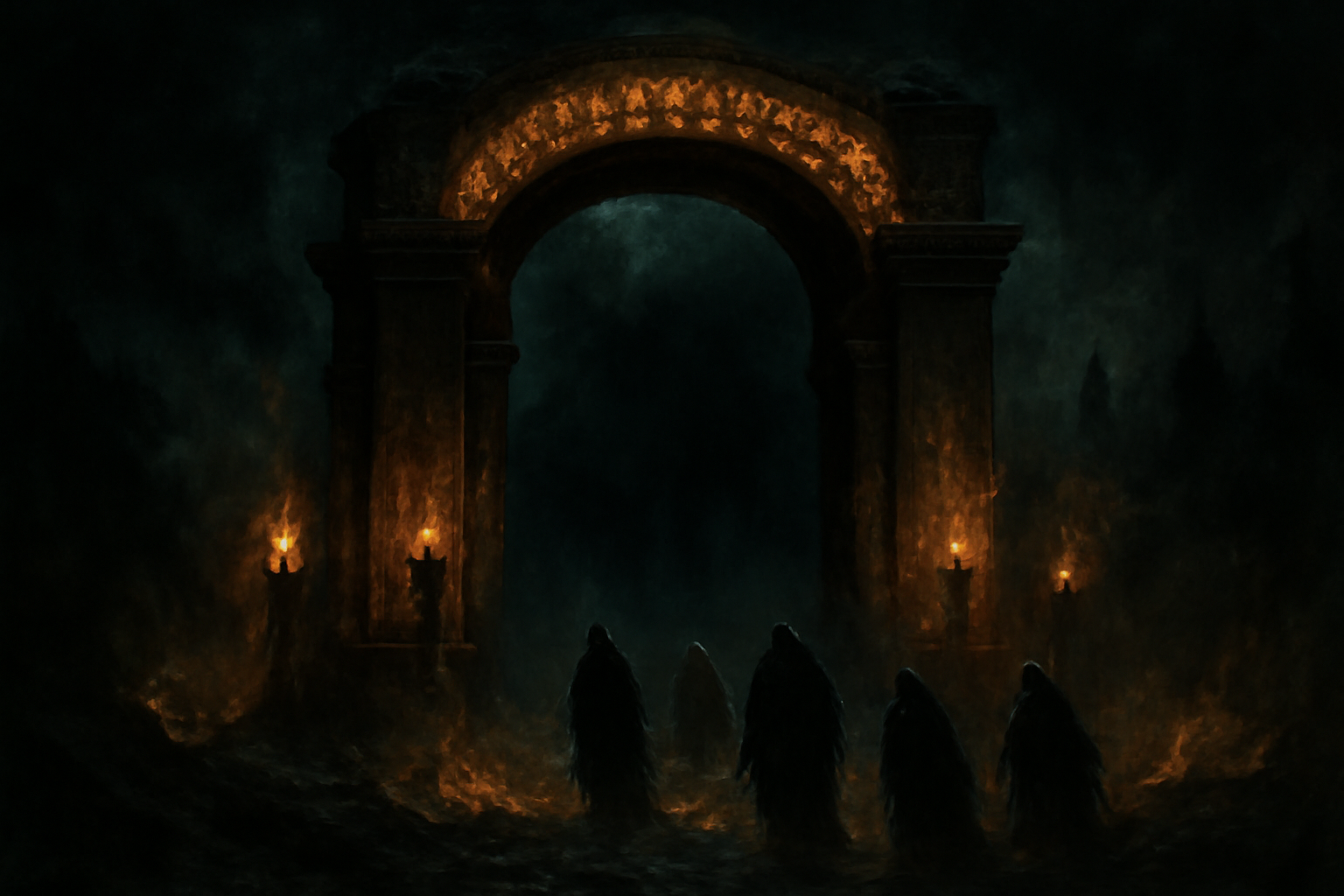
Dante Alighieri stands before a gate. Behind it lies Hell itself. The inscription carved into that threshold has echoed through seven centuries of Western culture, appearing in everything from video games to political cartoons. Yet few readers know what the full inscription actually says—or why a single line from it became perhaps the most quoted phrase in all of literature.
In Canto III of the Inferno, Dante and his guide Virgil approach the entrance to Hell. The gate itself speaks to them. Its words are chilling and absolute. They announce not just a warning, but an irreversible point of no return.
The Full Inscription: What the Gate Actually Says
Let me begin with what appears in Dante’s original Italian text, lines 1-9 of Canto III:
“Per me si va ne la città dolente,
per me si va ne l’eterno dolore,
per me si va tra la perduta gente.
Giustizia mosse il mio fattore;
fatto mi avea la divina podestate,
la somma sapïenza e ‘l primo amore.
Dinanzi a me non fuor cose create
se non etterne, e io etterno duro.
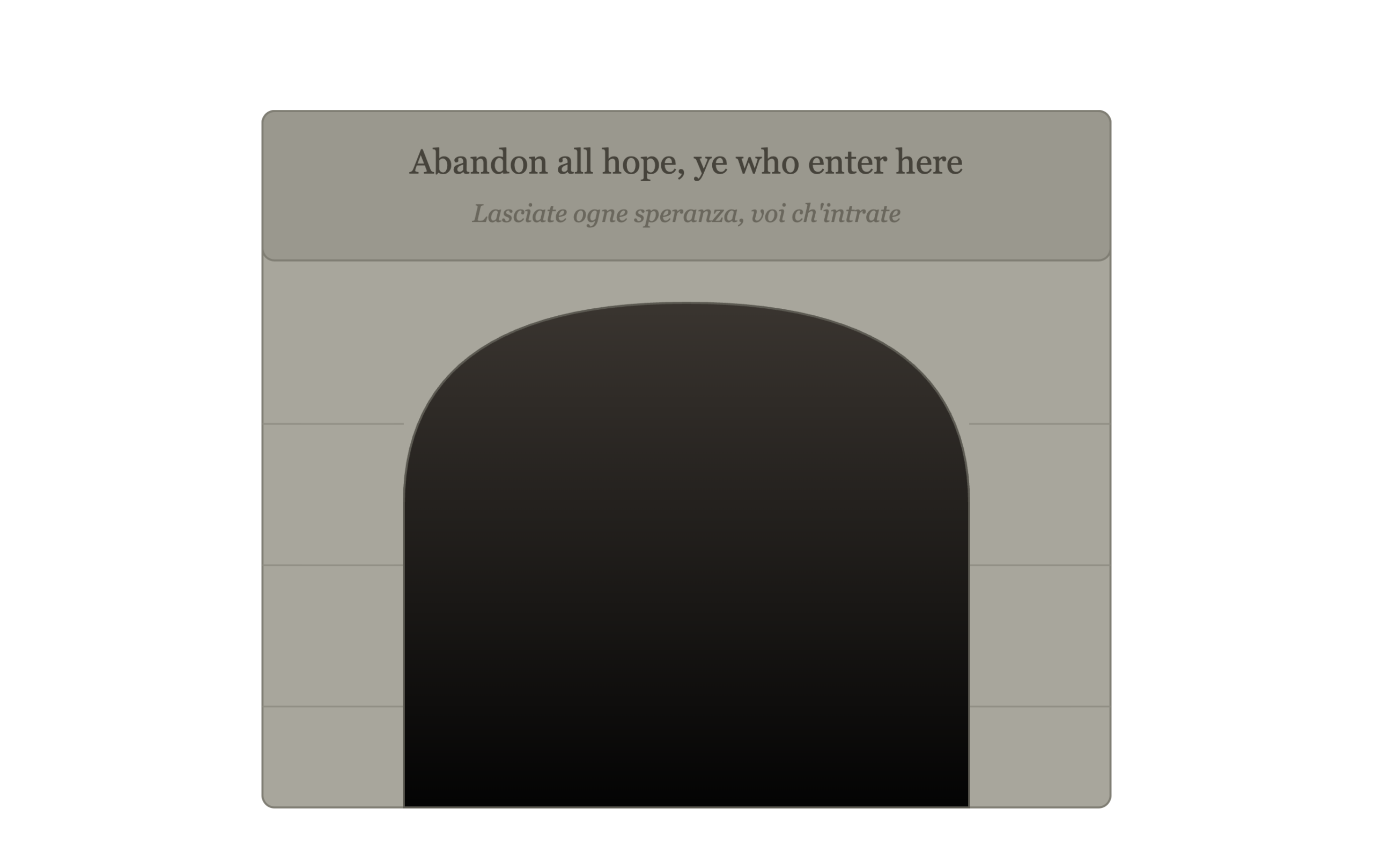
Lasciate ogne speranza, voi ch’intrate.”
The gate speaks in first person. This is crucial. The gate itself has agency and authority. It was made by three divine attributes: supreme wisdom, divine power, and primal love.
Only eternal things existed before this gate was created. That means Hell itself is eternal, unchanging, and woven into the cosmic order. Nothing can alter what lies beyond this threshold.
Translation Matters: Why Different Versions Sound Different
“Lasciate ogne speranza, voi ch’intrate.” This nine-syllable line drives home the horror. But how do we render it in English?
The most famous version reads: “Abandon all hope, ye who enter here.” However, other translations exist. Some render it as “Leave every hope, you who enter” or “Give up all hope, those who go in.”
Why the variations? Each translator faces choices. Does “lasciate” mean “abandon” or “leave”? Is “ogne speranza” better as “all hope” or “every hope”? Should it sound archaic and formal, or modern and direct?
The most iconic version—”Abandon all hope, ye who enter here”—uses archaic English (“ye,” “here”) to evoke timelessness. It emphasizes the totality: not some hope, but all hope. The imperative verb “abandon” feels more violent than “leave.” It sticks in memory precisely because it sounds profound yet simple.
In fact, that particular phrasing became canonical in English-speaking cultures. Writers, filmmakers, and artists quote it endlessly. Most people encounter it in this form before ever reading Dante directly.
The Context: A Moment of Irreversible Passage
Dante and Virgil have traveled through the darkness. They approach this gate together. This is the moment everything changes. Beyond it lies no redemption, no escape, no possibility of return.
For medieval Christian theology, this distinction mattered enormously. Hell is not a place of temporary punishment. It is final, eternal, and absolute. Those who enter have exhausted their chances at grace.
Dante’s journey through Hell aims toward understanding divine justice. Yet even as his guide, the Roman poet Virgil cannot enter the deepest circles. In medieval theology, even virtuous pagans lack the grace needed for salvation. They exist in a kind of limbo.
As they read this inscription, Dante experiences a very human response. He becomes confused and frightened. His body tenses. His emotional state threatens to overwhelm him. Later, after descending deeper into Hell, he will actually faint from the horror of what he witnesses.
What Does “Hope” Mean Theologically?
Modern readers might misunderstand this line. They imagine hope as mere optimism or wishful thinking. Medieval theology understood it very differently.
In Christian thought, “hope” is a theological virtue. It is the trust in God’s mercy and the possibility of salvation. For the damned, this hope is impossible. They have made their final choice. No redemption awaits.
That is what makes Hell eternal. Not external chains or torments, but the absence of any possibility for change. The damned cannot repent. They cannot appeal to mercy. Their condition is locked forever.
As a result, the inscription operates on two levels. It warns the living: choose wisely now, while you still can. For the dead already inside, it declares an unchangeable truth: your destiny is sealed.
The Vestibule: Even Hell Rejects Them
Immediately past the gate lies something unexpected. A vestibule. In it wander neither the damned nor the saved, but the “opportunists”—those who chose neither good nor evil during their lives.
These souls chased after a blank banner. They were motivated by neither virtue nor vice, but only by self-interest. Even Hell’s hierarchy—governed by divine justice—has no place for them. They occupy an in-between space.
Wasps and hornets sting them endlessly. Their blood mixes with their tears. Even the damned proper despise them. In Dante’s moral universe, indifference equals sin. This vestibule punishes the spiritually apathetic.
What does this tell us? Dante believed that moral choices matter absolutely. The neutral option does not exist. Refusing to choose is itself a choice—and a damning one at that.
Cultural Impact: A Line That Won’t Die
“Abandon all hope, ye who enter here” has become ubiquitous. It appears far beyond literary circles. This single line transformed how Western culture speaks about irreversible choices.
Video game designers use it. Political cartoonists quote it. It appears on warning signs, in song lyrics, in memes. Even people unfamiliar with Dante know this phrase. It has achieved the status of cultural shorthand for “the point of no return.”
Why has it endured so powerfully? Several reasons converge. First, it is memorable. The rhythm, the archaic language, the absoluteness—all stick in memory. Second, it taps into something universal: our fear of irreversible mistakes.
Specifically, it captures the existential dread of crossing a threshold. We all face moments where we recognize: after this, nothing will be the same. This line articulates that fear precisely.
A Physical and Psychological Turning Point
Notably, Dante responds to the inscription with physical collapse. His guide Virgil must reassure him. Fear nearly paralyzes him. This human reaction grounds the scene in emotional reality.
Dante does not stride boldly through. Rather, he hesitates. He trembles. Eventually, holding Virgil’s hand, he proceeds. The gate’s words have shaken him to his core.
This moment proves crucial to the poem’s power. Dante is not a detached observer. He is a traveler who experiences fear, confusion, and overwhelming dread. Readers connect with his vulnerability.
Why This Line Endures
After nearly 750 years, “Abandon all hope, ye who enter here” remains potent. We quote it casually, yet it preserves medieval theology beneath its cultural surface.
At its heart, the line concerns irreversibility. It speaks to the terror of finality. Once you cross certain thresholds, you cannot uncross them. Some choices echo forever.
In fact, this resonates with human experience across cultures and centuries. We all recognize moments of no return. Perhaps a betrayal, a commitment, a path chosen. The inscription’s power lies in its brutal honesty about such moments.
Moreover, it captures something about responsibility. The damned entered Hell through their own choices, their own sins. Dante insists on this point repeatedly. No external force dragged them in. They condemned themselves.
That moral clarity—combined with compassion for human weakness—gives the Inferno its enduring power. The gate’s inscription announces a truth both terrifying and humane: choices matter absolutely, and consequences are real.
A Gateway to Understanding Human Fate
When we encounter “Abandon all hope, ye who enter here,” we encounter Dante’s vision of justice itself. Hell exists not as cruelty, but as the inevitable consequence of sin.
The gate speaks with authority because it represents divine order. It tells us that some choices genuinely end possibilities. Hope, in the theological sense, requires humility and openness to grace. Those who reject grace find hope impossible.
For modern readers, secular or religious, the line raises timeless questions: How do choices shape destinies? What makes some situations truly irreversible? When do we cross points of no return? These questions outlast any single belief system.
In closing, Dante’s inscription survives because it articulates something humans have always known: that we are beings capable of damning ourselves. The gate does not lock from outside. We lock it from within, through our choices, our refusals, our indifference. That terrible freedom—and that terrible responsibility—is what makes the line eternal.