Dante’s Inferno is one of the most influential works in Western literature. It’s the first part of a three-part epic called the Divine Comedy. Written in the early 1300s by Italian poet Dante Alighieri, it remains surprisingly relevant and gripping today.
The poem blends theology, politics, and personal emotion into a single narrative. Think of it as a spiritual thriller wrapped in medieval Catholic cosmology. Understanding the plot opens doors to centuries of Western thought.
The Setup: Lost in the Dark Wood
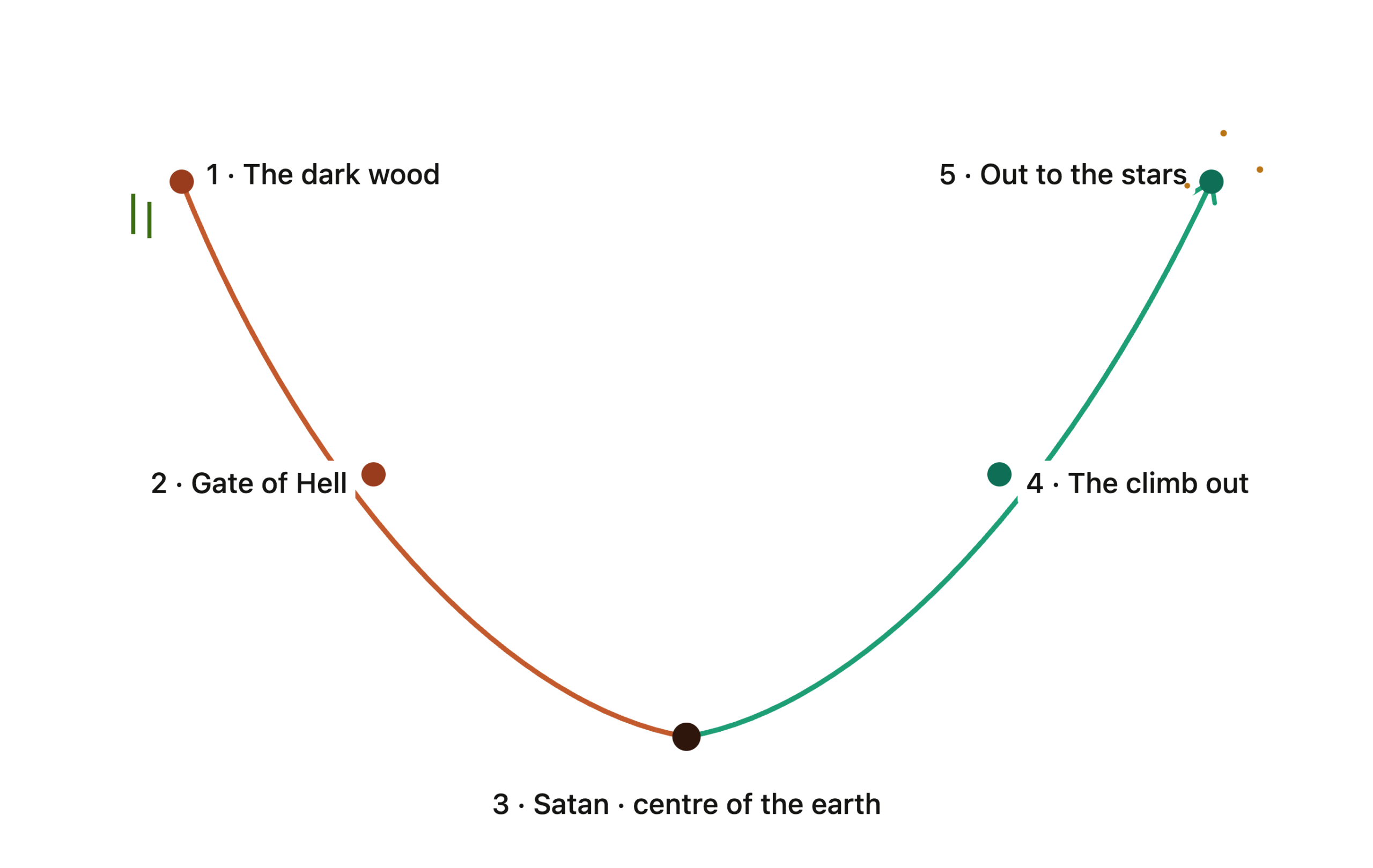
The story begins dramatically. Dante—both author and protagonist—wakes up lost in a dark forest. He’s thirty-five years old, “midway through life’s journey.” He’s terrified and alone, unsure how he arrived there.
Three beasts block his path forward. A leopard (representing lust) emerges first. Then comes a lion (representing pride). Finally, a she-wolf (representing greed) approaches hungrily.
Dante tries to climb a sunlit hill to escape. However, the beasts force him backward repeatedly. Hope fades. Fear overwhelms him. That’s when supernatural rescue arrives—the Roman poet Virgil appears before him.
Why Virgil? Why Now?
Virgil (70–19 BCE) was ancient Rome’s greatest poet. Dante revered him above all classical authors. The Aeneid, Virgil’s masterpiece, profoundly influenced Dante’s own work.
In the poem, Virgil explains his mission. Beatrice—Dante’s beloved—now dwells in Heaven. She loves Dante still. Concerned for his soul, she descended to Limbo (where virtuous pagans dwell). She begged Virgil to guide Dante through Hell and Purgatory.
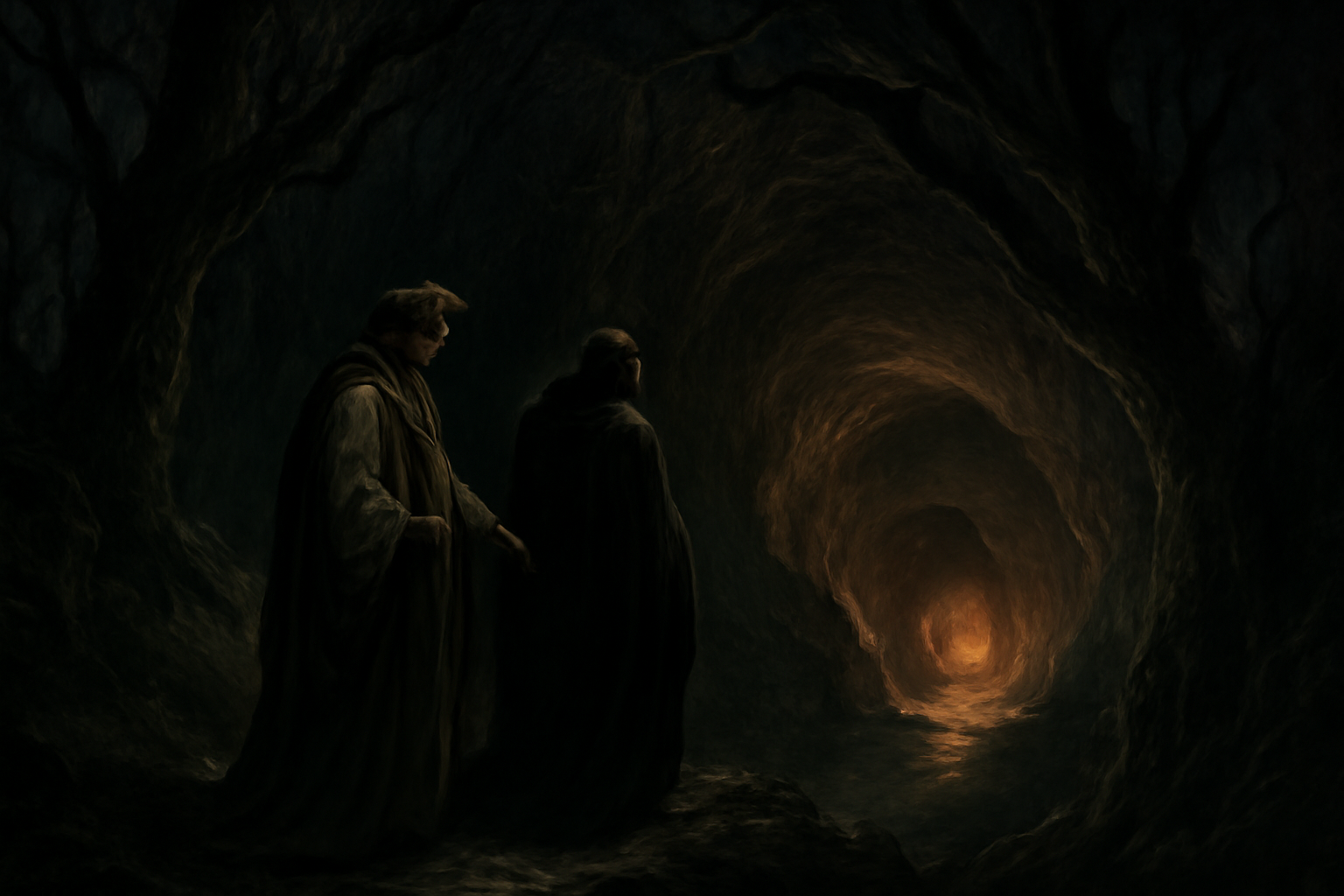
Dante agrees immediately. He trusts Virgil completely. Together they begin their descent into the underworld. This journey will fundamentally transform Dante’s understanding of sin, justice, and redemption.
The Descent Begins: Gate of Hell Through Limbo
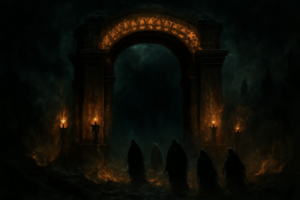
They reach Hell’s gate. Above it hangs an inscription: “Abandon all hope, ye who enter here.” The tone darkens instantly. This is no metaphorical journey—it’s literal descent into eternal punishment.
Just inside the gate lies the Vestibule. Here dwell the neutrals—souls who never chose sides morally. They aren’t evil, yet they never did good either. Dante judges them harshly. These cowardly spirits chase shadows eternally, stung by hornets.
Beyond the Vestibule flows the river Acheron. Here Charon, the mythological ferryman, transports souls across. Dante and Virgil cross safely. They’re living travelers, not damned souls, so Charon grants them passage.
Limbo and the Virtuous Pagans
The first circle houses Limbo. Here live virtuous non-Christians. They include great poets and philosophers—Homer, Aristotle, Cicero. In life, they achieved wisdom and moral excellence.
However, they were born before Christ. They never received Christian baptism or salvation. As a result, they dwell in a noble castle with meadows and light. Their punishment isn’t torment but rather separation from God.
Dante finds this circle morally complex. These souls deserved better fates. Yet medieval theology allowed no exceptions—even the greatest minds couldn’t enter Heaven without Christ. Dante honors them deeply while acknowledging theological necessity.
The Middle Circles: Lust, Gluttony, Greed, and Wrath
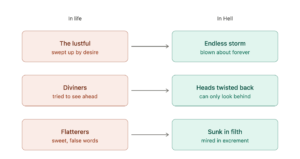
From Limbo, Dante descends to the second circle. Here dwell the lustful. Powerful winds blow these souls eternally in circles. They cannot rest or find stability.
Francesca’s Tragic Tale
Among the lustful, Dante encounters Francesca da Rimini. She tells a heartbreaking story. Years ago, she and her lover Paolo were reading a romance together. The book inflamed their desire for each other.
Her husband discovered them. He killed them both in jealous rage. Now they’re condemned to tumble through eternity together.
Dante is deeply moved. He nearly faints from pity. This scene reveals his empathy but also his moral framework—lust, however beautiful or sympathetic, earns eternal punishment.
The third circle houses the gluttons. Rain falls constantly, mixing with filth. Cerberus, the three-headed dog, guards them. These souls indulged excessively in food and pleasure.
In the fourth circle, the greedy suffer. They push great weights eternally. Half push in one direction; half push opposite. They’re blind to each other. In life they hoarded or wasted carelessly.
The fifth circle contains the wrathful. They fight and strike each other on the river Styx. Below the surface, the sullen gurgle in mud. Wrath and sullenness, Dante shows, consume the soul from within.
Lower Hell: Violence, Fraud, and Treachery
After the Styx, Dante and Virgil reach the City of Dis. Furies guard the gates, threatening them with hellfire. But angels intervene, allowing passage. They enter lower Hell, where sins grow more serious.
Here, Virgil explains Hell’s structure. Sins of violence and fraud dwelt below simple incontinence. These require more deliberate malice. Treachery sits lowest of all.
The Circle of Violence
The seventh circle contains three rings. In the outermost ring, violent people boil in a river of blood. Centaurs shoot arrows at those who escape.
The second ring holds suicides and self-harmers. They transform into thorny trees. Harpies tear at their branches. These souls rejected God’s gift of life itself.
The third ring is a burning desert. Violent blasphemers lie upon hot sand. Fire rains from above. Their punishment reflects their crimes against God’s majesty.
To cross into the eighth circle, they meet Geryon. This monster—part eagle, part serpent, part scorpion—descends from above. Dante and Virgil ride his back across a vast void. The descent becomes increasingly perilous.
Malebolge: The Ten Ditches of Fraud
The eighth circle contains Malebolge—an Italian term meaning “evil pockets.” Ten concentric ditches fill this region. Here dwell the fraudulent, who betray trust deliberately.
Dante spends considerable cantos describing these ditches. In fact, more than a third of Inferno focuses here. Fraud fascinates Dante more than violence does.
- First ditch: panderers and seducers
- Second ditch: flatterers, stuck in excrement
- Third ditch: simoniacs (church corruption), inverted in stone
- Fourth ditch: sorcerers and diviners
- Fifth ditch: corrupt politicians, boiling tar
- Sixth ditch: hypocrites, wearing leaden cloaks
- Seventh ditch: thieves, attacked by snakes
- Eighth ditch: evil counselors, wrapped in flames
- Ninth ditch: sowers of discord, split and torn
- Tenth ditch: counterfeiters, diseased and mad
Each punishment fits the crime. False counselors burn in flames because they burned with ambition. Thieves become prey to snakes who strip them bare.
The Final Descent: Giants, Cocytus, and Satan
Beyond Malebolge lies the ninth circle—Cocytus, a frozen lake. Giants guard its rim, waist-deep in ice. They represent rebellion against divine order itself.
Cocytus contains four zones, each frozen deeper. Here dwell traitors—the ultimate sinners in Dante’s moral cosmos. Treachery, the betrayal of trust, ranks worst of all sins.
- Caina: traitors to family (after Cain)
- Antenora: traitors to country (after Antenor)
- Ptolemea: traitors to guests/allies (after Ptolemy)
- Judecca: traitors to benefactors (named for Judas)
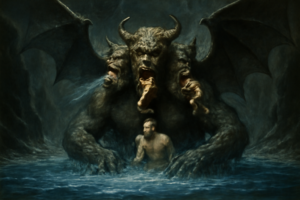
At Cocytus’s center lies Satan himself. Dante describes him as a three-headed giant, frozen in ice. Each mouth chews a supreme traitor eternally.
Judas Iscariot hangs from the central mouth, head inward. Brutus and Cassius occupy the side mouths—they betrayed Julius Caesar. Satan weeps constantly. His tears mix with blood, freezing into ice.
The Escape: Through the Center of Earth
Satan appears monstrous, yet he’s trapped helplessly. His great wings flap eternally but never propel him upward. He symbolizes ultimate powerlessness despite appearing mighty.
Dante and Virgil climb down Satan’s hairy body. They pass through his armpits and reach his legs. Then something unexpected happens—gravity reverses at earth’s center.
What felt like “down” becomes “up.” They’re climbing “up” Satan’s body now. They emerge in the Southern Hemisphere on the far side. Behind them, Hell lies sealed forever.
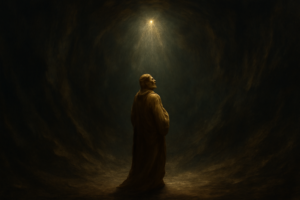
Above them twinkles a single star. Then four stars appear. Dante sees “the beautiful things that Heaven bears.” He’s escaped Hell and stands ready for redemption’s next stage.
What Comes Next: The Complete Picture
Inferno is Part One of the Divine Comedy. Two more sections follow: Purgatorio and Paradiso. Together they form an epic journey through all three realms of the afterlife.
In Purgatorio, Dante climbs a mountain. Here souls undergo moral purification. Unlike Hell’s eternal punishment, Purgatory offers eventual escape and Heaven.
Paradiso completes the trilogy. Beatrice herself guides Dante through celestial spheres. The focus shifts from punishment to glory, from suffering to divine beauty.
But Inferno stands complete in itself. Its moral architecture, vivid characters, and theological depth make it endlessly rewarding. It remains the most widely read section of the Divine Comedy for good reason.
Dante’s genius lies in balancing theology with humanity. Hell contains sinners, yes—but Dante shows genuine pity for many of them. They’re not abstract demons but recognizable humans who failed morally. That empathy, paired with unflinching judgment, gives the poem its power.