When most people imagine Hell, they picture flames. Sulfurous pits. Demons with pitchforks. Fire, fire, everywhere.
Dante Alighieri had a radically different vision.
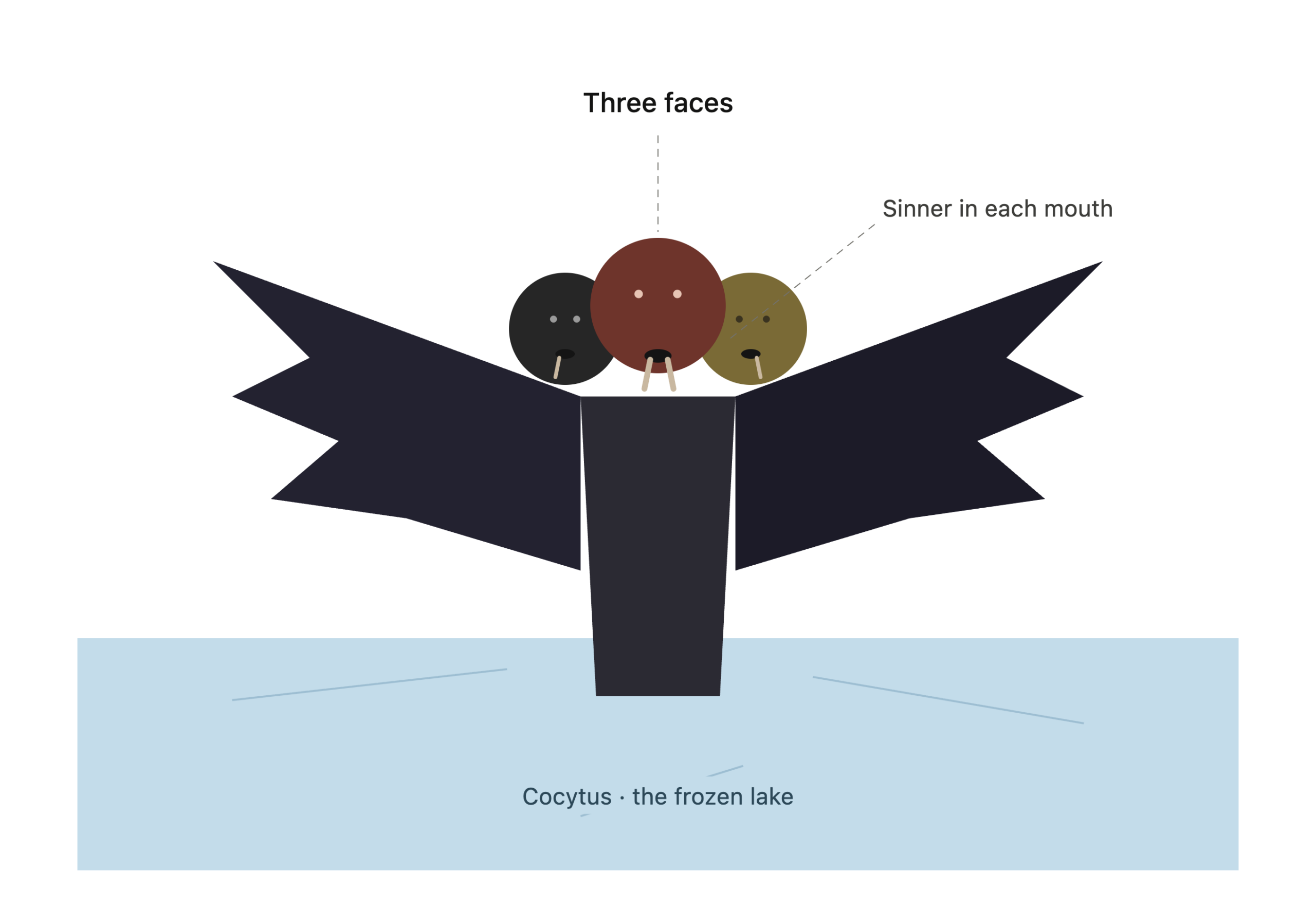
In his epic poem The Divine Comedy, the deepest, most terrible circle of Hell is not blazing—it is frozen solid. Cocytus, the ninth circle, is a lake of ice. And the further Dante descends toward the absolute center of Hell, the colder it becomes.
Why ice instead of fire? The answer reveals Dante’s theological genius. Cold represents the complete absence of God’s warmth and love. As divine heat recedes, only numbness remains. Satan himself, trapped at the very bottom, beats his massive wings endlessly. Those wings generate the arctic wind that keeps Cocytus frozen. The prince of heat has become the source of absolute cold.
The Journey Down: Giants and the Frozen Pit
Before reaching Satan, Dante must first navigate the ninth circle’s geography. At the rim of Cocytus stands a frightening barrier: the Giants.
These are not ordinary beings. Nimrod, Ephialtes, and Antaeus—towering figures from myth and scripture—stand partially submerged in a deep well. Their bodies extend far above the frozen lake, creating a natural staircase downward. In fact, these giants serve a purpose. They guard the descent and represent humanity’s most arrogant rebellion against God.
Antaeus, the legendary wrestler, proves crucial to the journey. Unlike his fellow giants, Antaeus shows Dante and Virgil mercy. He gently lowers them down into the abyss below. His massive hand descends like a cage, carrying the two travelers deeper into the frozen darkness. Specifically, Antaeus helps because he never fought against God directly—his sins were different. As a result, he alone possesses capacity for compassion.
Four Zones of Betrayal: The Frozen Lake Divided
Cocytus itself divides into four concentric zones. Each zone contains a specific type of traitor. Understanding these distinctions matters enormously.
The outermost zone is Caina, named for Cain who murdered his brother. Here lie traitors to family bonds. These souls are partially submerged, frozen at waist level. Their punishment reflects their crime: they severed the closest human relationships. Family betrayal cuts deepest, so it occupies the “least severe” position in the ninth circle.
Antenora, the second zone, holds traitors to their country or political faction. One notorious resident is Count Ugolino. In life, Ugolino betrayed his political enemies. Now, eternally, he gnaws the skull of Archbishop Ruggieri, the man who betrayed him in return. It is a grotesque, cannibalistic image. On the other hand, this mutual enmity continues forever—no reconciliation, no rest.
The third zone, Ptolemaea, punishes traitors to guests and hosts. This zone contains something genuinely unsettling. Many souls here have their physical bodies still walking the earth—living people unaware they are already damned. Their souls have already descended to Hell. In other words, they live as spiritual corpses. That said, their betrayal was so severe that Hell claimed them before physical death.
Judecca, the innermost zone, reserves space for traitors to lords and benefactors. These are the worst offenders. They lie completely encased in ice, silent and motionless. Unlike other sinners who can move or speak, these figures are utterly still. Specifically, this total immobility symbolizes their complete spiritual death.
Satan Himself: A Pathetic Prisoner
At the absolute center lies Satan. Dante calls him both Dis and Lucifer—the Devil himself. And his portrayal is shocking in its weakness.
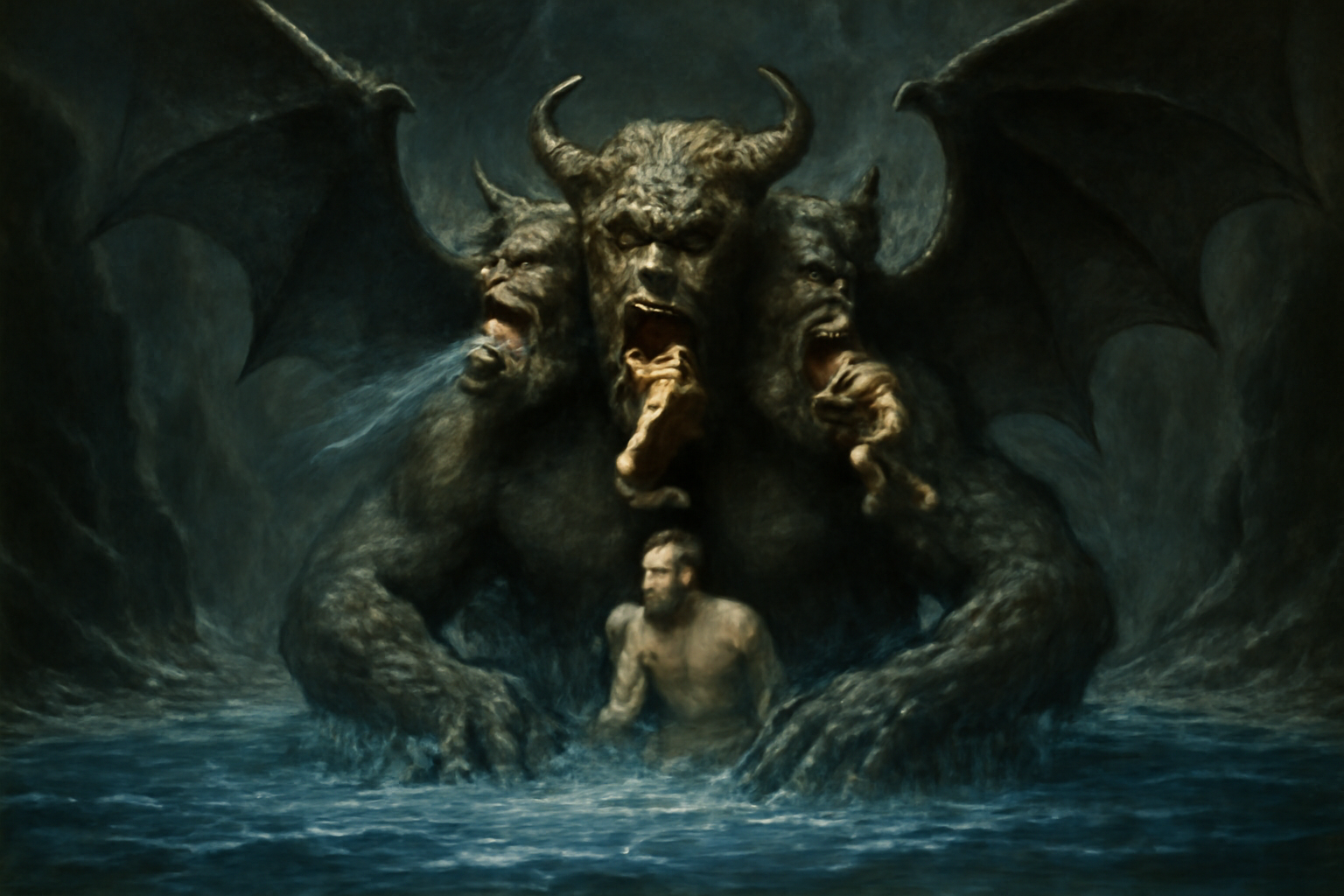
Satan is enormous. His body dwarfs anything imaginable. Yet he is frozen from the mid-chest downward, trapped eternally in the ice. Rather than a powerful rebel, he appears a pitiful prisoner. His wings—massive, bat-like appendages—beat ceaselessly. These wings create the wind that maintains Cocytus’s frozen state.
Most disturbing is his face. Satan possesses three faces—a grotesque mockery of the Holy Trinity. One face is red. Another is yellow-white. The third is black. Each face possesses its own mouth. And each mouth chews upon a specific traitor.
- The center mouth gnaws Judas Iscariot, betrayer of Christ. Judas receives the worst position—the primary mouth. His suffering is paramount.
- The left mouth chews Brutus, betrayer of Julius Caesar and the Roman state.
- The right mouth devours Cassius, Brutus’s co-conspirator in Caesar’s assassination.
Significantly, Satan is not consuming these traitors to gain power. Rather, he is stuck in eternal torment alongside them. He cannot swallow. He cannot digest. He simply chews endlessly, experiencing suffering equal to his victims.
The Inversion of Power
What makes this portrayal genius? Satan is impotent. He possesses no authority, no dominion. His supposed power has become literal imprisonment. That said, medieval readers expected Satan to be formidable. Dante inverts expectations completely.
In Christian tradition, Satan rebels through pride and rebellion. He refuses to submit. Yet Dante shows him utterly broken. Weeping. Trapped. Pathetic. This Satan is punishment incarnate, not a force still struggling for control.
The Escape: Climbing Down to Climb Up
Getting out proves stranger than getting in. Dante and Virgil must climb down Satan’s hairy body. They descend further and further into apparent darkness. However, as they pass the absolute center of gravity—the midpoint of Hell itself—something shifts.
Suddenly, what was down becomes up. Gravity inverts. The two travelers find themselves climbing upward through Satan’s legs. For example, a tunnel that seemed to lead deeper actually leads toward the surface. In fact, the spatial logic of Hell itself changes at its center. As a result, they emerge on the other side of the Earth, freed from the underworld.
This escape mechanism is mathematically and theologically brilliant. Hell inverts everything—even direction itself. The only way out is through.
Why Dante’s Vision Still Matters
Modern readers often find Dante’s Satan disappointing. We expect cosmic villains, not whimpering prisoners. Yet that disappointment is precisely the point.
Dante understood something profound. Ultimate punishment is not violence or fire. It is isolation from God’s love. Cold rather than heat. Stillness rather than rage. Eternal imprisonment rather than freedom. On the other hand, contemporary culture obsesses over powerful evil. Dante suggests real damnation is powerlessness.
After studying world mythology for decades, I find Dante’s ninth circle more theologically sophisticated than much earlier religious literature. Specifically, he argues that evil is ultimately self-defeating. The ultimate rebel becomes the ultimate prisoner.
Reading The Divine Comedy‘s final circles teaches us this: Hell is not a kingdom Satan rules. It is a tomb he inhabits. And the deepest cold comes not from opposition to God, but from absolute separation from Him.