“`html
Dante Alighieri’s Inferno is often misread as a medieval torture catalog—a sensationalized inventory of punishment and pain. But this interpretation misses the poem’s spiritual architecture entirely. The Inferno is not Dante’s destination. It is his diagnosis. And like any honest diagnosis, it wounds before it heals.
What makes the spiritual meaning of Dante’s Inferno so compelling to modern readers—Christian and secular alike—is that it refuses comfort. The poem does not flatter the soul or offer easy absolution. Instead, it maps the human capacity for self-deception with surgical precision. Understanding this map is understanding why Dante descended into Hell at all, and why that descent matters theologically.
For over twenty-five years, I have studied how ancient religious traditions and medieval Christian theology shape narrative. What emerges from The Divine Comedy is not punishment for its own sake, but a vision of spiritual transformation so radical it requires passing through the absolute worst of human nature first. That is the paradox at the heart of Dante’s genius.
The Inferno Is Not the Destination
We must begin with a correction. Readers often treat the Inferno as a standalone work—a Gothic descent into horrors. But Dante himself conceived it as the first movement of a single, continuous ascent toward God. The Divine Comedy is one poem in three parts. The soul cannot rise authentically without first descending completely into what it has become.
This is not poetic ornament. It is theological necessity.
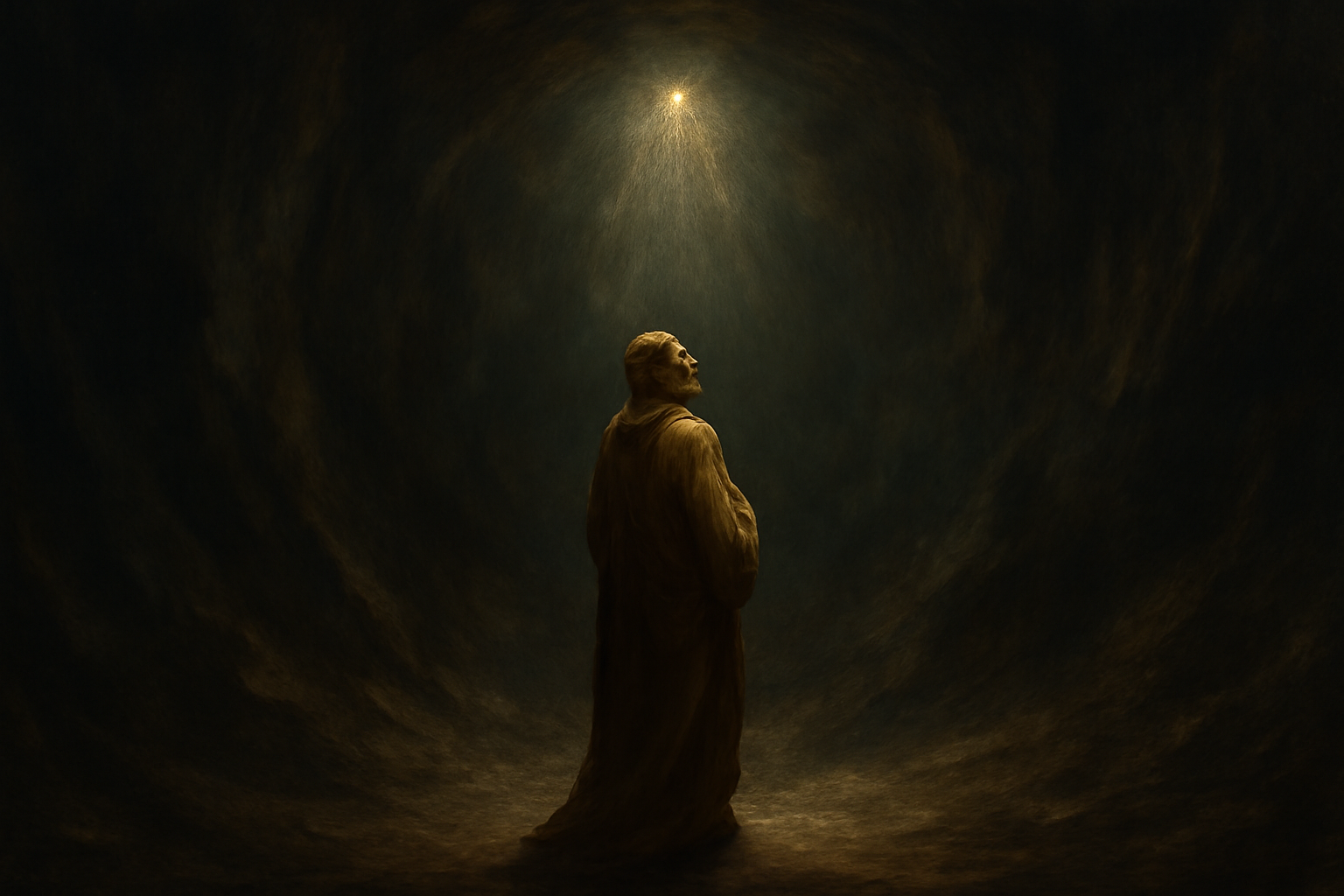
Dante as everyman begins the journey lost—spiritually disoriented in a dark wood at midlife. He encounters three beasts: lust, pride, and avarice. He cannot pass them alone. Virgil, representing human reason, appears. Together they descend through Hell, through Purgatory, and Virgil eventually surrenders his charge to Beatrice, who represents divine grace, and finally to St. Bernard, who embodies mystical contemplation.
Hell itself is ground to be traversed, mapped, and understood—not a final state but a necessary stage. The deepest circles of Hell contain the greatest sinners, yes, but they are frozen, fixed, unable to move or change. They have made their wills permanent monuments to themselves. This is not where the soul remains. It is what the soul must pass through and leave behind.
Understanding this changes everything. The Inferno is brutal because honesty is brutal. The poem does not soften what sin does to the human soul. But its purpose is not to trap us there. It is to show us the way out.
Descent Before Ascent: The Paschal Pattern
Dante’s journey begins on Good Friday, April 8, 1300. It concludes on Easter morning. This timing is not accidental—it echoes the central Christian mystery: Christ’s descent into death, His harrowing of Hell, and His Resurrection. Dante structures his spiritual autobiography according to the paschal pattern, the rhythm that defines Christian theology itself.
Rise by first going down. This is the grammar of Christian mysticism.
In medieval theology, humility precedes exaltation. Pride is the root of all sin because it refuses the descent, refuses to acknowledge dependence on God. Only by descending into the full recognition of our capacity for evil—our potential for treachery, fraud, violence, and self-love—do we become capable of genuine transformation.
Purgatory, the second canticle, shows souls actively suffering to be cleansed. They suffer willingly because they have recognized their condition. Hell, by contrast, shows souls who have refused recognition entirely. They are locked in their sins not because God imprisons them, but because they have chosen their sins as identity.
Dante’s timing matters because it tells us the journey is possible. No soul is excluded from the path upward. Even Dante, lost and afraid, surrounded by demons and the damned, emerges on Easter. The poem is saying: your sins are not the final word. Your descent, if made consciously and in company with reason and grace, contains within it the seeds of your resurrection.
The Hinge: Climbing Down Satan’s Body
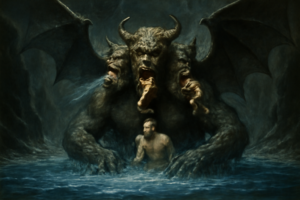
The Inferno reaches its theological climax at the absolute center of the earth. Here Dante encounters Satan, the fallen angel frozen in ice at the bottom of creation. Satan is not a king ruling in fire and glory. He is pathetic: three-faced, weeping, trapped, his massive wings beating uselessly against the ice they create.
Dante and Virgil climb down Satan’s enormous body. At the midpoint—passing the gravitational center of the universe—orientation inverts. What seemed down becomes up. When they emerge on the other side, they are climbing upward. The absolute nadir of evil is the turning point toward good.
This inversion is not accident or literary decoration. It is the poem’s central spiritual claim: by passing completely through sin, by refusing to look away or take a shortcut, the soul reaches the point where descent becomes ascent. You must touch bottom to push off.
Satan himself embodies the consequence of absolute self-love divorced from God. He is isolated, impotent, frozen. His wings beat but produce only ice. His three mouths chew the three greatest traitors—Judas, Brutus, Cassius—forever. He is locked in the act of consuming what he betrayed. Satan is not powerful; he is the final impotence, the will that has chosen itself over everything and become paralyzed by that choice.
Sin as a Turning Away From Love
The architecture of Dante’s Hell rests on a theology older than he was: the Augustinian and Thomistic understanding that evil is not a substance but a privation. Evil is the absence of good, the way darkness is the absence of light. This is not a weak metaphor in the Inferno—it becomes the literal geography.
God dwells at the summit as perfect light, warmth, and love. The further from God one moves through willful sin, the colder and darker it becomes. Lower Hell is literally frozen. Satan is ice, not flame. Why? Because sin is a turning away from the source of all warmth and light. The punishment is not imposed from outside; it is the sin’s own true nature revealed.
Dante structures Hell according to the gravity of each sin. Upper circles contain the incontinent—those who lack self-control but are not fundamentally malicious. Lust, gluttony, avarice. Further down come the violent. Deeper still come the fraudulent and treacherous. Why treachery at the bottom? Because it corrupts the very bonds of trust and love that mirror divine love itself.
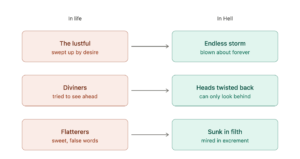
Medieval theologians called this the contrapasso—the punishment is the sin’s own shape made permanent and visible. The lustful are blown about by winds, never finding rest. The wrathful fight eternally. The treacherous are frozen in ice. Hell is the will granted its own final wish—the wish to be separate from God, made absolute and eternal.
This theology transformed Dante’s poem into something that endures. Because it is not about external punishment at all. It is about the spiritual consequences of habitual choice. Choose separation from love long enough, and you become separated. Choose it absolutely, and that separation becomes your eternal reality.
The Three Ways of Christian Mysticism
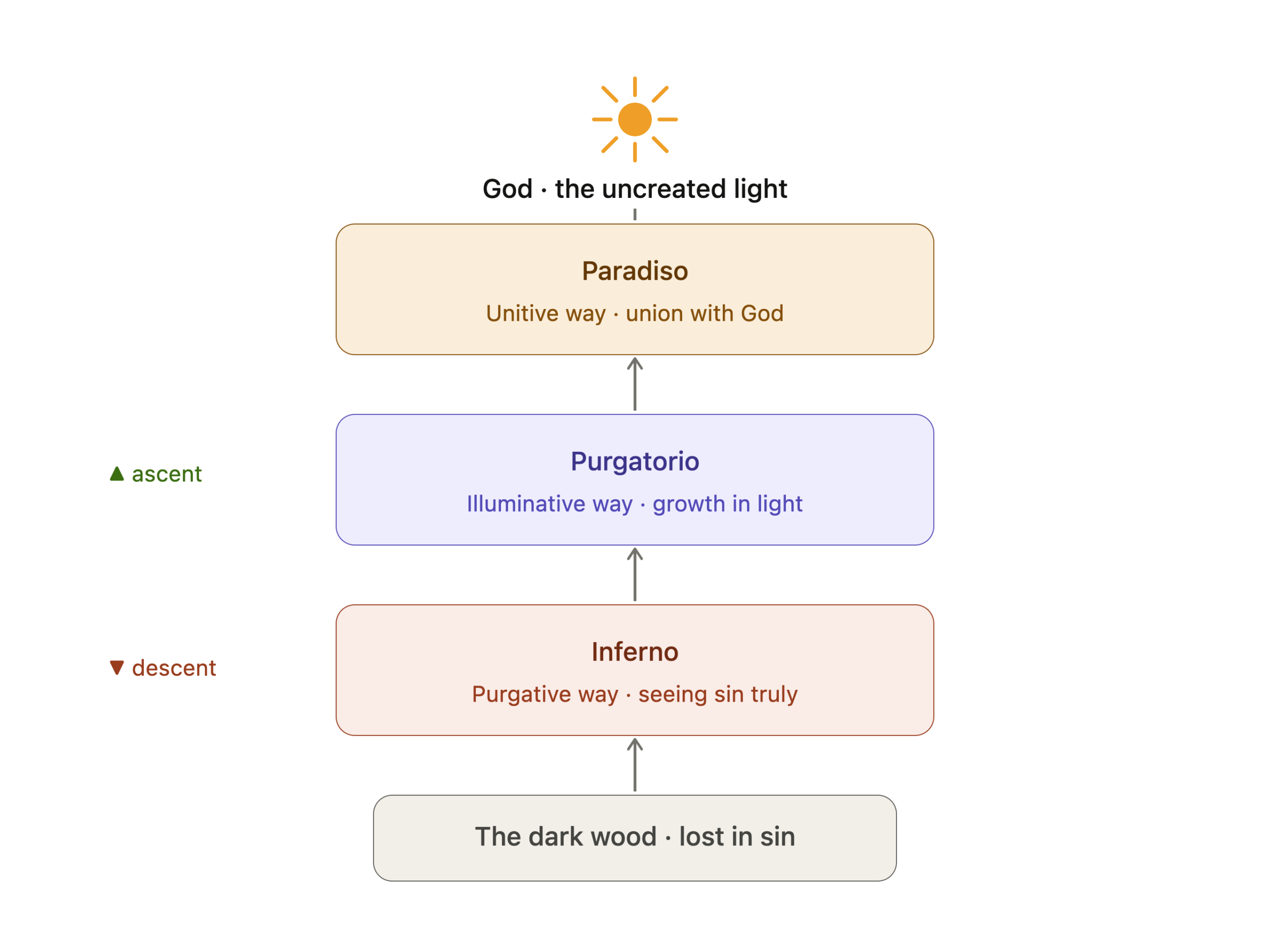
Medieval Christian theology identified three stages in the soul’s return to God: the Via Purgativa (the purgative way), the Via Illuminativa (the illuminative way), and the Via Unitiva (the unitive way). Dante’s three canticles map directly onto these stages.
Inferno corresponds to the purgative way—the soul’s recognition and purging of sin. It is the stage of honest diagnosis, of seeing oneself without illusion. Purgatorio corresponds to the illuminative way—the soul actively works to transform itself, understanding virtue, seeking healing. Paradiso corresponds to the unitive way—the soul at last achieves union with God, seeing reality as it truly is.
This is a useful simplification, and scholars debate the seams. But the direction holds unambiguously. We do not leap directly to paradise. We cannot. The human soul ascending to God must first recognize what it has become through sin. Then it must patiently work to undo that damage. Only then can union become possible.
What makes Dante remarkable is that he does not rush past Hell. He spends a third of his poem there. He listens to the damned. He weeps. He becomes disoriented and confused. Because seeing sin truly is disorienting. Understanding the depths to which the human will can fall is confusing. This is the purgative stage, and it cannot be shortened without becoming superficial.
Who Can Guide You, and How Far
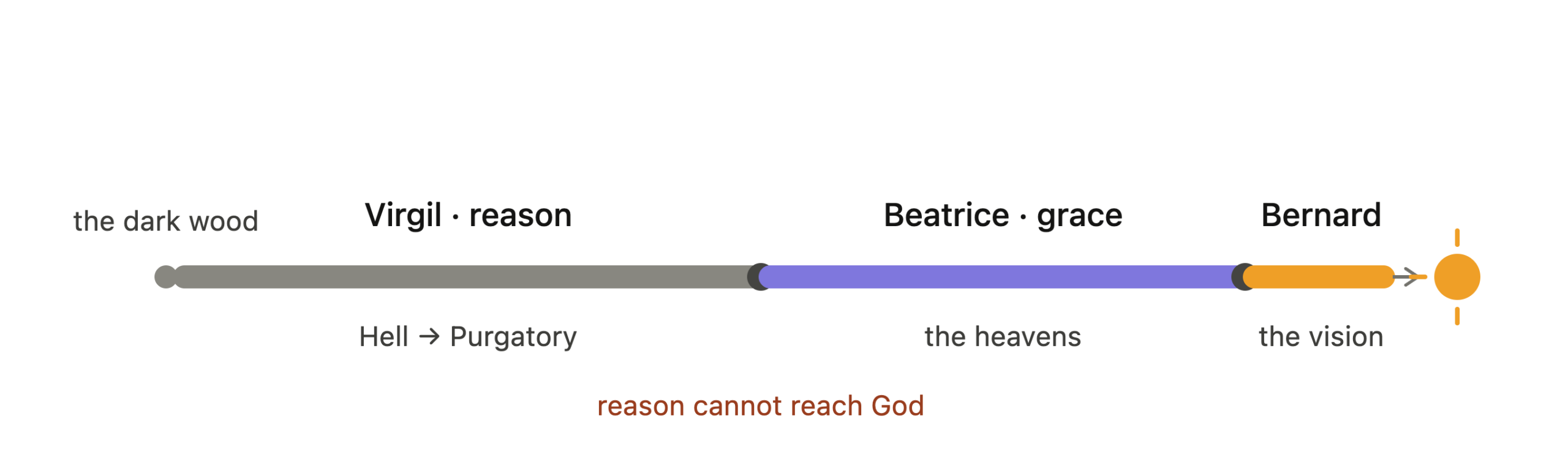
Dante does not descend alone. Virgil, the pagan poet and representative of human reason, guides him through Hell and Purgatory. Virgil is wise, compassionate, and can take Dante far. But Virgil himself dwells in Limbo. Reason has limits. It cannot enter Paradise.
At the threshold of Purgatory’s highest circle, Beatrice appears. She represents divine grace—the supernatural love that draws the soul toward God. Where reason fails, grace enters. Beatrice leads Dante through Paradise. And in the final circles of Paradise, St. Bernard guides him, representing mystical contemplation—the direct experience of divine union.
This hierarchy is not denigration of reason. Dante honors Virgil profoundly. But it is clear-eyed about reason’s boundaries. We need reason to understand our sins, to map our failures, to see the structure of evil and virtue. But salvation itself requires something reason cannot provide: grace, divine love reaching down to meet us, drawing us beyond what human intellect alone can achieve.
Who guides you matters. And how far they can take you depends on what they are. This too is theological precision dressed as narrative.
What the Descent Is For
The spiritual meaning of Dante’s Inferno emerges in its ultimate purpose: cosmic examination of conscience. Every circle, every punishment, every damned soul presents a mirror. Are you lustful? There is Francesca. Violent? There is Vanni Fucci. Treacherous? There is Judas at the center of betrayal.
Dante the poet lived in medieval Florence. He was a political actor, an exile, a man capable of rage and resentment. The Divine Comedy is not written from detachment. It is written from inside the struggle. Many sinners in Hell are people Dante knew or people whose sins he recognized in himself.
This is why the poem endures beyond its medieval Catholic context. The Inferno does not ask us to believe a specific theology. It asks us to walk through Hell. It asks what sins are. Why we commit them. What we become when we choose separation over connection, self over love, appearance over truth.
The descent is for honesty. The journey through Hell is the soul’s refusal to lie to itself anymore. Not around what went wrong, but through it. Not past the difficult truths, but toward them. This is why Dante emerges on Easter. Only the soul that has descended fully into honest reckoning can rise with genuine transformation.
Twenty-five centuries of readers keep returning to Dante because the path he maps is universal. The specific sins shift with history. The fundamental pattern—blindness, the necessary descent into truth, the possibility of transformation—does not. That is why the Inferno remains spiritually alive: it does not offer escape from the human condition. It offers the hard way through it.
And that way leads upward.
“`
—