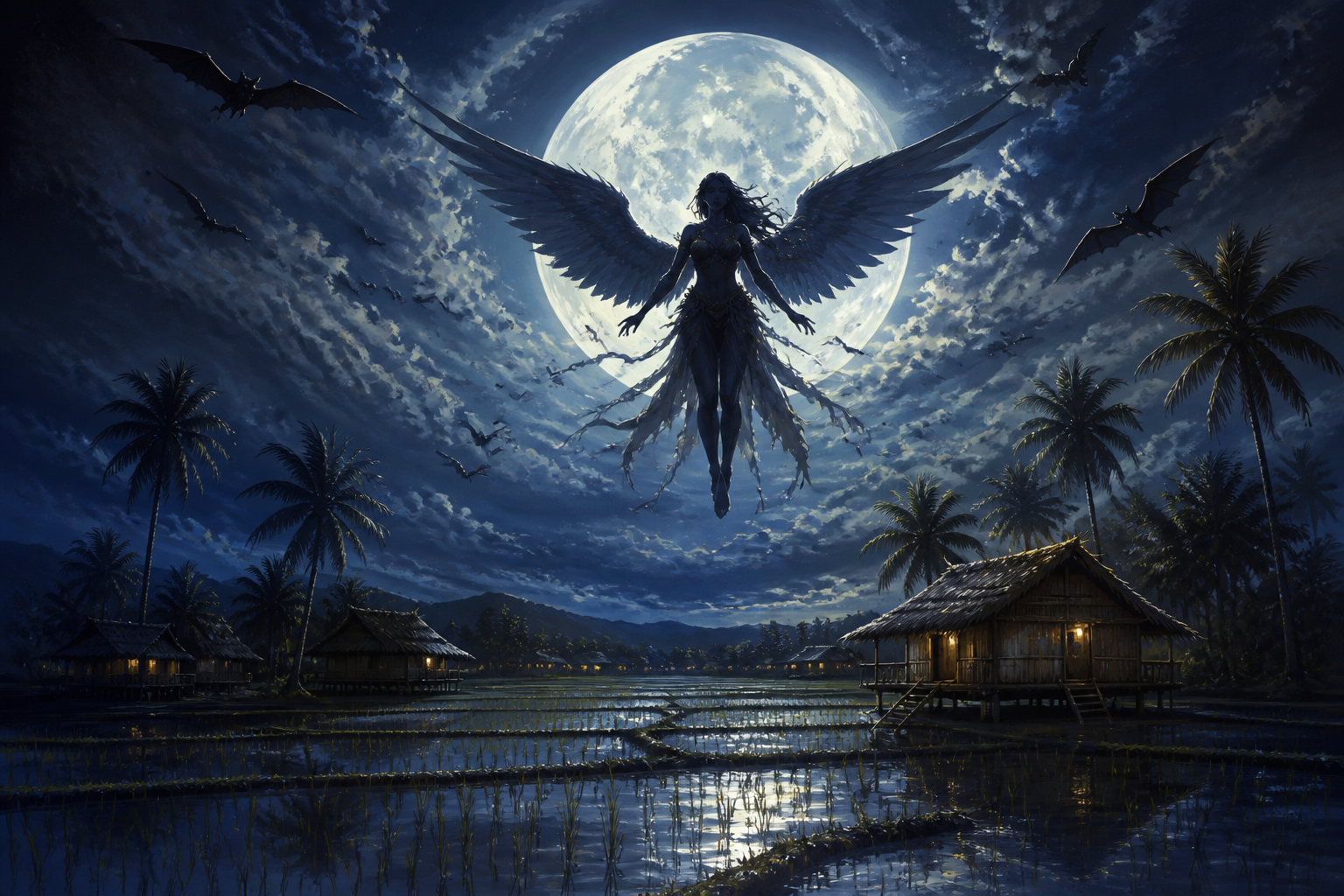
The manananggal is the Philippines’ most visually arresting vampire, a creature that solves the problem of flight by the simplest and most gruesome method imaginable: she cuts herself in half. By night she abandons her legs and torso to hunt on leathery wings, trailing intestines like grim streamers across the moonlit sky. I have spent much of my career tracing how cultures imagine the vampire, and I have rarely encountered a figure whose mechanics are so specific, so bodily, and so thoroughly documented by Filipino folklorists over the past century.
The Etymology of Manananggal: Severing as the Root of the Name
The name comes directly from the Tagalog verb root “tanggal,” meaning to remove, detach, or separate. Add the agentive prefix “mana-” and the reduplication common in Tagalog word formation, and the result is “manananggal,” literally “the one who separates” or “the self-severer.” This is not a poetic nickname assigned after the fact. It is a functional description, and it tells you everything you need to know before a single story is even told. Folklorist Maximo Ramos, whose 1969 study “The Aswang Complex in Philippine Folklore” remains the foundational academic text on this subject, noted that Filipino monster names are almost always descriptive rather than symbolic. The manananggal is named for the one act that defines her entirely.
The Nightly Severance: How the Manananggal Transforms
As darkness falls, the transformation begins. The creature’s torso detaches at the waist, and great bat-like wings unfurl from her shoulder blades, dark and membranous like those described in accounts collected across Capiz, Iloilo, and Antique provinces. Her lower half, meanwhile, is left standing upright in a chosen hiding spot, often tucked into banana groves or dense underbrush near the family home. This is a crucial detail. The legs do not collapse or vanish; they remain rooted and waiting, vulnerable, until dawn.
As she flies, her entrails and viscera hang loose beneath her, visible against the moon to anyone unlucky enough to look up. Jesuit folklorist Francisco Demetrio recorded multiple regional variants of this image in his “Encyclopedia of Philippine Folk Beliefs and Customs,” and the consistency across informants is striking. In fact, this trailing-organ imagery appears so reliably that it functions almost as a diagnostic marker, distinguishing the manananggal from other aswang types even in areas where terminology overlaps.
Hunting the Womb: Prey and the Long Proboscis Tongue
Unlike many vampiric figures across world folklore, the manananggal has a preferred and terrifyingly specific target: sleeping pregnant women. Anthropologist Fay-Cooper Cole documented this pattern among Visayan communities as early as the 1910s, and it persists almost unchanged in twentieth-century collections. The creature does not need to break into a home. Instead, she perches on the roof above the expectant mother’s sleeping mat and lowers a long, thread-like proboscis tongue through gaps in the thatch or nipa palm.
This tongue is often described as impossibly thin, almost hair-like, capable of slipping through the smallest crack. Through it, she draws blood from the mother, or, in the more feared versions of the tale, she reaches directly for the heart or blood of the unborn fetus. This is, without question, the most psychologically potent element of the legend. Comparative folklorists studying the vampires of Southeast Asia have repeatedly pointed to childbirth-focused predators as a distinct regional pattern, one shared with Malaysia’s penanggalan and Indonesia’s leyak, both close cultural cousins of the manananggal.
Salt, Garlic, and Ash: The Vulnerability Every Villager Knew
Every community with manananggal lore also carried the same piece of practical, almost domestic, defensive knowledge. If a villager could locate the abandoned lower half, standing exposed somewhere near the house, the fight was already half won. The exposed flesh at the severed waist had to be treated immediately, before the upper half returned before sunrise.
- Salt sprinkled directly onto the raw wound of the standing lower torso
- Crushed garlic cloves rubbed or scattered on the exposed flesh
- Ash from the household hearth packed into the severed opening
- Ground spices, sometimes specifically black pepper or ginger, applied the same way
Any of these substances, according to the informants Ramos interviewed in his extensive 1950s and 1960s fieldwork, would prevent the two halves from rejoining. As a result, the flying torso would be trapped outside her own body when the sun rose, and sunlight itself would kill her outright. This detail matters because it shifts the manananggal story from passive terror into active, communal defense. Villagers were not merely victims. They were, at least in theory, equipped.
A Beautiful Neighbor by Day: The Domestic Disguise
By daylight, the manananggal appears as an entirely ordinary woman, often described in the lore as strikingly beautiful. She might be a quiet neighbor, a midwife, or a young widow living at the edge of the barangay. Herminia Meñez, in her 1996 study “Explorations in Philippine Folklore,” argued that this daytime normalcy is precisely what gives the legend its lasting power. The threat is not a stranger from outside the village. It is someone already trusted, already seated at the table, already known by name.
This intimacy transforms ordinary social anxieties into supernatural ones. Suspicion could fall on any unmarried woman who kept to herself, or any neighbor whose behavior seemed slightly withdrawn. Historically, this had real and troubling consequences, as accusations of being an aswang or manananggal sometimes led to genuine social ostracism or violence within small rural communities, a pattern folklorists have compared to European witch-panic dynamics.
The Visayas and the Aswang Complex: Regional Grounding of the Manananggal
The manananggal is most densely documented in the Visayas region, particularly Capiz province, which has been informally called the country’s aswang capital by both journalists and folklorists. However, she is not a standalone monster. She is one named subtype within the broader aswang complex, a term Ramos used to describe an entire taxonomy of shape-shifting, blood-hungry beings recognized across the archipelago.
The aswang complex includes the tik-tik, whose clicking call supposedly grows quieter as it draws nearer, along with the wak-wak, the sigbin, and various regional viscera-eaters. Specifically, the manananggal is distinguished by her literal bodily separation, a trait not shared by every aswang type. Ramos’s informant surveys, conducted across dozens of towns, found that terminology shifted from province to province, yet the severing motif remained remarkably stable wherever the manananggal specifically was named. This consistency places her firmly within the wider history of vampires as a distinct regional innovation rather than a simple import from elsewhere.
From Grimm Legends to Graphic Novels: The Manananggal in Modern Filipino Media
The manananggal has never faded from Filipino popular culture. The long-running horror anthology film series “Shake, Rattle & Roll,” beginning in 1984, has returned to manananggal segments repeatedly, cementing her image for generations of moviegoers. The 1992 film “Aswang,” along with numerous later adaptations, continues to lean on her severing transformation as a signature visual set piece.
Contemporary comics have kept the tradition alive as well. “Trese,” the graphic novel series by Budjette Tan and Kajo Baldisimo, folds the manananggal into a modern urban mythology alongside detectives and other aswang. This staying power is not accidental. The childbirth-predation theme taps into universal fears surrounding pregnancy, vulnerability, and the safety of the home, fears that remain culturally resonant regardless of century or medium. As a result, the manananggal continues to feel less like a relic and more like an active, evolving figure in Filipino storytelling.
After twenty-five years of studying vampiric folklore across continents, I still find the manananggal one of the most narratively efficient monsters I have encountered. Her name tells you what she does. Her method, the salt, the garlic, the exposed flesh at dawn, tells you exactly how to survive her. Few folkloric vampires offer such a complete, self-contained system of threat and defense, and that clarity is precisely why the manananggal endures.
About This Article

Written by Elias Blackwood. Elias Blackwood has spent 25 years as an obsessive collector of world mythology and folklore, from Greek and Norse epics to Japanese yokai and West African trickster tales — entirely self-taught, for the love of it. His reading draws on comparative mythology, cultural anthropology, and a personal library of translations most people have never heard of. More about this site.
Verify this against a primary source
Specifics change, and your situation may differ from the one described here. These are the authorities worth checking directly:
- Theoi Project — Greek mythology texts with primary source citations
- Perseus Digital Library — classical texts in the original and in translation
- Encyclopaedia Britannica — edited reference for figures and traditions


