Dante’s Inferno: The Nine Circles of Hell Explained (Complete Guide)

Dante's Inferno: The Nine Circles of Hell Explained (Complete Guide)

Dante Alighieri wrote the Inferno in the early 1300s. His medieval vision of Hell shaped how the West imagines damnation. Before Dante, Hell was abstract theology. After him, it became vivid, specific, and unforgettable. Every circle has its own logic, its own torment, and its own moral lesson. Understanding these nine circles means understanding one … Read more

The Cult of Dionysus Song: Genre, Meaning, and Mythological Roots

The Cult of Dionysus Song: Genre, Meaning, and Mythological Roots

The Cult of Dionysus: How a Synth-Pop Banger Channeled an Ancient Greek God “The Cult of Dionysus” by The Orion Experience is about rejecting the rigid, joyless norms of ordinary life in favor of a hedonistic, pleasure-and-freedom-centered existence — framed as joining a “cult” devoted to Dionysus, the Greek god of wine, theater, and ecstatic … Read more

The Spiritual Meaning of Dante’s Inferno: Why the Way Down Is the Way Up

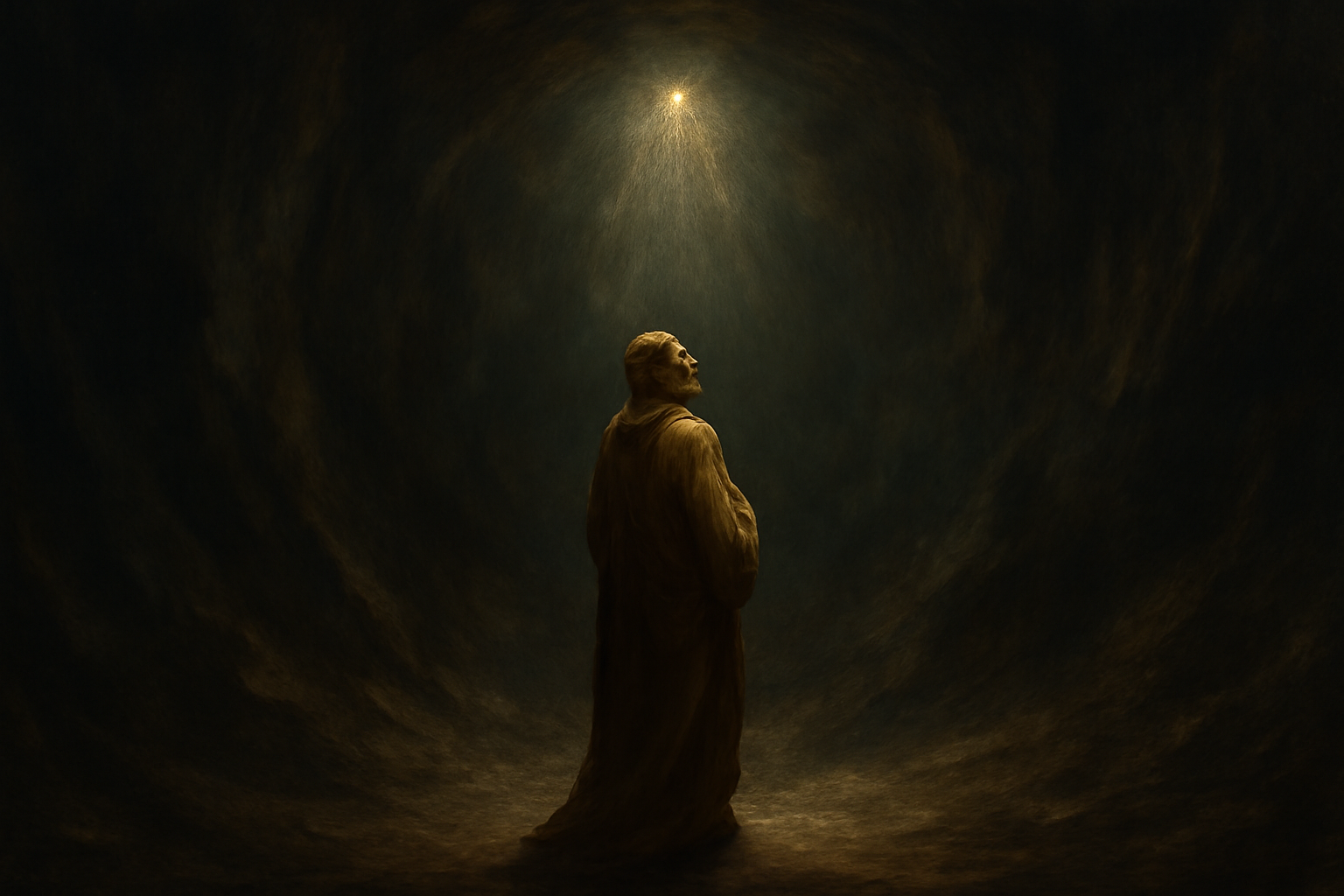
A figure at the lowest point of Hell looking upward toward distant stars — the spiritual turning point in Dante's Inferno

Most readers approach Dante Alighieri’s Inferno as a medieval compendium of torment—a lurid ledger of suffering inflicted on the damned. This reading fundamentally distorts the poem’s inner logic. The Inferno functions not as Dante’s endpoint but as his clinical assessment. Like any rigorous diagnosis, it brings pain before healing begins. The spiritual architecture of Dante’s … Read more

Contrapasso: How Every Punishment in Dante’s Inferno Fits the Sin

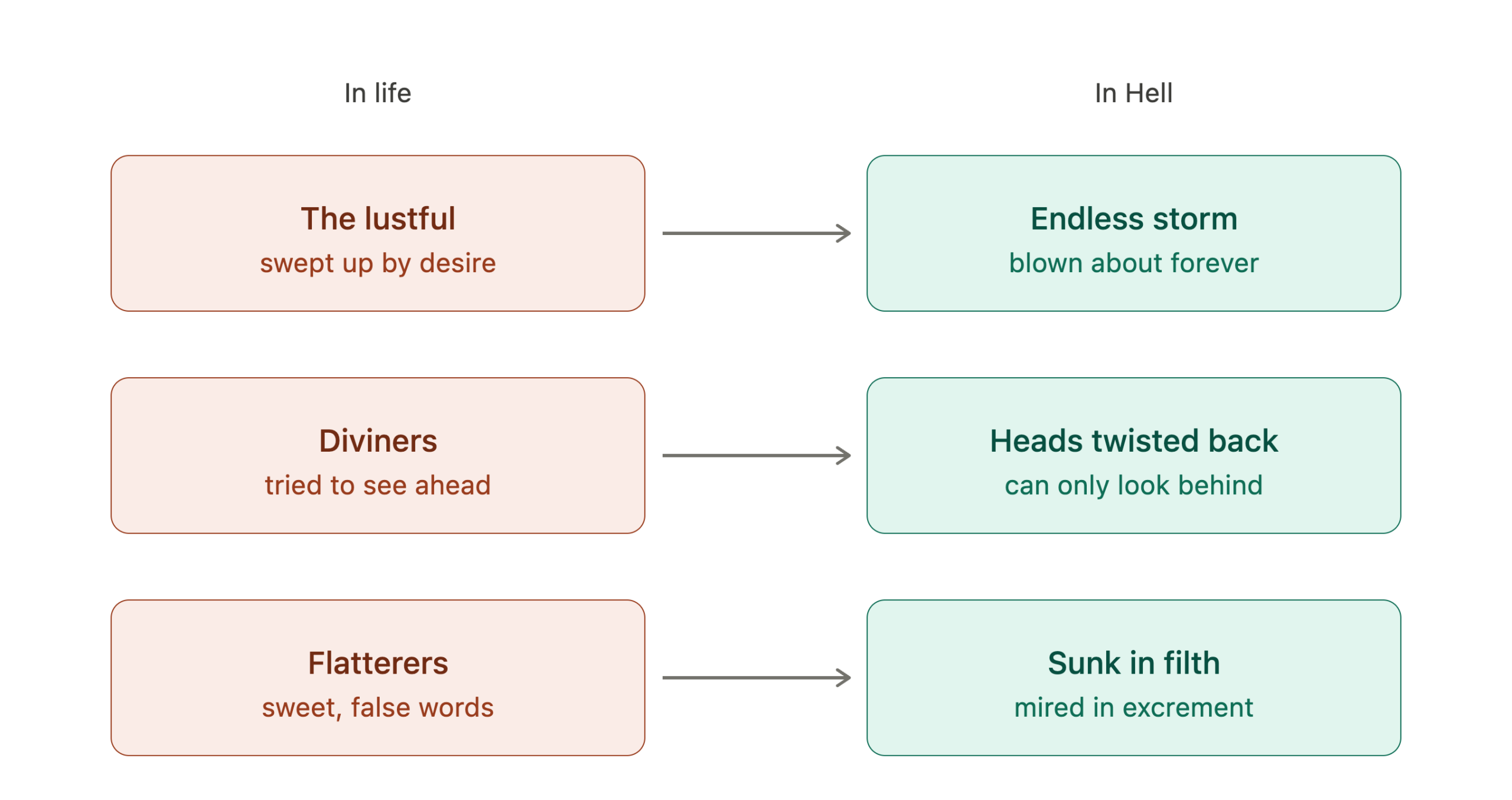
Diagram showing three examples of contrapasso: the lustful blown by storms, diviners with heads twisted back, flatterers sunk in filth

A yellowed facsimile of Dante’s original manuscript sits behind museum glass in Florence, its medieval ink faded but still legible where his hand moved across vellum centuries ago. What strikes you, standing before it, is not the poetry’s beauty but its specificity—the obsessive precision with which Dante mapped each circle, each torment, each sinner’s eternal … Read more

Satan in Dante’s Inferno: The Frozen Ninth Circle and the Three-Faced Devil

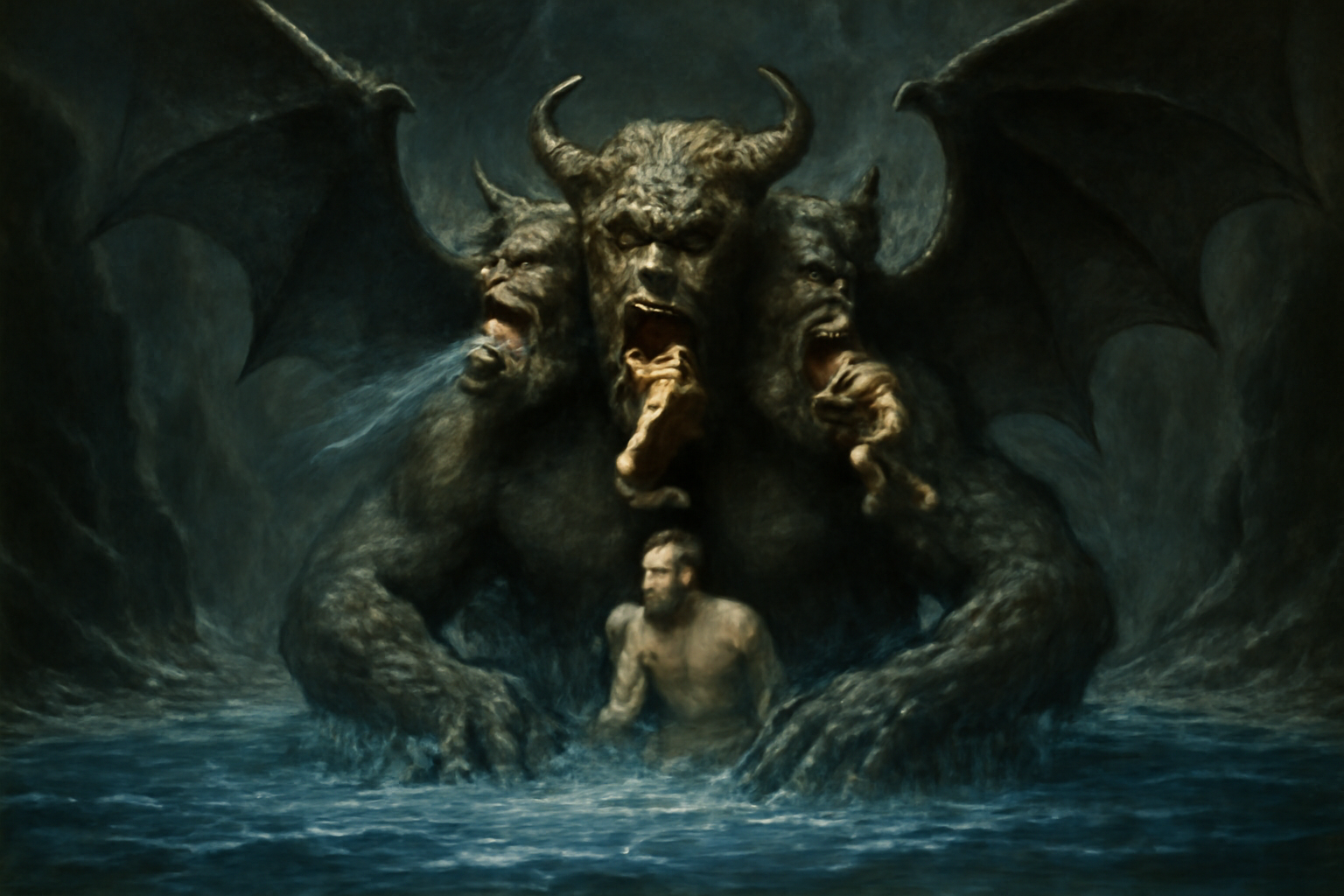
Satan in Dante's Inferno: The Frozen Ninth Circle and the Three-Faced Devil

When most people imagine Hell, they picture flames. Sulfurous pits. Demons with pitchforks. Fire, fire, everywhere. Dante Alighieri had a radically different vision. In his epic poem The Divine Comedy, the deepest, most terrible circle of Hell is not blazing—it is frozen solid. Cocytus, the ninth circle, is a lake of ice. And the further … Read more

A Beginner’s Guide to Dante’s Inferno: The Full Plot Summary (Canto by Canto)

A Beginner's Guide to Dante's Inferno: The Full Plot Summary (Canto by Canto)

Dante’s Inferno is one of the most influential works in Western literature. It’s the first part of a three-part epic called the Divine Comedy. Written in the early 1300s by Italian poet Dante Alighieri, it remains surprisingly relevant and gripping today. The poem blends theology, politics, and personal emotion into a single narrative. Think of … Read more

“Abandon All Hope, Ye Who Enter Here”: The Meaning Behind Hell’s Most Famous Inscription

"Abandon All Hope, Ye Who Enter Here": The Meaning Behind Hell's Most Famous Inscription

The full inscription above the Gate of Hell in Dante’s Inferno (Canto III) reads, in the most famous English translation: “Abandon all hope, ye who enter here.” It’s the last line of a nine-line warning, spoken by the gate itself, declaring that Hell is eternal and that anyone who enters has lost any possibility of … Read more

Chapter 16: The Crystal Oasis and a Cactus Who Smiled

Ollie and Biscuit — Chapter 16, scene 1

The gods of any mythology aren’t arbitrary — they’re a direct map of what a society considered most powerful, most unpredictable, and most worth appeasing. Spend enough time with any pantheon and you’ll understand more about the culture that created it than almost any other source. What strikes me every time I dig into a … Read more

Chapter 15: Captain Cactus Hears a Song

Ollie and Biscuit — Chapter 15, scene 1

Legendary races and peoples — whether in ancient texts or richly constructed fantasy worlds — always reflect something real about how the culture that created them thought about difference, hierarchy, and belonging. That’s what makes studying them so rewarding: you’re always reading two things at once. In Chapter 15, as our narrator and Captain Cactus … Read more