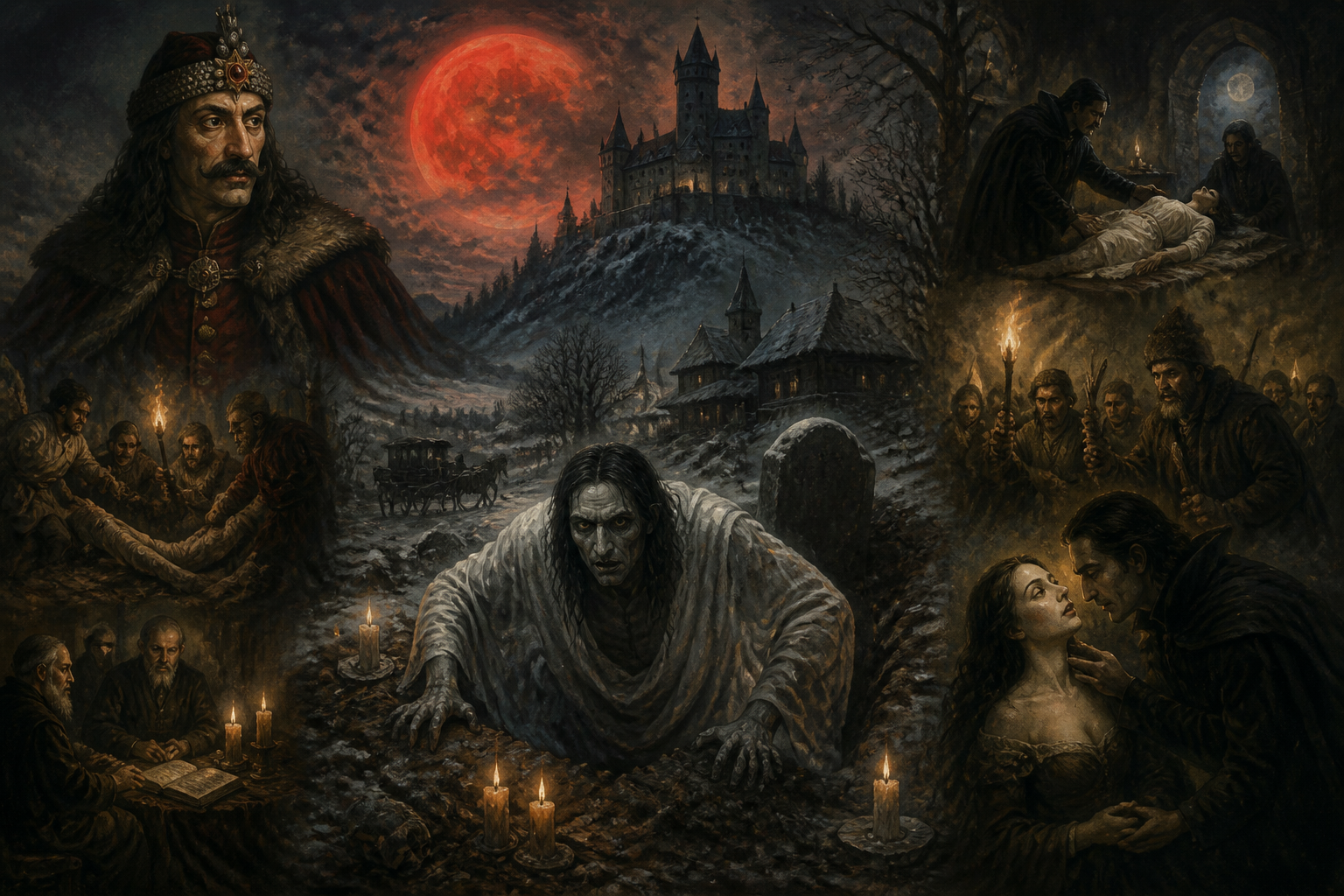
I have spent over twenty-five years combing through parish burial records, military reports, and medieval chronicles, and I can tell you the real history of vampires has almost nothing to do with capes or castles. It begins in muddy village graveyards, not gothic manors. Long before Bram Stoker gave us a suave Transylvanian count, the vampire was a bloated, ruddy-faced corpse that neighbors dug up in a panic, convinced it had been sneaking home at night to strangle its own children. That folk creature came first, and people genuinely feared it.
The Two Vampires: Folk Revenant vs. Fictional Seducer
Anyone tracing the history of vampires has to separate two very different creatures wearing the same name. The first is the folk vampire: a recently deceased peasant, often a suicide, a suspected witch, or someone who died suddenly and “unclean.” Villagers believed this corpse swelled up underground, turned red or purple, and crept out at night to drain the life from family members and livestock.
The second creature is the fictional vampire born in nineteenth-century literature. He is pale, aristocratic, charming, and sexually magnetic. He wears fine clothes and speaks in drawing rooms rather than skulking through barns.
These two figures share a name and a thirst for blood, but little else. The folk revenant was a bloated farmer’s corpse dragged from a shallow grave. The literary vampire was a novelist’s invention, built to titillate Victorian readers. Understanding that gap is the key to understanding everything that follows.
Ancient Precursors: Demons Before the Vampire
No true vampire, in the corpse-that-returns sense, appears in the ancient world. However, its demonic ancestors show up remarkably early. Mesopotamian texts describe Lilitu, a night-demon associated with storms, sterility, and the deaths of infants. Over centuries, this figure fed into the Jewish Lilith tradition, a child-endangering spirit named in the Alphabet of Ben Sira and earlier hinted at in Isaiah 34:14.
Greek folklore offers its own blood-drinkers. The lamia was said to steal and devour children, later reimagined by some writers as a seducer who drained young men. The empusa, a shape-shifting attendant of Hecate, appears in Aristophanes and later demonology as a similarly predatory night-spirit.
Roman belief contributed the strix, a screech-owl-like creature that fed on the blood of sleeping infants. Ovid describes the striges in the Fasti, and Pliny the Elder references the bird-omen tradition behind them. None of these figures were reanimated corpses. They were demons and monstrous spirits, and they set the emotional groundwork, the fear of nighttime blood loss, that the medieval revenant would later inherit.
The Medieval Revenant: Corpses That Would Not Stay Down
The direct ancestor of the vampire proper shows up in twelfth-century England, oddly enough, not in the Balkans. The chronicler William of Newburgh, writing around 1198 in his Historia rerum Anglicarum, recorded several accounts of corpses rising from their graves to torment the living. In one case from Buckinghamshire, a dead man returned nightly to his wife’s bed until local clergy intervened.
Walter Map, writing his De Nugis Curialium around the same period, described similar wandering dead in the Welsh Marches. These were not blood-drinkers in the strict sense. They spread disease, suffocated sleepers, and generally brought misfortune wherever they wandered.
That said, the pattern is unmistakable. A body improperly settled in death, a community gripped by illness or bad luck, and a decision to dig up the grave and mutilate the corpse. This exact sequence would repeat itself across Eastern Europe five centuries later, almost beat for beat.
The Slavic Heartland: Where the Vampire Crystallised
The vampire as we now recognize it took shape specifically in Slavic and Balkan folk belief. Terms like upir or upyr in Old Russian and Ukrainian sources, vampir in Serbian, strigoi in Romanian, and vrykolakas in Greek all describe overlapping versions of the same anxiety: the dead refusing to stay dead.
Certain deaths marked a person as a likely candidate for vampirism. Suicide was one. Excommunication was another. Dying suddenly, being born with a caul, or even being bitten by a dog were all considered risk factors in various regional traditions.
Burial customs across this region reflect genuine, practical fear. Families placed stones or sickles over graves, buried suspect corpses face-down, or drove stakes through them before burial rather than after. I go into far more depth on these regional variations in my piece on Slavic and Eastern European vampire folklore, since the customs differ meaningfully from village to village.
What matters here is timing. By the early 1700s, this folklore was about to collide with something new: the Habsburg bureaucracy. That collision is what turned a regional peasant belief into a European sensation.
The 18th-Century Vampire Panics That Changed Everything
If I had to name the single hinge-point in the entire history of vampires, it would be the Austrian-administered Serbian frontier between 1725 and 1732. This is when the word “vampire” entered Western European languages, and it happened because of official government paperwork, not folklore collecting.
Petar Blagojević and the Village of Kisiljevo, 1725
In the Serbian village of Kisiljevo, a farmer named Petar Blagojević, sometimes recorded as Peter Plogojowitz, died and was buried in 1725. Within weeks, nine villagers fell ill and died, each reportedly claiming Blagojević had visited and choked them in their sleep.
Terrified locals demanded an exhumation. An Austrian imperial provisor named Frombald was pressured into attending, along with an Orthodox priest. Their report describes a corpse with fresh skin, new nail and hair growth, and blood in the mouth. Villagers staked the body on the spot. Frombald’s written account, filed with imperial authorities, is one of the earliest official vampire documents in European history.
Arnold Paole and Medveđa, 1726 to 1732
An even more consequential case unfolded in the village of Medveđa. A former soldier named Arnold Paole, sometimes written Arnaut Pavle, died around 1726 after claiming he had once been tormented by a vampire himself. Soon after his death, villagers began dying, and rumors spread that Paole had returned.
Locals exhumed him and reportedly found an undecomposed body. In fact, they claimed fresh blood ran from his eyes, nose, and ears. They staked him, and, according to belief at the time, four of his supposed victims as well.
The story didn’t end there. Between 1731 and 1732, a fresh wave of deaths struck Medveđa, and officials suspected Paole’s old cattle-eating habits had passed vampirism to livestock, and from livestock to the people who ate them. This time, the Austrian military took the matter seriously enough to send actual physicians.
The Visum et Repertum of 1732
Regimental medical officer Johann Flückinger led a formal investigation, and the resulting document, titled Visum et Repertum, meaning “seen and discovered,” was filed in January 1732. It describes multiple exhumed bodies in clinical, almost bored bureaucratic language, corpses with “florid” skin, fresh blood, and no visible decay.
Copies of this report reached Vienna and quickly spread across German and French newspapers. As a result, “vampire,” adapted directly from the Serbian vampir, entered common Western European usage almost overnight. Within a year or two, the word appeared in English print as well. A regional peasant belief had become an international news story, verified, or so it seemed, by official military medicine.
The Enlightenment Strikes Back
The vampire panics arrived at exactly the wrong moment for wide, unquestioned acceptance. Enlightenment Europe loved a mystery, but it loved debunking one even more. The French Benedictine scholar Dom Augustin Calmet gathered the Serbian cases, along with older Central European reports, into his 1746 treatise on the apparitions of spirits and vampires.
Calmet himself was cautious rather than credulous. He presented the evidence without fully endorsing supernatural explanations, which frustrated readers hoping for a firm verdict either way.
Voltaire, on the other hand, mocked the whole affair in his Philosophical Dictionary, joking that real vampires were tax collectors and courtiers who drained the living without ever leaving their graves. His sarcasm reflected a growing elite skepticism toward peasant superstition.
The more consequential skeptic was Gerard van Swieten, personal physician to Empress Maria Theresa of Austria. Van Swieten investigated later vampire scares and concluded the exhumations were driven by ignorance and mass hysteria rather than genuine undeath. His reports helped convince Maria Theresa to ban further exhumations and staking across her territories by the 1750s, effectively ending the official panics.
What the Corpses Actually Showed
Modern forensic understanding explains what those frightened villagers actually saw. Decomposition often causes bloating from internal gases, which can push blood up into the mouth and nose. Skin can shrink and pull back, making nails and hair appear to have grown. Cool, wet soil can also slow decay far longer than people expected.
None of this was mysterious to trained pathologists. To an anxious eighteenth-century village, however, it looked exactly like a corpse feeding on the living. That gap between forensic reality and folk interpretation is really the whole story.
From Peasant Grave to Gothic Novel
Once the panics faded from newspapers, the vampire migrated into fiction, and it transformed almost completely. John Polidori’s 1819 story The Vampyre introduced Lord Ruthven, a cold, aristocratic seducer clearly modeled on Lord Byron. This is the true birth of the fictional vampire template.
Varney the Vampire, a sprawling penny dreadful serialized through the 1840s, gave English readers a sympathetic, tragic bloodsucker and introduced tropes like fangs and hypnotic power. Sheridan Le Fanu’s Carmilla followed in 1872, centering a female vampire with unmistakable erotic undertones aimed at a young female victim.
Bram Stoker’s Dracula arrived in 1897 and fixed the template permanently. Stoker borrowed real Eastern European geography and folklore fragments, then fused them with Gothic romance conventions. The result became the template every later vampire story, film, and novel would react to, imitate, or subvert.
Vampires Around the World
Everything above traces the specific European lineage that gave us the word “vampire.” However, blood-drinking revenants and night-demons appear independently across nearly every world culture, often with no direct connection to the Slavic tradition at all. I have built out dedicated regional guides for readers who want to go deeper into these traditions.
- Slavic and Eastern European vampire folklore, the direct source of the modern vampire word and its village burial customs
- the vampires of Southeast Asia, including floating-head creatures and other regional blood-feeders
- the jiangshi of China and the vetala of India, hopping corpses and corpse-inhabiting spirits with their own ancient literature
- vampire beliefs across Africa and the Caribbean, shaped by both indigenous tradition and the trauma of colonial history
After twenty-five years of reading these accounts in their original chronicles, treatises, and military reports, I still find the history of vampires more unsettling than any novel it inspired. The real story is not about capes or castles. It is about frightened villages, grieving families, and the very human need to explain sudden death. That fear, recorded in Latin chronicles and Austrian medical reports alike, is the true origin of every vampire that followed.
About This Article

Written by Elias Blackwood. Elias Blackwood has spent 25 years as an obsessive collector of world mythology and folklore, from Greek and Norse epics to Japanese yokai and West African trickster tales — entirely self-taught, for the love of it. His reading draws on comparative mythology, cultural anthropology, and a personal library of translations most people have never heard of. More about this site.
Verify this against a primary source
Specifics change, and your situation may differ from the one described here. These are the authorities worth checking directly:
- Theoi Project — Greek mythology texts with primary source citations
- Perseus Digital Library — classical texts in the original and in translation
- Encyclopaedia Britannica — edited reference for figures and traditions


