Of all the figures in Greek mythology, few are as simultaneously fascinating and disturbing as the maenads — the ecstatic female followers of Dionysus who appear throughout ancient art, literature, and religious record as women in the grip of divine madness, dancing on mountaintops, tearing animals apart with their bare hands, and immune to pain and fire.
Understanding what maenads actually did — separating the historical ritual practice from the mythological elaboration — is one of the more challenging problems in the study of ancient Greek religion. This guide covers both dimensions: what the ancient sources say about maenad rituals, and what modern scholarship believes actually happened.
The Oreibasia: Mountain Dancing
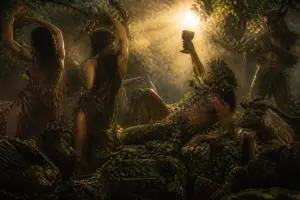
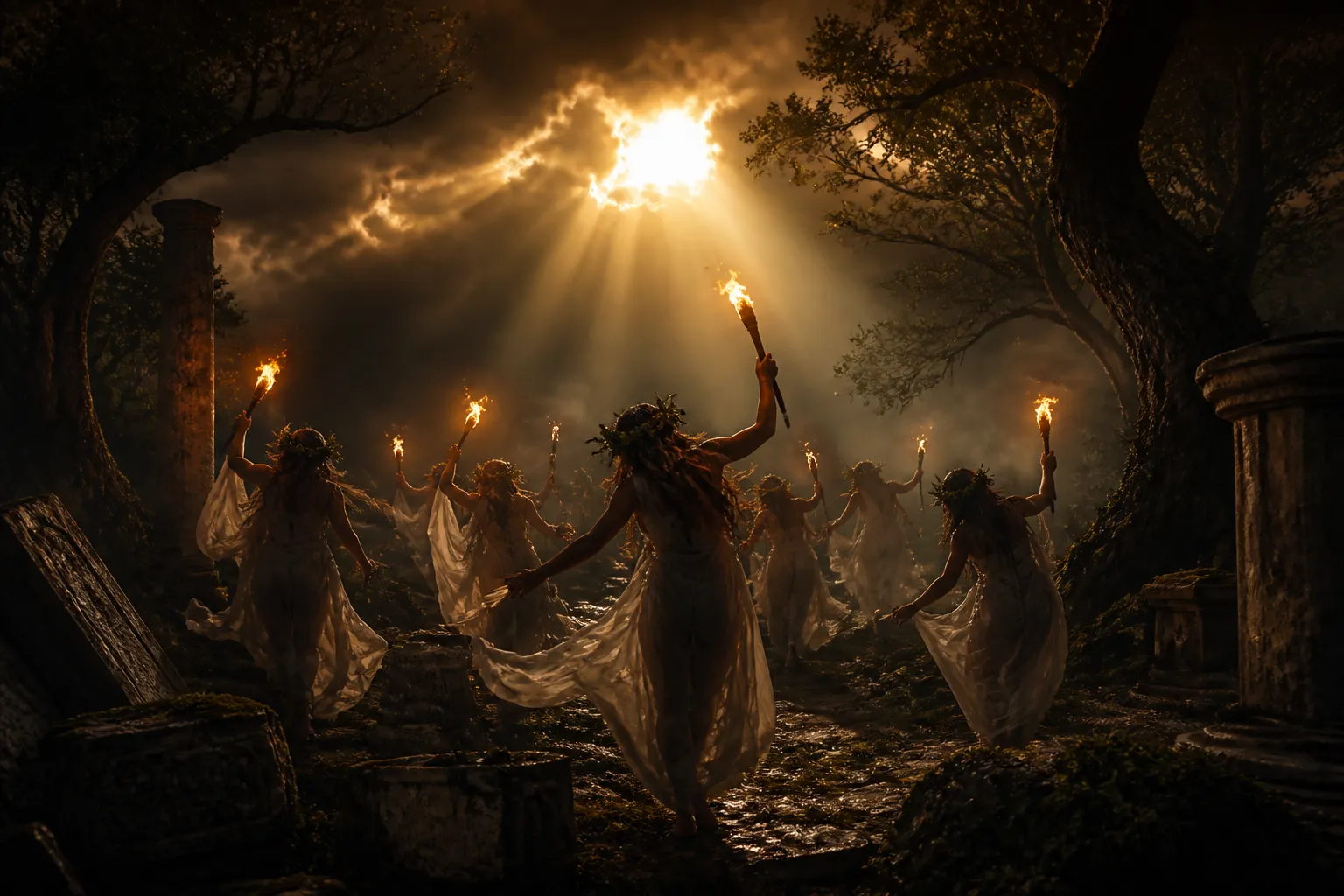
The most characteristic maenad ritual was the oreibasia — literally “mountain roaming” — in which groups of women left their cities and homes to perform rites on a mountain at night, away from the civilised, domestic spaces that ordinarily defined their lives.
Ancient sources describe these rites as involving:
- Nocturnal procession — the women moved by torchlight, which added a dramatic, disorienting quality to the proceedings
- Wild dancing — characterised by violent head-tossing (tinassein), spinning, and movements that ancient observers described as bacchic or ecstatic in quality
- Music — the aulos (a double-reed instrument), drums (tympanon), and cymbals produced the driving, trance-inducing sound that accompanied maenad ritual. The rhythm was hypnotic and insistent.
- The thyrsus — each maenad carried a thyrsus, the staff of Dionysus: a fennel stalk topped with a pinecone and wreathed in ivy. It was a weapon (Dionysus threatens to use it in the Bacchae), a ritual instrument, and a symbol of the god’s power
- Fawn skins (nebrides) — the women wore fawn skins draped over their clothing, connecting them to the wild animals that Dionysus himself could become or command
- Snakes — maenads in ancient art are frequently depicted carrying live snakes, which they wore in their hair or twined around their arms. Snakes were sacred to Dionysus, associated with chthonic power and rebirth.
Sparagmos: The Ritual Tearing
Sparagmos — from the Greek sparassein, to tear — was the ritual act of tearing apart a living animal (and, in myth, sometimes a human being) with bare hands. It is perhaps the single most disturbing element associated with maenad ritual and appears consistently in ancient descriptions of Dionysiac worship.
In myth, the most famous instances of sparagmos are:
- The tearing apart of King Pentheus by his own mother Agave and her sisters on Mount Cithaeron, as described in Euripides’ Bacchae
- The death of Orpheus, torn apart by Thracian maenads in a scene depicted on numerous ancient vases
- The myth of the infant Dionysus himself being torn apart by the Titans — making sparagmos a re-enactment of divine dismemberment
Whether sparagmos actually occurred in historical ritual practice is debated. Some scholars argue that the tearing of animals was a real ritual act, representing the primal encounter with Dionysus as a god of raw, pre-civilised nature. Others argue it was primarily mythological — a symbolic or theatrical representation rather than a literal practice.
What seems likely is that the ritual hunt and killing of animals did occur in some Dionysiac contexts, and that the idea of sparagmos was central to how participants understood and described their experience, even if the most extreme accounts are mythological elaborations.
Omophagia: The Eating of Raw Flesh
Closely linked to sparagmos was omophagia — the eating of raw flesh, typically from the animal just killed. This was one of the most transgressive aspects of Dionysiac ritual, since cooked meat was the norm in Greek sacrificial and dining practice, and raw animal consumption was associated with savagery and the pre-human world.
Eating raw flesh in a Dionysiac context had a specific ritual logic: by consuming the animal raw, the worshipper consumed the raw life-force directly, before fire (a civilising element) could transform it. It was also associated with the idea of eating the god himself — Dionysus was sometimes identified with the bull or the goat that was sacrificed, so consuming the raw sacrifice was, symbolically, communion with the divine.
Wine, Ecstasy, and the Altered State
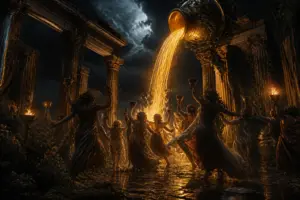
Wine was, naturally, central to maenad ritual — both as Dionysus’s gift and as the primary vehicle for achieving the altered state that was the goal of the rites. Ancient writers describe the god himself as providing the wine miraculously: rivers of wine, milk, and honey were said to spring from the earth at the maenads’ touch during their mountain rites.
The goal of the ritual was enthousiasmos — being filled with the god, entered by the divine presence. This state was characterised not just by intoxication but by a complete transformation of the self: the maenad ceased to be herself and became a vessel for Dionysus. Ancient accounts consistently describe this state as involving:
- Superhuman physical capacity — women performing feats of strength impossible in normal circumstances
- Invulnerability to pain, fire, and physical injury
- Prophetic speech
- Inability to be harmed by weapons (the soldiers sent to capture the maenads in the Bacchae report that their weapons have no effect)
Historical Evidence for Maenad Ritual
Several lines of historical evidence confirm that something like maenad ritual actually took place in ancient Greece, rather than existing purely in mythology:
- Inscriptions — a number of Greek inscriptions record women’s groups (thiasoi) dedicated to Dionysus performing ritual activities, including nocturnal rites
- The Thyiades of Athens and Delphi — Plutarch explicitly describes biennial nocturnal rites performed on Mount Parnassus by women from Athens who joined Delphic women in oreibasia
- Vase paintings — hundreds of Attic red-figure and black-figure vases depict maenads in ritual contexts: dancing, carrying thyrsi and snakes, tearing animals, making offerings
- The Dionysia festivals — the major state festivals of Athens were explicitly connected to Dionysus, and their theatrical performances emerged from Dionysiac ritual contexts
The Maenads as a Symbol of Release
Beyond the specific ritual acts, the maenads represent something central to the Greek understanding of Dionysus: the necessity of periodic release from the constraints of civilised life. The women who participated in maenad rites were, in normal life, confined to the domestic sphere, subject to male authority, and excluded from most forms of public life.
The maenad ritual temporarily inverted all of this. For the duration of the rites, these women were free, wild, powerful, and in direct communion with a god. They were outside the city, outside the household, outside normal time. They were dangerous — as the myth of Pentheus demonstrates — and they knew it.
This is why the rituals frightened and fascinated Greeks in equal measure. The maenad was not simply a worshipper; she was a demonstration that Dionysus could not be refused, and that the forces he represented — ecstasy, the irrational, the dissolution of order — were always present beneath the surface of even the most ordered society.
About This Article

Written by Elias Blackwood. Elias Blackwood has spent 25 years as an obsessive collector of world mythology and folklore, from Greek and Norse epics to Japanese yokai and West African trickster tales — entirely self-taught, for the love of it. His reading draws on comparative mythology, cultural anthropology, and a personal library of translations most people have never heard of. More about this site.
Verify this against a primary source
Specifics change, and your situation may differ from the one described here. These are the authorities worth checking directly:
- Theoi Project — Greek mythology texts with primary source citations
- Perseus Digital Library — classical texts in the original and in translation
- Encyclopaedia Britannica — edited reference for figures and traditions