The Persephone myth seasons cycle stands at the heart of ancient Greek religious thought. It explained why winter comes, why spring returns, and why the earth itself grieves and rejoices. At its core lies a story of abduction, divine compromise, and a daughter who becomes queen of the dead—yet returns each year to bring the world back to life. This narrative, preserved in the Homeric Hymn to Demeter, was no mere fairy tale. It anchored one of the ancient world’s most sacred religious practices and shaped how Greeks understood loss, renewal, and the rhythms of time itself.
Who Persephone Was Before the Darkness
Before her name became synonymous with winter and the underworld, Persephone was simply Kore—”the girl.” She was the daughter of Demeter, goddess of grain, harvest, and all growing things, and Zeus, king of the gods. In classical sources, Persephone exists in a state of perpetual youth and bloom.
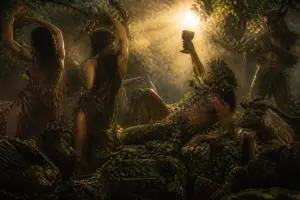
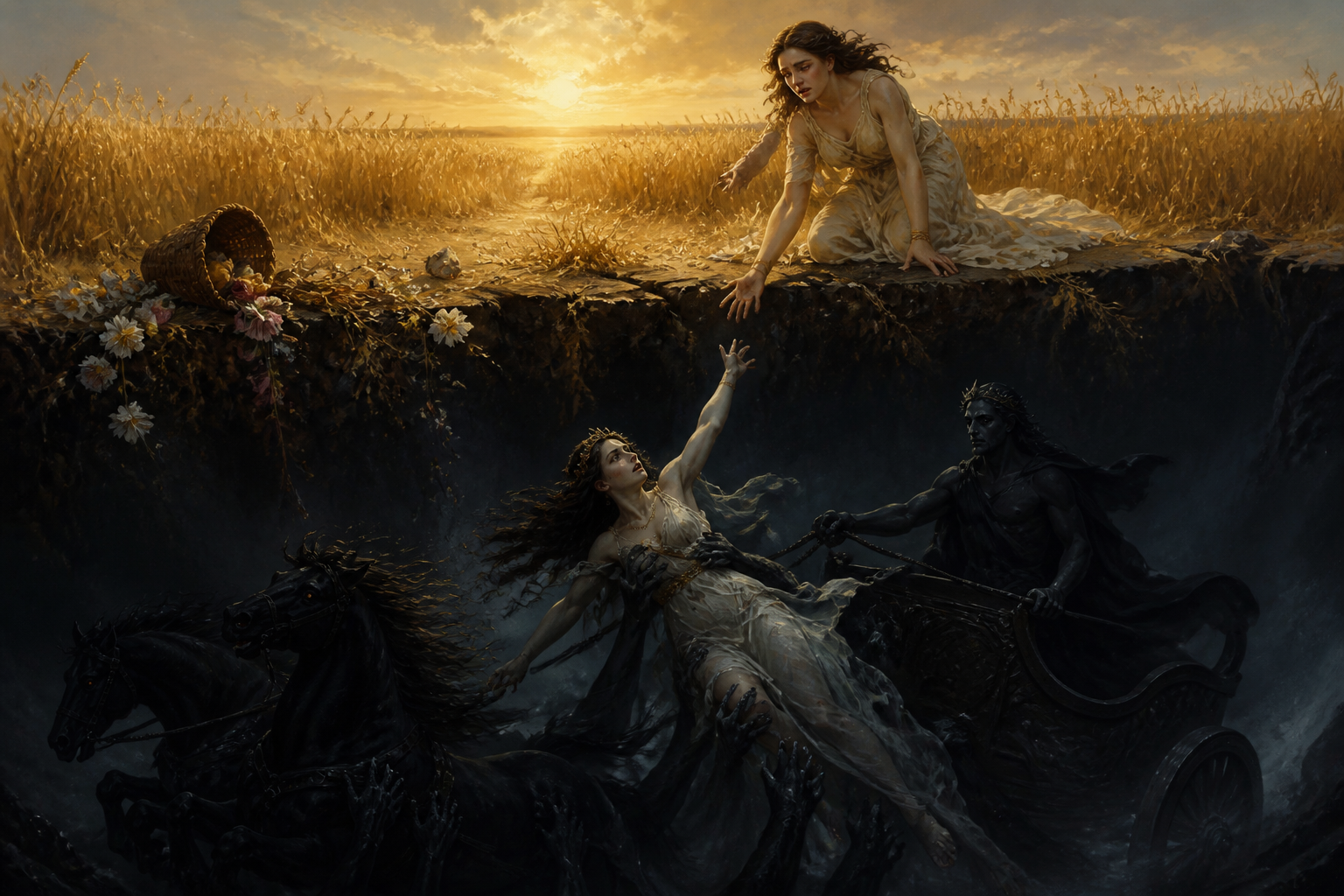
The Homeric Hymn describes her gathering flowers in a meadow with her divine companions. This was not a punishment or servitude. It was the innocent activity of a goddess who had never known confinement, darkness, or adult responsibility. She picked roses, crocuses, and violets—symbols of springtime and beauty.
Yet among the flowers grew something else. In some versions of the myth, Zeus himself—or the earth goddess Gaia at his command—had planted a narcissus flower as a trap. Its bloom was irresistibly beautiful. When Persephone reached down to pluck it, the earth split open. That moment of reaching for beauty became the threshold between her former life and her transformation.
The Abduction: Hades Emerges From Below
Hades, god of the underworld and the dead, did not simply ask permission. His brother Zeus had already granted it. With tacit divine approval, Hades burst from the earth in a chariot drawn by immortal black horses. He seized the young goddess as she reached for the flower.
Persephone screamed. Her voice echoed across sky and sea, calling out to her mother. No one heard her—except Demeter, and Hecate, goddess of boundaries and hidden knowledge. For Demeter, that cry changed everything.
This was not a seduction or a romance dressed up in mythological language. It was violent and non-consensual. Hades carried Persephone down through the chasm into the darkness of his kingdom. She became his queen, ruling over the realm of the dead. In some versions, she would eventually come to care for him, to understand his loneliness, to rule with justice and even mercy. But that transformation came later—after loss, after bargaining, after she had learned to navigate a world of shadows.
Demeter’s Grief and the Search
When Demeter heard her daughter’s cry, she abandoned Olympus. For nine days, she wandered the earth without food, without drink, without rest. She searched everywhere, her grief so profound that she could not eat or sleep.
On the tenth day, still disguised as an old woman, Demeter encountered Helios, the sun god. Helios sees everything from his high vantage point. He revealed the truth: Zeus had permitted Hades to take Persephone. The girl was now queen of the underworld.
Hecate also confirmed what had happened. In fact, these two deities became Persephone’s guardians and witnesses—her links to the world above even in darkness below. Yet knowledge of the truth did not comfort Demeter. It intensified her anguish. Her daughter had not simply vanished. She had been given away.
When the Earth Stops Growing: Demeter’s Curse
Grief transformed Demeter into something else—not comforted, but defiant. She withdrew her blessing from the earth. Specifically, she refused to let seeds sprout, refused to let crops grow, refused to grant the fertility that kept all life alive.
What followed was the first winter. Not merely cold, but barrenness. Animals starved. Humans starved. Entire civilizations faced annihilation from famine. As a result, the gods faced a crisis of their own: without humanity to offer them sacrifices and prayers, the divine order itself weakened.
Zeus realized he had miscalculated. His grant of permission to Hades had seemed minor—one daughter, married off to stabilize the cosmos. Instead, it triggered a catastrophe. The king of gods had to intervene.
This detail matters. Demeter’s grief was not passive mourning. It was economic and theological leverage. She used her power over nature as a bargaining tool. In doing so, she forced even Zeus to negotiate with her. A mother’s love and rage proved stronger than divine hierarchy.
The Compromise: A Year Divided
Zeus sent Hermes to the underworld. His mission: bring Persephone back to her mother. Hades obeyed. However, before releasing Persephone, he offered her pomegranate seeds to eat. She consumed them—sources vary on whether it was four or six seeds, but the number matters less than the act itself.
By eating food of the underworld, Persephone became irrevocably bound to it. She could return to Demeter and the world above. But she could never fully leave the realm of the dead. This was the compromise Zeus brokered, and both parties accepted it.
Each year, Persephone would spend part of her time with her mother on earth. She would spend the rest as Hades’ queen, ruling alongside him in darkness. Neither Demeter nor Hades had fully won. Both had sacrificed something. And Persephone herself existed in a state of permanent liminality—belonging to two worlds, never fully confined to one.
How This Myth Explains the Seasons
The Persephone myth seasons cycle became the ancient Greek explanation for autumn, winter, spring, and summer. When Persephone descended to the underworld, Demeter’s grief returned to the earth. Crops withered. Leaves fell. Warmth vanished. This was winter—the season of separation and barrenness.
When Persephone emerged again, Demeter’s joy became visible in the world. Flowers bloomed. Seeds sprouted. Warmth returned. Spring and summer embodied reunion, growth, and renewal. The cycle would repeat endlessly, built into the fabric of nature itself.
For ancient Greeks, this was not a poetic metaphor. It was literal theology. The seasons existed because two goddesses—mother and daughter—had reached a bargain over loss. Every spring was Persephone’s return. Every winter was Demeter’s sorrow. Agriculture, the foundation of Greek civilization, was held together by this divine family drama.
The Eleusinian Mysteries and Sacred Knowledge
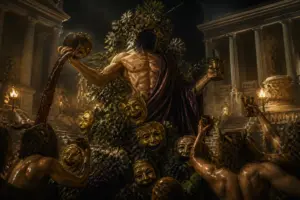
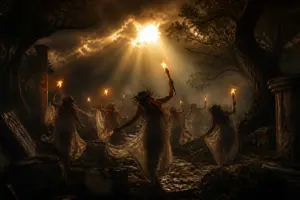
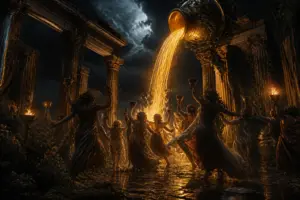
The myth of Persephone was not simply told. It was ritualized. In the town of Eleusis near Athens, the Eleusinian Mysteries—perhaps the most important religious rite in the ancient Greek world—celebrated Demeter and Persephone each year.
Thousands of initiates from across Greece gathered to participate in secret ceremonies. These rites were so sacred that revealing their details was punishable by death. What we know comes from fragments and careful hints left by participants and priests.
The Mysteries promised initiates something extraordinary: a better fate after death, a glimpse of hope beyond the grave. In Hades’ realm, most souls existed as mere shades. But those initiated into the Mysteries of Demeter and Persephone would be blessed, remembered, cared for.
Essentially, the Mysteries offered initiates a relationship with Persephone herself. They honored her journey through darkness. They affirmed that descent into shadow did not mean permanent death—transformation was possible. Renewal was guaranteed. This was Persephone’s own promise, enacted in ritual form.
Why This Ancient Story Still Resonates
Two millennia later, the Persephone myth seasons cycle endures for good reason. It captures something true about loss and renewal that transcends ancient agriculture. Every person experiences descent into darkness—grief, failure, depression, trauma. Every person hopes for return, for spring, for transformation.
Persephone herself became a symbol of this possibility. She did not escape the underworld unchanged. She did not return as the innocent girl who picked flowers. She became queen of the dead, wise in the ways of shadow, capable of ruling with justice over realms of sorrow.
This mythological detail matters profoundly. The myth does not promise that darkness simply vanishes. It promises that things can pass through darkness and still return transformed—stronger, wiser, deeper. Persephone is not rescued. She is reborn.
In a world that often treats grief as weakness or failure, this ancient story offers a radical alternative. It says that loss is real, that darkness is real, that separation tears us apart. Yet it also insists that return is possible. Renewal is not magical thinking. It is the structure of the cosmos itself.
—About This Article

Written by Elias Blackwood. Elias Blackwood has spent 25 years as an obsessive collector of world mythology and folklore, from Greek and Norse epics to Japanese yokai and West African trickster tales — entirely self-taught, for the love of it. His reading draws on comparative mythology, cultural anthropology, and a personal library of translations most people have never heard of. More about this site.
Verify this against a primary source
Specifics change, and your situation may differ from the one described here. These are the authorities worth checking directly:
- Theoi Project — Greek mythology texts with primary source citations
- Perseus Digital Library — classical texts in the original and in translation
- Encyclopaedia Britannica — edited reference for figures and traditions