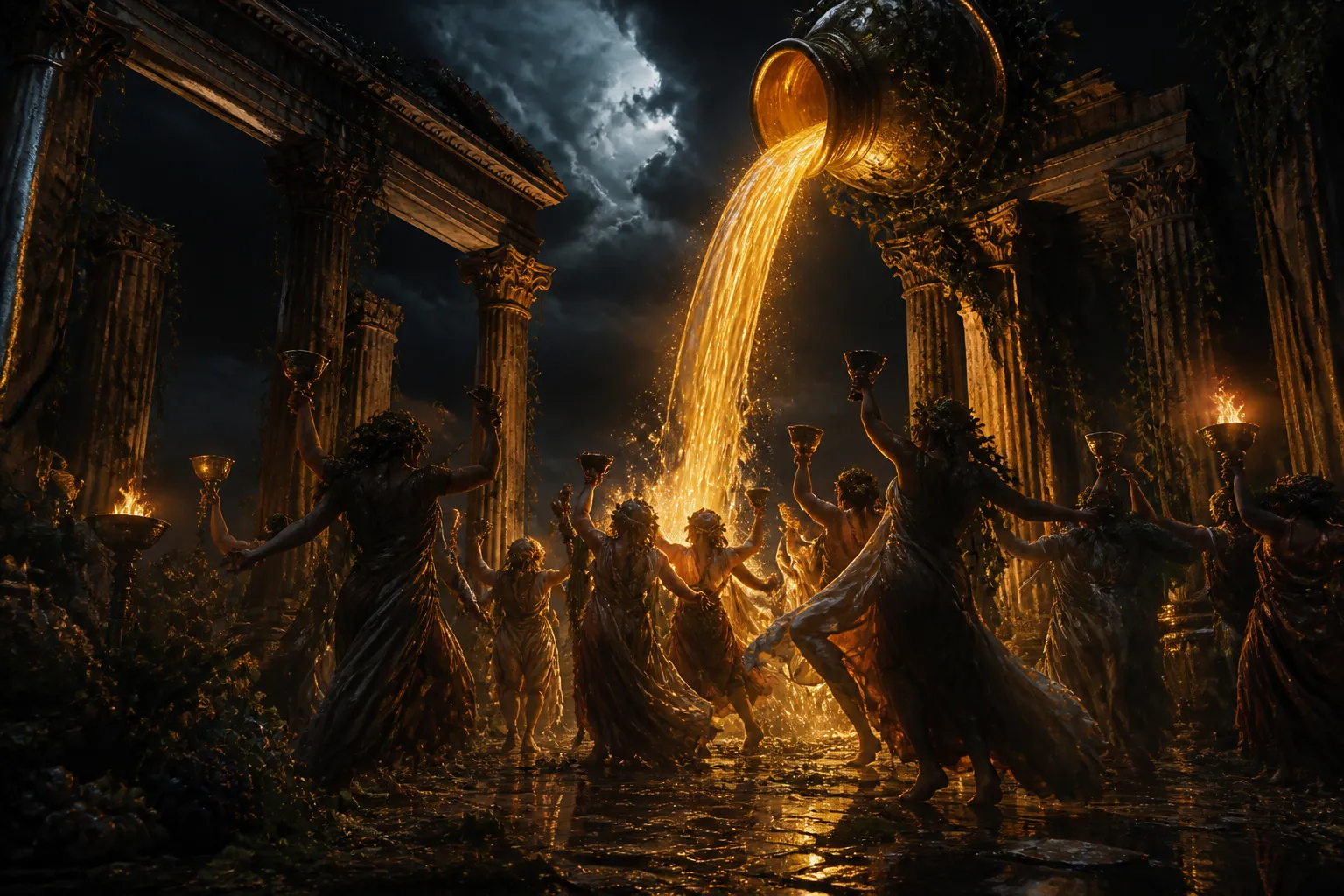
If you have come across the word Dionysian in philosophy, literary criticism, or cultural commentary and found yourself uncertain exactly what it means — you are in good company. It is one of those terms that floats freely across disciplines, carrying different shades of meaning depending on whether you encounter it in Nietzsche, in a theatre review, or in a description of ancient Greek religious practice.
At its core, Dionysian means relating to Dionysus — the ancient Greek god of wine, ecstasy, fertility, theatre, and ritual madness. But the word has taken on a much broader philosophical life, particularly since the nineteenth century, where it became shorthand for a whole cluster of ideas about passion, irrationality, creative frenzy, and the dissolution of boundaries between self and the world.
Understanding what Dionysian really means requires looking at both the god himself and the ideas that have been built around him across two and a half millennia.
Dionysus: The God Behind the Word
Dionysus was one of the most complex and contradictory figures in the Greek pantheon. Unlike the cool rationalism of Apollo or the martial discipline of Athena, Dionysus embodied everything that lay outside civilised order: wine, intoxication, sexual ecstasy, communal frenzy, theatrical illusion, and the blurring of identity.
He was a god of paradoxes. He was simultaneously the bringer of joy and the author of madness. He offered liberation — from social constraints, from the isolation of individual selfhood, from the grinding sobriety of everyday life — and he delivered destruction to those who resisted or denied him. In Euripides’ Bacchae, the most famous dramatic treatment of the god, the price of rejecting Dionysus is catastrophic: the king Pentheus is torn apart by his own mother in a state of divine madness.
His worshippers did not encounter him through prayer and temple sacrifice in the way they might venerate Zeus or Hera. They encountered him through altered states — through wine, through wild dancing on mountaintops, through music that overwhelmed the rational mind, through becoming temporarily something other than themselves. This is the experiential core of what Dionysian came to mean.
The Dionysian in Ancient Greek Religion
In ancient Greece itself, Dionysian (or Dionysiac) referred directly to the religious practices, festivals, and states of being associated with the god’s worship. These included:
- Ecstatic ritual — known as enthousiasmos (literally “having the god within”), the state of being possessed or filled by Dionysus, which manifested as wild dancing, prophetic speech, and apparent invulnerability
- The mysteries — initiatory rites, particularly the Orphic-Dionysiac mysteries, which promised initiates a better fate in the afterlife in exchange for ritual participation and moral transformation
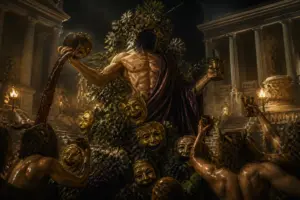
- Theatre — the Dionysia festivals in Athens, at which the great tragedies and comedies were performed, were explicitly Dionysian events, held in the god’s sacred precinct
- Communal dissolution — the temporary erasure of social hierarchies during festival time, when slave and master, man and woman, citizen and foreigner might participate together in a way that everyday Greek society did not permit
The Dionysian in this original sense was not simply about getting drunk (though wine was central). It was about accessing a state of being that lay beyond normal waking consciousness and normal social identity — a state that the Greeks regarded as both sacred and dangerous.
Nietzsche and the Dionysian–Apollonian Dichotomy
The term Dionysian entered modern intellectual life primarily through Friedrich Nietzsche’s first major work, The Birth of Tragedy from the Spirit of Music (1872). It is here that the word acquired its most philosophically influential meaning.
Nietzsche proposed that all great art — and particularly ancient Greek tragedy — was produced by the tension and interplay between two fundamental impulses, which he named after the gods Apollo and Dionysus:
- The Apollonian — representing order, form, reason, individuation, beautiful illusion, the principium individuationis (the principle of individual identity). Apollo was the god of light, prophecy, art, and rational measure. The Apollonian impulse creates beautiful, bounded, intelligible forms.
- The Dionysian — representing chaos, formlessness, the dissolution of individual boundaries, primal unity, ecstatic experience, the will-to-power in its rawest creative-destructive form. The Dionysian impulse breaks down the individual self and plunges the participant into the primal flux of existence.
For Nietzsche, the greatest art emerged not from one impulse alone but from their collision. Greek tragedy was supreme precisely because it combined the Dionysian energy of its choral origins — wild, ecstatic, musically overwhelming — with the Apollonian form of individual character, plot, and dramatic language. The tension between them produced something neither could achieve alone.
Nietzsche was deeply critical of what he called the victory of Socratic rationalism — the gradual triumph of reason, logic, and optimism that he believed had killed the Dionysian spirit in Western culture. His diagnosis of modernity was essentially that it had become too Apollonian: too rational, too ordered, too comfortable, and therefore spiritually impoverished.
In this Nietzschean framework, to describe something as Dionysian is to say it taps into something pre-rational, overwhelming, and dissolving of individual boundaries — whether in art, music, sexuality, intoxication, or collective experience.
What Dionysian Means in Practice
Outside of academic philosophy, Dionysian is used to describe a wide range of experiences and phenomena that share the same core quality: the breakdown of rational control and the submission of the individual self to something larger, more primal, and more intense.
You might encounter it describing:
- Music — particularly music that overwhelms the listener rather than engaging them intellectually. Heavy rock concerts, certain types of classical music (Wagner was Nietzsche’s model for Dionysian art), electronic dance music that produces collective trance states
- Art — expressionist, surrealist, or abstract work that prioritises raw emotional force over beauty and formal structure
- Celebrations and festivals — events where normal social rules are suspended, identities blur, and collective ecstasy is the goal. Carnival, Mardi Gras, and ancient bacchanalia all qualify
- Sexual experience — particularly experiences that dissolve the boundary between self and other
- Intoxication — wine, naturally, but also any substance-induced alteration of consciousness that strips away the rational, controlled self
Dionysus as Patron of Excess and Addiction
The connection between Dionysus and what we might today call addiction or compulsive excess is not accidental. He was sometimes described by ancient writers as the god who offers both liberation and enslavement — the same cup that brings ecstasy and communion also brings dependence and ruin.
Modern interpreters have drawn on this ambivalence to frame Dionysus as the mythological patron not just of wine but of all forms of compulsive pleasure-seeking — the archetype of the god who promises transcendence and sometimes delivers it, but always at a cost. The mythology consistently shows that what Dionysus gives can never be fully controlled: the gift of wine is the gift of both joy and madness, in proportions that the recipient cannot always determine.
Dionysian Frenzy: The State of Ecstatic Possession
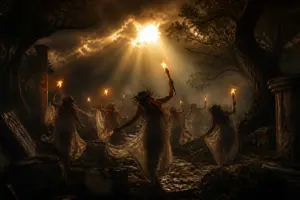
Dionysian frenzy refers specifically to the state of ecstatic, god-possessed madness experienced by the god’s worshippers — particularly the maenads, the female devotees who followed Dionysus on his mythological processions and in historical ritual practice.
Ancient sources describe this state as one of complete ego dissolution: the maenad in the grip of Dionysian frenzy was no longer herself. She was the god, or the god was in her. She was reported to have superhuman strength, to feel no pain, and to perform acts — including the ritual tearing apart of animals (sparagmos) and the consumption of raw flesh (omophagia) — that would be unthinkable in her normal waking state.
Whether these accounts reflect literal historical practice or mythological elaboration remains debated among scholars. What is certain is that the concept of Dionysian frenzy was central to how the Greeks understood the god’s power: he did not merely intoxicate; he possessed.
Summary: What Dionysian Means
To describe something as Dionysian is to place it in relationship with one of the most enduring and philosophically rich concepts in Western thought. Whether you are encountering the word in a discussion of Nietzsche, a review of a music festival, a description of ancient ritual, or a study of addiction and ecstasy, the core meaning remains consistent:
- Relating to Dionysus, the Greek god of wine, ecstasy, theatre, and ritual madness
- Characterised by the dissolution of individual boundaries in favour of collective or primal experience
- Representing the passionate, irrational, and ecstatic pole of human experience — as opposed to the ordered, rational, and formally beautiful (Apollonian)
- Associated with states of altered consciousness, creative frenzy, intoxication, and the temporary suspension of normal social and psychological constraints
It is a word that carries millennia of thought about what lies beyond reason — and why human beings have always been drawn there.
About This Article

Written by Elias Blackwood. Elias Blackwood has spent 25 years as an obsessive collector of world mythology and folklore, from Greek and Norse epics to Japanese yokai and West African trickster tales — entirely self-taught, for the love of it. His reading draws on comparative mythology, cultural anthropology, and a personal library of translations most people have never heard of. More about this site.
Verify this against a primary source
Specifics change, and your situation may differ from the one described here. These are the authorities worth checking directly:
- Theoi Project — Greek mythology texts with primary source citations
- Perseus Digital Library — classical texts in the original and in translation
- Encyclopaedia Britannica — edited reference for figures and traditions