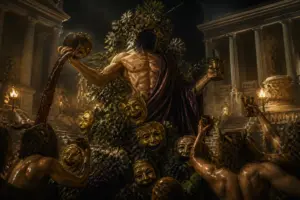

Among the gods of the Greek pantheon, Dionysus had one of the richest relationships with the plant world. While Zeus commanded thunder and Poseidon ruled the sea, Dionysus’s power was expressed through growing things — through the vine, the ivy, the pine, the fig — the fertile, intoxicating, and sometimes dangerous bounty of the earth.
Understanding the plants and flowers associated with Dionysus opens a window into how the ancient Greeks understood his nature: as a god of growth, intoxication, ecstasy, and the wild fertility that underlies civilised life.
The Grapevine: The Most Sacred Plant of Dionysus
The grapevine (ampelos) was Dionysus’s primary plant symbol, inseparable from his identity and his gift to humanity. According to Greek mythology, Dionysus was the god who taught mortals how to cultivate the vine and make wine — a gift that could elevate human life toward the divine but also drag it toward ruin.
In art, Dionysus is almost always depicted in association with grapes and vines. Grape clusters hang from his thyrsus staff, they drape his clothing, they surround him in procession. On ancient vase paintings, the drinking cup (kantharos) he carries is frequently paired with grapevines climbing around the vessel’s handles.
The myth of Ampelos — “Vine” in Greek — tells of a young satyr beloved by Dionysus who was killed by a bull and transformed into the first grapevine by the grieving god. The wine made from the vine was thus not just a gift; it was the sublimated life-force of a creature Dionysus loved, transformed into something that could be shared across time and distance.
In religious practice, grapevines were sacred to Dionysus and decorated his temples and precincts. The harvesting of grapes and the production of wine were religious acts — the Anthesteria festival centred on the opening of the new wine — and the intoxicating quality of wine was understood not as mere chemistry but as the god’s presence made drinkable.
Dionysus Depicted: The Rider on the Leopard
Before looking at other plants, it is worth pausing on one of the most striking images of Dionysus in ancient art: the god riding a leopard (or panther), typically wreathed in ivy and vine leaves, often carrying his kantharos or thyrsus.
This image appears on Attic vase paintings, Hellenistic mosaics (including the famous Pella mosaic from Macedonia, circa 300 BCE), and Roman floor mosaics. The leopard was the primary animal sacred to Dionysus — wild, beautiful, and dangerous, it embodied the same paradox as the god himself: exotic, untamed, capable of both beauty and violence.
The image of Dionysus on the leopard’s back combined his botanical and animal symbols: a god crowned with vines and ivy, carried by a wild predator, moving through a world that is simultaneously lush with plant life and edged with danger. It is one of the most complete visual representations of what Dionysus actually meant in ancient Greek religious imagination.
Ivy: The Sacred Vine That Never Fades
After the grapevine, ivy (kissos) was the plant most closely associated with Dionysus. It appeared on his thyrsus staff (wound around the fennel stalk alongside the pinecone tip), as a crown on his head, and as garlands worn by his followers.
Why ivy? Several reasons converged to make it sacred:
- Evergreen permanence — ivy remains green year-round, unlike the grapevine which is bare in winter. Ivy thus represented the eternal, undying aspect of Dionysus — the god who was dismembered and reborn, who descends to Hades and returns. Where the vine sleeps, ivy persists.
- Climbing growth — ivy clings to and climbs over other structures, both supporting and eventually overwhelming them. This parasitic-yet-decorative quality mirrored Dionysus’s relationship to civilised order.
- Medicinal properties — ancient Greeks believed that ivy could counteract the effects of wine. This led to the practice of placing ivy crowns on heavy drinkers and decorating wine vessels with ivy, in the hope of moderating intoxication. That the god’s remedy and the god’s gift were botanically paired was understood as a characteristic Dionysian paradox.
- Mythological origin — one myth holds that ivy sprang up around the infant Dionysus’s cradle to protect him from the flames when Semele’s palace burned. Ivy was thus his protector from birth.
The Pinecone: Fertility and the Thyrsus
The top of Dionysus’s thyrsus staff was crowned with a pinecone — a detail that seems curious until you understand what the pinecone represented in the ancient world. Pine cones were symbols of fertility and fecundity: their tight, seed-packed scales were visually associated with the generative potential packed within a single structure, ready to burst forth given the right conditions.
The pine tree itself was also sacred to Dionysus. One of the myths of King Pentheus describes him climbing a pine tree to spy on the maenads, before Dionysus causes the maenads to tear the tree (and Pentheus) apart. The pine forest was the maenad’s wild domain.
The Fig: The Earthy, Fertile Counterpart
The fig (sykon) was less prominently associated with Dionysus than the grapevine or ivy, but it appears in several mythological and cult contexts. Like the grapevine, the fig was cultivated — a product of human agriculture — but it was also considered one of the oldest and most fundamental foods, associated with the very earliest stages of human civilisation.
In some versions of the myth, Dionysus taught mortals not only viticulture but also fig cultivation, making him a double patron of the two most important fruits of Mediterranean agriculture. The fig’s luscious sweetness and its association with sexuality (the word sykon had sexual double meanings in Greek comedy) fitted the Dionysiac sphere of bodily pleasure and fertile excess.
What Flower Represents Dionysus?
The question of what flower specifically represents Dionysus is more complex than the plant question, because the god’s primary botanical associations were with climbing vines and cultivated plants rather than with flowers in the strict sense. However, several flowers do appear in Dionysiac contexts:
Is There a Single “Wildflower of Dionysus”?
Searchers sometimes ask about “the wildflower of Dionysus,” as though ancient sources pointed to one specific bloom. They do not — no single wildflower carried that exclusive title in Greek or Roman tradition. Dionysus’s floral associations were plural and shifting, as the rose, violet, and narcissus below each show in different Dionysiac contexts, and none of them was cultivated for the god the way the grapevine and ivy were. If there is a meaning behind calling any of them Dionysus’s wildflower, it is this: his power showed up in things that grew untamed, on hillsides and roadside verges, as readily as in the cultivated vineyard — a reminder that Dionysian energy could never be fully domesticated.
The Rose
Roses were associated with wine-drinking in antiquity — garlands of roses were worn at symposia (drinking parties) alongside ivy wreaths, and roses appeared alongside grapevines in images of Dionysiac celebration. The rose’s connection to intoxicating beauty, pleasure, and the banqueting world made it a natural companion to the wine god’s aesthetic.
The Violet
Violets appear in some accounts of the flowers that accompanied Dionysiac spring festivals. The violet’s association with springtime, renewal, and the return of life after winter connected it to Dionysus as a vegetation deity — the god who died in winter (when the vine was bare) and was reborn in spring (when it burst back into growth).
Narcissus
The narcissus (daffodil) appears in Orphic-Dionysiac mythology as a flower of the underworld, associated with Persephone and with the chthonic aspects of Dionysus — his descent to Hades to retrieve his mother Semele, and his role as a god of death and rebirth as well as intoxication and fertility.
Bees and Dionysus
Bees sit at the margins of the Dionysus myth, but the connections are real. In some tellings, the infant Dionysus was fed honey by the nymphs of Mount Nysa alongside — or instead of — milk, tying him from birth to the sweetness of the hive. Honey was also fermented into mead, one of the oldest intoxicants in the Mediterranean world and a natural precursor to the wine cult that came to define him. Honeycomb and bee imagery also appear on vessels used in Bacchic ritual, likely because honey, like wine, was a substance transformed by fermentation — from something ordinary into something intoxicating and sacred.
Dionysus as a Vegetation God
Underlying all these botanical associations is Dionysus’s fundamental nature as a vegetation deity — a god whose power was expressed through the fertility and death-and-rebirth cycle of growing things. His mythology consistently mirrors the agricultural cycle: born, dismembered, buried, reborn. The vine stripped bare in winter is the dead god; the vine bursting with growth in summer and laden with fruit in autumn is the returned, triumphant god.
This is why his plants are not just symbols but extensions of his divine nature. The grapevine is not merely associated with Dionysus — it is Dionysus, in the sense that the wine it produces carries his presence. The ivy does not merely decorate his thyrsus — it embodies his eternal, undying aspect. The pinecone does not merely top his staff — it represents the explosive fertile energy that he unleashes when he arrives.
In ancient Greek religion, the boundary between the god and his sacred objects was permeable in a way that modern categories struggle to capture. To hold a thyrsus wound with ivy and topped with a pinecone was not just to carry a symbol of Dionysus — it was to carry something of the god himself.
Dionysus in Ancient Art: A Visual Summary
When ancient artists depicted Dionysus, the botanical and animal elements appeared in consistent combination:
- A crown or wreath of ivy leaves and grape clusters
- A thyrsus staff wound with ivy and topped with a pinecone
- A grapevine growing around or behind him
- A kantharos (two-handled cup) filled with wine
- A leopard or panther at his feet, or as his mount
- Satyrs and maenads surrounding him, also crowned with ivy
This combination — vine, ivy, pine, leopard, cup — was so consistent across centuries and regions that even a partial rendering of these elements was immediately recognisable as Dionysiac. The plants were not decorations. They were the god’s language: the visual vocabulary through which his presence, his nature, and his power were communicated to a world that understood sacred symbols in a way we are only beginning to recover.
About This Article

Written by Elias Blackwood. Elias Blackwood has spent 25 years as an obsessive collector of world mythology and folklore, from Greek and Norse epics to Japanese yokai and West African trickster tales — entirely self-taught, for the love of it. His reading draws on comparative mythology, cultural anthropology, and a personal library of translations most people have never heard of. More about this site.
Verify this against a primary source
Specifics change, and your situation may differ from the one described here. These are the authorities worth checking directly:
- Theoi Project — Greek mythology texts with primary source citations
- Perseus Digital Library — classical texts in the original and in translation
- Encyclopaedia Britannica — edited reference for figures and traditions