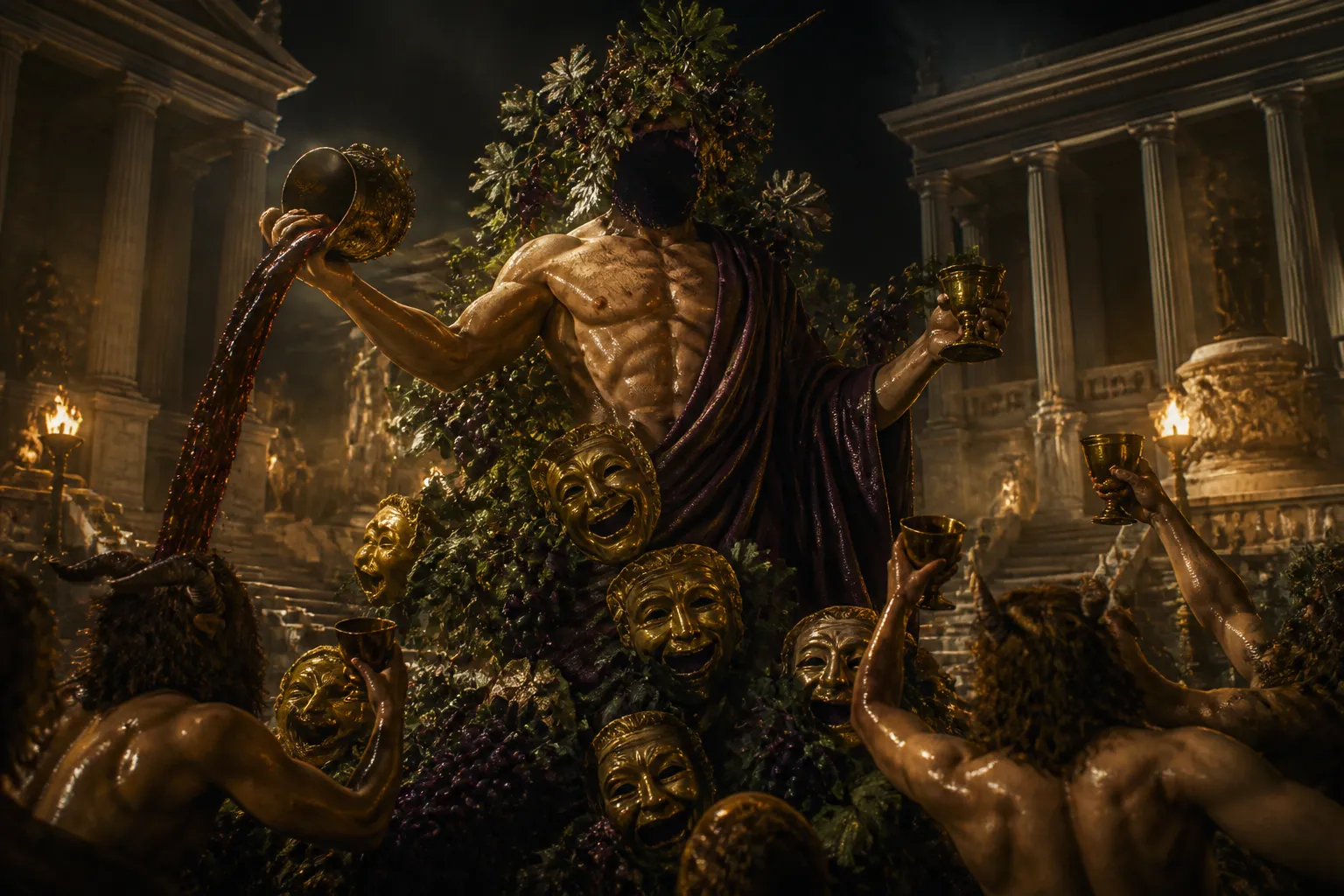
When people learn that Dionysus — the Greek god of wine, ecstasy, and ritual madness — was also the patron deity of theatre, the connection can seem surprising. What does drama have to do with wine? The answer is everything, and understanding it requires looking at the festivals of Dionysus: among the most important and culturally consequential religious events in the ancient world.
The Athenian festivals of Dionysus produced Greek tragedy and comedy, shaped the development of Western theatre, and served as the primary context in which audiences first encountered Aeschylus, Sophocles, Euripides, and Aristophanes. They were also genuine religious festivals — occasions for prayer, sacrifice, and communal worship that happened to take place in a theatre.
Which God Was Associated with Wine, Theatre, and Madness?
The answer is Dionysus — a single god who embodied what might seem like an unlikely combination of domains. But the connection between wine, theatre, and madness was not coincidental in the Greek religious imagination; it was the point.
All three — wine, theatre, and ritual madness — involved the same fundamental experience: the temporary abandonment of the ordinary, bounded, rational self in favour of something larger, wilder, and more intoxicating. Wine dissolved social inhibitions and personal identity. Theatrical performance involved the actor becoming someone else entirely. And the ecstatic rituals of Dionysus required the worshipper to surrender individual selfhood to the god’s presence. This was Dionysus’s domain: the sacred and terrifying space where the self dissolves.
The Major Festivals of Dionysus
Athens celebrated several festivals in honour of Dionysus throughout the year. The two most important for the history of theatre were the City Dionysia and the Lenaia.
The City Dionysia (Great Dionysia)
Held in late March, at the beginning of spring when the Aegean seas opened to allow travel, the City Dionysia (ta kata asty Dionysia, or simply ta Megala — “the Great”) was Athens’ most prestigious Dionysiac festival. Because it fell at a time when visitors from across the Greek world could travel to Athens, it also served as a showcase for Athenian cultural and political power.
The festival lasted several days and included:
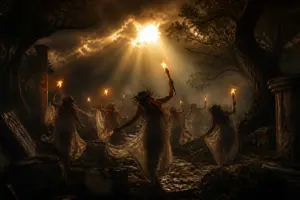
- The pompe (procession) — a great processional parade through Athens in which a statue of Dionysus was escorted by priests, musicians, sacrificial animals, and citizens carrying phalluses (symbols of Dionysus’s fertility) to the theatre
- Bull sacrifice — the day began with sacrifice at the altar of Dionysus in the sacred precinct of the Theatre of Dionysus on the south slope of the Acropolis
- Dithyrambic competitions — choral performances of dithyrambs (hymns to Dionysus) competed, with each of Athens’s ten tribes entering a chorus of fifty men and fifty boys
- Tragedy competitions — three tragedians each presented three tragedies and a satyr play over three consecutive days, competing for the prize awarded by judges selected by lot
- Comedy competitions — comedies were also performed, though their status in the festival programme changed over the course of the fifth century BCE
Admission was open to the broad citizen population, and evidence suggests that the festival had significant popular attendance — with seating in the Theatre of Dionysus accommodating perhaps twelve to seventeen thousand spectators.
The Lenaia
The Lenaia was a winter festival of Dionysus, held in the month of Gamelion (January–February). It was a smaller, more local festival than the City Dionysia — held when the sea routes were closed and foreign visitors rare — but it was equally important for the development of Greek comedy in particular.
The Lenaia included its own tragic and comic competitions, and many of Aristophanes’ most famous comedies received their first performance there. The atmosphere of the Lenaia appears to have been somewhat rowdier and less formal than the Great Dionysia, appropriate for the winter season and a more intimate Athenian audience.
The Rural Dionysia
Before the great urban festivals, and continuing alongside them throughout the classical period, various demes (rural communities) of Attica held their own local festivals of Dionysus in the month of Poseideon (December). These kata dēmous Dionysia featured processions, sacrifices, and theatrical performances on a smaller scale — and were the environment in which many future playwrights and performers received their first theatrical experience.
The Anthesteria
The Anthesteria was a three-day festival focused specifically on wine — both its celebration and its potential for danger. Held in the month of Anthesterion (February–March), it marked the opening of the new wine jars from the previous autumn’s harvest.
The three days had distinct characters:
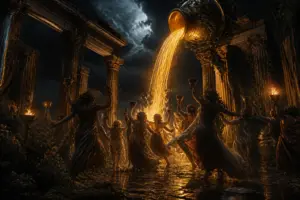
- Pithoigia (“jar-opening”) — the new wine was opened and offered first to Dionysus, then drunk by the participants
- Choes (“jugs”) — a day of wine-drinking competitions and rituals, during which citizens drank in silence from their own jugs rather than sharing — a reminder that Dionysus could bring isolation and madness, not only communal joy
- Chytroi (“pots”) — offerings were made to Hermes as guide of the dead; the Anthesteria was also understood as a time when the dead returned to walk among the living, and the final day involved ritual closure to send them back
Dionysus and the Birth of Theatre
The connection between Dionysus and theatre was not arbitrary or merely conventional. Ancient Greek tradition held that tragedy developed directly from the dithyramb — the choral hymn sung in honour of Dionysus — and that the first tragedies were performed within the context of Dionysiac religious celebration.
The actor Thespis is credited by ancient tradition with the innovation of separating a single performer from the chorus to play a distinct speaking role — an act that created drama in the modern sense. This is said to have occurred in the context of Dionysiac performance in the sixth century BCE.
The word tragedy itself reflects the Dionysiac connection. The Greek tragōidia is most commonly explained as “goat song” (tragos, goat + ōidē, song) — a reference to either the goat sacrificed to Dionysus, the goat-skin costume of early performers, or the prize of a goat awarded to the winner of early competitions. The goat was sacred to Dionysus, and satyr plays (the fourth play that followed each set of three tragedies) featured choruses of satyrs — the half-goat mythological followers of the wine god.
The Sacred Space: The Theatre of Dionysus
The world’s first stone theatre, the Theatre of Dionysus Eleuthereus, was built on the southern slope of the Acropolis in Athens, within the sacred precinct of Dionysus. Its location was not incidental: the performances that took place there were acts of worship. The stone altar at the centre of the orchestra (the circular performance space) was the altar of Dionysus, and theatrical competition was framed as religious offering.
The priest of Dionysus occupied the most prominent throne in the front row, a reminder to all in attendance that the performances were sacred events. The tragedies and comedies of Athens were not secular entertainment; they were how the Athenians worshipped their most paradoxical god.
Why Dionysus and Theatre Belong Together
The deeper logic connecting Dionysus to theatrical performance is the logic of transformation and impersonation. The actor — wearing a mask, speaking in another’s voice, becoming a character who is not himself — enacts the most fundamental Dionysiac experience: the dissolution of individual identity.
The theatrical mask, the prosōpon, was one of Dionysus’s own symbols. In ancient art and cult, the god’s presence was often represented by a mask alone — hung on a pillar, propped in a wine jar, suspended in a tree. The mask was Dionysus because Dionysus was the god of faces-behind-faces, of the self that disappears into another self.
When an Athenian playwright put Dionysus on stage — as Euripides did in the Bacchae — the god was being played by an actor performing in the god’s own sacred precinct, at the god’s own festival, before an audience that included the god’s priest. The layers of performance, presence, and paradox were entirely deliberate.
About This Article

Written by Elias Blackwood. Elias Blackwood has spent 25 years as an obsessive collector of world mythology and folklore, from Greek and Norse epics to Japanese yokai and West African trickster tales — entirely self-taught, for the love of it. His reading draws on comparative mythology, cultural anthropology, and a personal library of translations most people have never heard of. More about this site.
Verify this against a primary source
Specifics change, and your situation may differ from the one described here. These are the authorities worth checking directly:
- Theoi Project — Greek mythology texts with primary source citations
- Perseus Digital Library — classical texts in the original and in translation
- Encyclopaedia Britannica — edited reference for figures and traditions