The vrykolakas is the walking corpse of Greek folklore, a revenant so feared that entire island communities reorganized their burial customs around keeping it in the ground. I have spent over twenty-five years tracing how Slavic werewolf legends mutated into a Greek Orthodox vampire, and the vrykolakas remains one of the strangest hybrids I have encountered. It borrows a name from lycanthropy, a theology from Byzantine excommunication doctrine, and a body of eyewitness testimony that reads more like a criminal investigation than a ghost story.
Vrykolakas Etymology: A Werewolf Word Attached to a Vampire
The word vrykolakas did not originate in Greece. It descends from the Slavic term vǎrkolak, meaning “werewolf,” a word still recognizable across Slavic and Eastern European vampire folklore. Linguists have traced this root through Bulgarian, Serbian, and South Slavic dialects, where it originally described a shapeshifting predator rather than a corpse that refuses to decay.
However, as the term migrated into Greek-speaking regions, particularly through contact zones in the Balkans, its meaning shifted dramatically. The Greeks fused the werewolf concept with an indigenous belief in the restless dead. As a result, the vrykolakas became something neither Slavic peasants nor earlier Greek villagers would have fully recognized on their own: a corpse that rises, retains its name and voice, and preys on the living. Folklorist John Cuthbert Lawson, writing in his 1910 study “Modern Greek Folklore and Ancient Greek Religion,” noted this linguistic borrowing directly, observing that the Greek vampire inherited a wolf’s name but a corpse’s habits.
This etymological layering matters because it shows how folklore travels. A word can cross a linguistic border and attach itself to an entirely different set of anxieties. In this case, the anxiety was specifically Orthodox Christian, concerning sin, burial, and the fate of the soul.
Incorruption as Damnation: The Orthodox Theology Behind the Vrykolakas
Here is where the vrykolakas becomes genuinely distinct within global vampire lore. In Catholic hagiography, an incorrupt corpse signals sainthood; the body of a holy person resists decay as proof of divine favor. Greek Orthodox popular belief inverted this completely. Specifically, a body that failed to decompose after death was read as a sign of spiritual corruption, not purity.
Three categories of the dead were considered especially at risk. The excommunicated, cut off from the sacraments by a priest, could not properly dissolve back into the earth. The anathematised, formally cursed by the Church, faced the same fate. And those who died under a parental curse, unforgiven by mother or father before death, were believed doomed to walk. This last category reflects how seriously Greek village culture treated filial obligation and blessing. A parent’s dying anger carried theological weight equal to a bishop’s excommunication.
Priests in rural Greece sometimes exhumed bodies years after burial specifically to check for decomposition, a practice called the “second burial.” If the flesh had rotted away cleanly, the soul was assumed safe. If not, panic followed. This theological inversion, where incorruption equals damnation rather than sanctity, sits at the very core of vrykolakas belief, and it separates the creature sharply from Western European vampire traditions.
Other Paths to Becoming a Vrykolakas
Excommunication and parental curses were not the only routes. Burial in unconsecrated ground was equally dangerous, since a body denied proper Orthodox rites lacked the spiritual protection needed to decompose and release its soul. A violent or unavenged death carried similar risk. Villagers believed that murder victims, in particular, might rise if their killers went unpunished, their restlessness a form of postmortem justice-seeking.
One of the more curious folk beliefs involved diet. Eating the meat of a sheep killed by a wolf was thought to transfer some contaminating quality into the eater, potentially setting them up for vrykolakas transformation after death. This detail, recorded across several nineteenth-century Greek folklore collections, reveals the lingering werewolf DNA buried inside the vampire concept. The wolf never fully disappears from the vrykolakas; it lurks in the etymology and in beliefs like this one, connecting predator and revenant through shared contamination.
- Excommunication or formal anathema by the Orthodox Church
- Dying under an unresolved parental curse
- Burial in unconsecrated or unblessed ground
- A violent, sudden, or unavenged death
- Consuming meat from an animal killed by a wolf
How the Vrykolakas Behaves: Knocking, Naming, and Plague
Unlike many revenants confined to graveyards, the vrykolakas actively returns home. Folklore consistently describes it growing stronger the longer it remains undestroyed, gaining both physical power and cunning over weeks or months. It approaches the houses of family and neighbors at night, knocking on doors and calling residents by name in a voice that sounds convincingly human.
This detail produced one of the most durable folk rules in Greek village life: never answer a door on the first knock. Villagers believed a vrykolakas could only call a person’s name twice before losing the ability to compel them outside. As a result, families waited for a second or third knock before responding, a superstition that persisted in some rural communities well into the twentieth century.
The creature was also blamed for a phenomenon resembling sleep paralysis, sitting crushingly on sleepers’ chests and leaving them gasping and immobile until dawn. Beyond individual hauntings, however, the vrykolakas carried a communal threat. Villagers held it responsible for spreading plague and unexplained illness through entire settlements, functioning less like a solitary predator and more like a walking source of contagion, similar to some figures found in the wider history of vampires across plague-era Europe.
Santorini and the Islands: Where “Sending Someone to Santorini” Became an Idiom
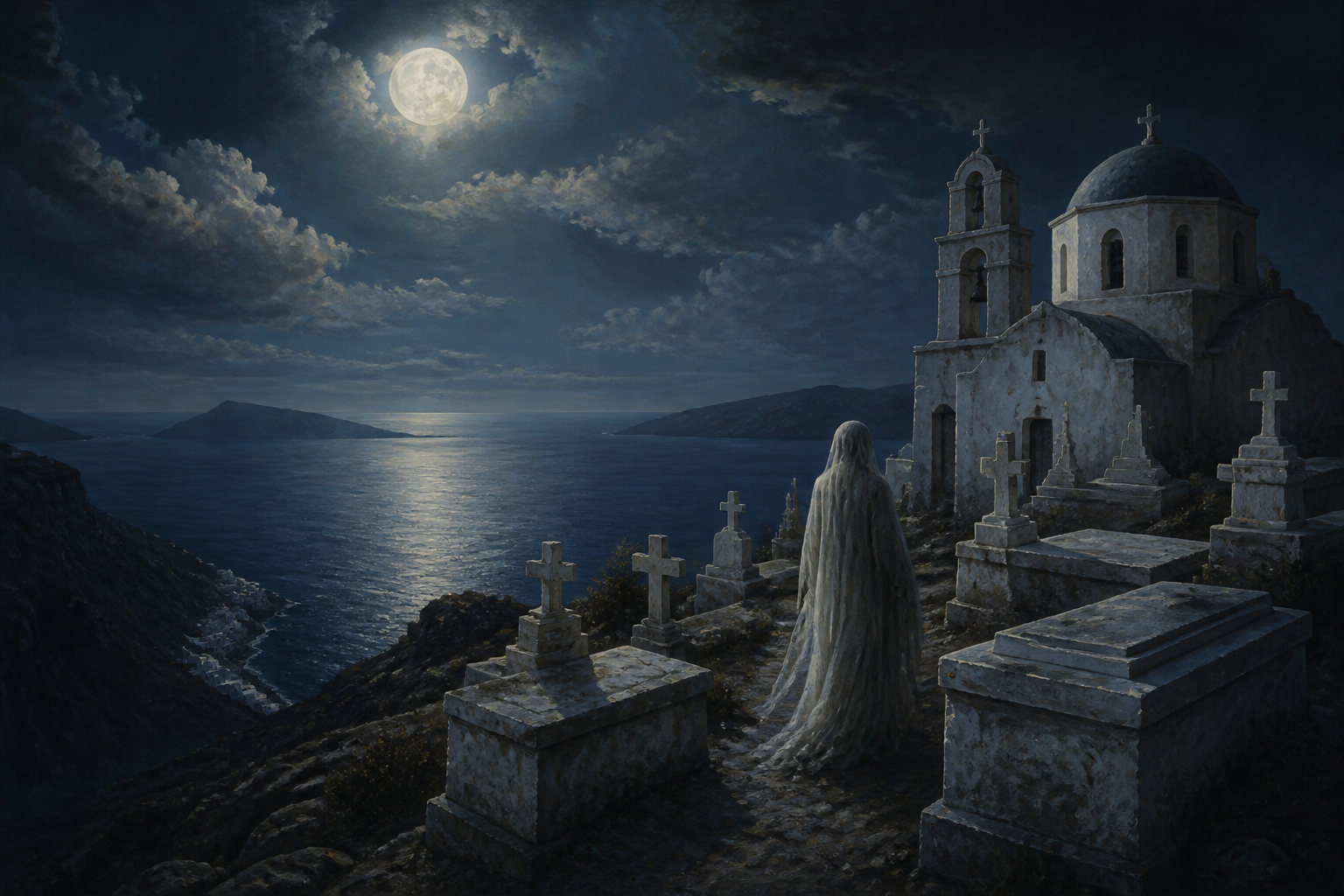
No region became more associated with the vrykolakas than the volcanic islands of the Aegean, particularly Santorini. The connection ran so deep that “to send someone to Santorini” developed as a Greek idiom meaning to banish a troublemaker or a source of misfortune. This phrase alone tells us how thoroughly the island’s reputation for revenants had saturated everyday language.
Part of the explanation is geological. Santorini’s volcanic soil is rocky and shallow, making proper burial genuinely difficult. Bodies decomposed unevenly, and shallow graves were prone to disturbance, both by animals and by erosion. Villagers interpreted these practical failures through a supernatural lens, assuming that poorly preserved or oddly positioned remains indicated vrykolakas activity rather than simple soil chemistry.
Consequently, exhumation, dismemberment, and burning became routine responses on Santorini and similar islands like Mykonos. Communities developed near-ritualized procedures for checking suspect graves, and reports of these practices eventually reached educated travelers from Western Europe, who documented them with a mixture of fascination and skepticism.
Primary Sources: Leo Allatius and Tournefort’s 1701 Mykonos Panic
The earliest substantial scholarly account of the vrykolakas comes from Leo Allatius, a Greek Catholic scholar working in Rome. In his 1645 text “De Graecorum hodie quorundam opinationibus,” Allatius described the vrykolakas belief in detail for a Western European audience, treating it as a genuine ethnographic phenomenon within Greek popular religion rather than mere fable. His account remains one of the foundational primary sources folklorists still cite today.
The most vivid firsthand account, however, comes from Joseph Pitton de Tournefort, a French botanist who witnessed a vrykolakas panic on Mykonos in 1701. Tournefort described how villagers exhumed a recently deceased man suspected of returning from the grave, examined his body for signs of continued vitality, and eventually resorted to burning the heart after other measures failed to calm the community’s fear. His account, published in his travel journals, reads with remarkable specificity: named individuals, dated events, and detailed procedural steps.
What makes Tournefort’s report so valuable is his outsider perspective. He approached the panic with scientific skepticism, yet he still recorded the villagers’ actions faithfully, giving modern folklorists a rare, dated window into an actual vrykolakas scare rather than a secondhand legend collected decades later.
Destroying a Vrykolakas: Saturday Exhumation and Fire
Greek folk practice specified precise conditions for dealing with a suspected vrykolakas. Exhumation had to happen on a Saturday, the one day the creature was believed to rest quietly in its grave rather than roam. This timing gave villagers a practical window to act without immediate confrontation.
Once the grave was opened, the response typically escalated in stages. If the body appeared unusually preserved, bloated, or discolored, villagers proceeded to dismemberment or outright burning, the most decisive method for ending the threat. In some regions, boiling water or vinegar was poured over the remains, a practice believed to accelerate decomposition and neutralize whatever spiritual corruption caused the incorruption in the first place.
Afterward, the grave itself required re-consecration by a priest, restoring its status as sanctified ground. This final step underscores how thoroughly the vrykolakas belief remained embedded within Orthodox ritual practice. Destroying the body alone was not enough; the site itself needed spiritual correction to prevent recurrence.
Why the Vrykolakas Still Matters to Folklore Studies
After decades of comparative research, I still find the vrykolakas remarkable for how openly it merges categories that other traditions keep separate. It carries a werewolf’s name, a vampire’s habits, and a distinctly Orthodox theology of sin and burial. Its documented history, from Allatius’s 1645 treatise to Tournefort’s 1701 Mykonos report, gives us something rare in vampire folklore: named witnesses and dated events rather than vague legend. The vrykolakas endures not as a simple monster story, but as a genuine record of how communities used ritual to manage fear, grief, and the unsettling mystery of a body that refuses to return to the earth.
About This Article

Written by Elias Blackwood. Elias Blackwood has spent 25 years as an obsessive collector of world mythology and folklore, from Greek and Norse epics to Japanese yokai and West African trickster tales — entirely self-taught, for the love of it. His reading draws on comparative mythology, cultural anthropology, and a personal library of translations most people have never heard of. More about this site.
Verify this against a primary source
Specifics change, and your situation may differ from the one described here. These are the authorities worth checking directly:
- Theoi Project — Greek mythology texts with primary source citations
- Perseus Digital Library — classical texts in the original and in translation
- Encyclopaedia Britannica — edited reference for figures and traditions


