The moroi is one of the most confusing figures I have encountered in twenty-five years of tracing vampiric folklore across Eastern Europe. Depending on the village, the era, and the collector doing the asking, a moroi could be a wandering ghost, a living sorcerer draining his neighbors’ strength, or the restless soul of a baby who died before baptism. I have spent years reading Romanian ethnographies trying to pin down a single definition, and honestly, I have concluded that the search for tidiness is the wrong approach entirely.
What a Moroi Actually Is, According to the Sources I Trust
Romanian folklore scholars, most notably Agnes Murgoci in her 1926 paper “The Vampire in Roumania” for the journal Folklore, treat the moroi as a category distinct from, yet constantly overlapping with, the strigoi. Murgoci collected testimony from Wallachia and Oltenia in the early twentieth century, and she noted that villagers used moroi and strigoi almost interchangeably in some districts, while in others they described very specific differences. That inconsistency is not a failure of her fieldwork. It is an accurate reflection of oral tradition, which was never meant to satisfy a taxonomist.
In broad strokes, folklorists working after Murgoci, including Harry Senn in his 1982 study “Were-Wolf and Vampire in Romania,” describe the moroi as leaning more toward the incorporeal. Where the strigoi is frequently imagined as a corpse that rises physically from the grave, the moroi is more often a spirit, a shade, or an unquiet soul that troubles the living without necessarily needing a body at all. However, I want to stress that this is a tendency, not a rule. Romanian tradition simply resists the clean binary that later writers, myself included, wish it offered.
The Living Moroi and the Blurred Line With Strigoi
One detail I find genuinely striking, and one that separates the moroi from most vampire lore across Slavic and Eastern European vampire folklore, is that the moroi could be alive. A living person, usually born under unusual circumstances such as with a caul, or born as a seventh child, could carry moroi power from birth. This living moroi supposedly wandered at night in spirit form while the body slept, causing mischief, draining vitality from sleeping neighbors, or souring milk in the dairy.
According to several regional accounts recorded in Ion Muslea and Ovidiu Bîrlea’s twentieth-century Romanian folklore archives, a living moroi typically transformed into a strigoi mort, a dead strigoi, upon death. In other words, the moroi represents an earlier stage in a single unfolding condition, and the strigoi represents its terminal, post-mortem form. This progression model is not universal across all Romanian regions, but it appears often enough that I consider it one of the more reliable throughlines in the material.
Moroi as the Male, Strigoaica as the Female
In certain Transylvanian and Moldavian sources, I have found a linguistic split worth noting specifically. Some villages used moroi to denote the male vampire figure while reserving strigoaica for the female equivalent, effectively treating strigoi as the general category and moroi as a gendered subtype within it. This is not a universal grammar; other regions used strigoi and strigoaica as the male-female pair and moroi as something else entirely, usually the ghost-child figure I will address below. As a result, any writer claiming a single fixed vocabulary for Romanian vampire lore is, in my professional judgment, overstating the evidence.
The Moroi as Psychic Vampire, Not Just Blood-Drinker
What sets the moroi apart from the fanged predators familiar from later fiction is its method of harm. Rather than drinking blood exclusively, the moroi was frequently described as draining life energy, vitality, or luck itself. Families who suffered a run of illness, a failed harvest, or a mysterious drought sometimes blamed a moroi’s lingering presence rather than a strigoi’s physical assault. This is an important distinction because it places the moroi closer to what modern folklorists sometimes call a psychic or energy vampire, a being that weakens rather than punctures.
I find this energy-draining quality significant for understanding the wider history of vampires because it shows the vampire figure was never solely about blood. Specifically, Romanian peasants attributed a whole cluster of misfortunes, including chronic fatigue, livestock failure, and unexplained crop death, to moroi activity. The creature became a convenient explanatory frame for the ordinary disasters of agrarian life, which is precisely why belief in it persisted so stubbornly into the twentieth century.
- Chronic exhaustion or wasting illness in a household member, often called “being ridden” by the moroi
- Sudden drought or failed rain following a suspicious death in the village
- Livestock going dry or sickening without apparent cause
- A string of bad luck traced back to an improperly buried relative
The Infant Moroi: Romania’s Most Haunting Variant
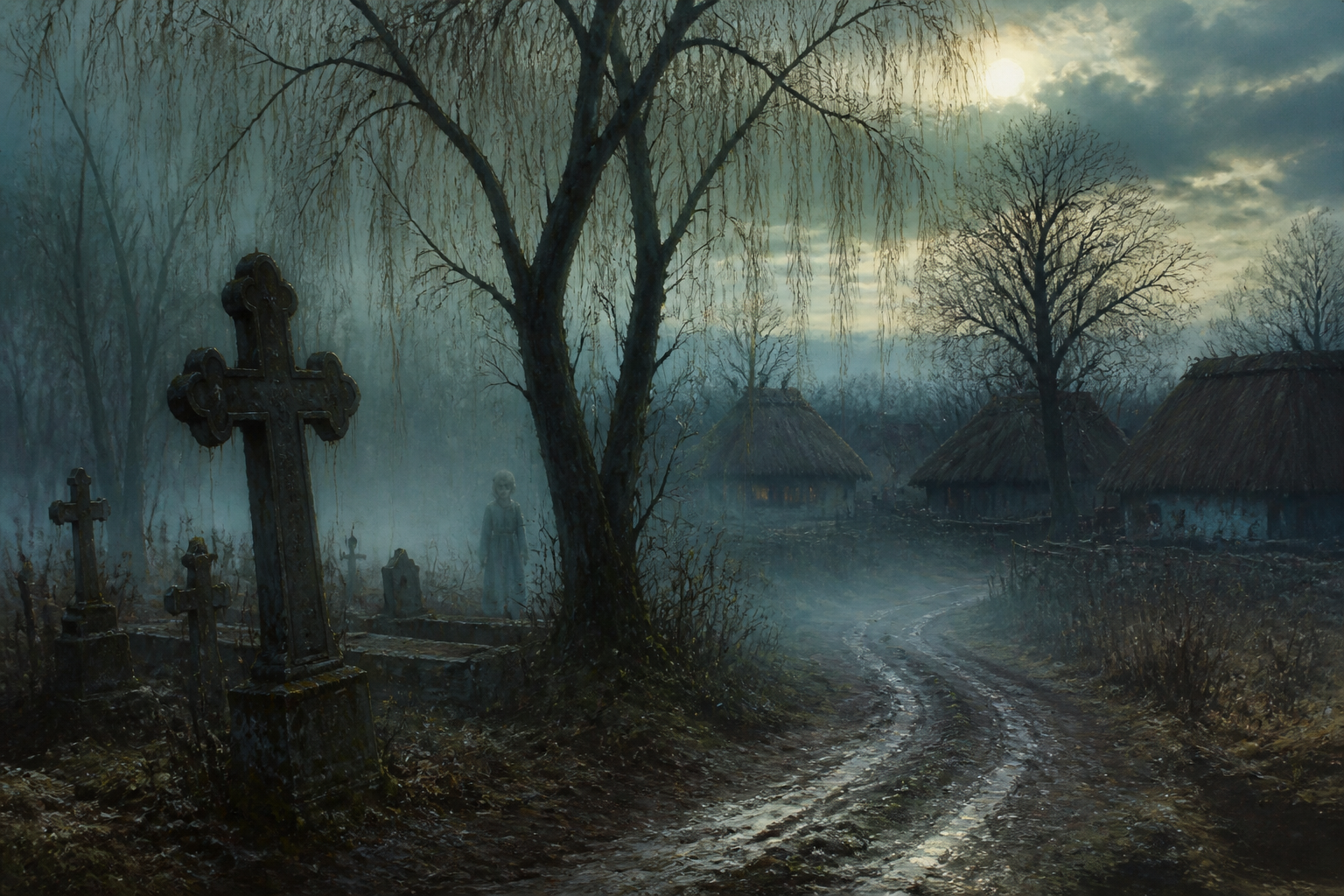
The version of the moroi that unsettles me most, even after decades of reading this material, is the infant form. Across large stretches of Romania, tradition held that a child who died stillborn or before baptism could return as a moroi. Baptism, in Orthodox Christian folk belief, was not merely a religious formality; it was the ritual act that fully admitted a soul into the community of the living and the dead alike. A child who died outside that ritual boundary was, in a real sense, caught between worlds.
This belief carried enormous emotional weight for grieving families, and it also generated very specific funerary precautions. Communities in Oltenia and parts of Muntenia reportedly performed emergency baptisms on dying infants whenever possible, even administered by a midwife if no priest could reach the household in time. For infants who died before this could happen, some families buried the small body with particular herbs, or beneath the threshold of the home, or with items meant to symbolically complete the missing rite. Murgoci recorded variations of this practice in her fieldwork, and later Romanian ethnographers confirmed similar customs well into the interwar period.
The underlying anxiety is not difficult to understand. Infant mortality was tragically common in pre-modern Romanian villages, and a belief system that framed unbaptised infant death as spiritually unfinished business gave grieving communities a ritual language for their loss. It also, unfortunately, placed enormous pressure on mothers and midwives to perform the correct sequence of actions quickly, under circumstances that were already devastating.
Protective Measures Shared With, and Distinct From, Strigoi Lore
Protection against the moroi overlapped heavily with strigoi apotropaic practice, and I think this overlap is itself evidence of how blurred the two categories were in lived tradition. Garlic placed at windows and doorways, iron objects laid near a coffin, and thorny branches such as hawthorn positioned across a threshold all appear in accounts of moroi prevention just as they do in strigoi cases. Correct burial rites, proper mourning observance, and, for infants, the completion of baptismal ritual whenever humanly possible, rounded out the standard defensive toolkit.
However, I want to frame the moroi accurately rather than sensationally. Compared to the strigoi, which folklore often depicts as physically violent, corporeal, and requiring drastic remedies such as exhumation and staking, the moroi generally reads as the gentler, more spectral relative within the same extended family of the unquiet dead. Its harm was usually attritional rather than sudden, its presence felt through misfortune rather than assault. This softer register does not make it less feared; it simply makes it a different kind of fear, one rooted in slow depletion rather than violent encounter.
Why the Moroi Resists Neat Classification
I want to end on the point that has guided this entire piece. Folk categories were never designed as academic taxonomies; they evolved organically across isolated villages, oral chains of transmission, and centuries of retelling. Scholars such as Murgoci, Senn, and later folklorists did valuable work trying to organize this material, but the organizing itself was always an act of imposed order on something inherently fluid. The moroi, in that sense, is not a poorly defined creature. It is an honestly reported one, and the blur between moroi and strigoi tells us more about how folklore actually functions than any artificial clarity ever could.
About This Article

Written by Elias Blackwood. Elias Blackwood has spent 25 years as an obsessive collector of world mythology and folklore, from Greek and Norse epics to Japanese yokai and West African trickster tales — entirely self-taught, for the love of it. His reading draws on comparative mythology, cultural anthropology, and a personal library of translations most people have never heard of. More about this site.
Verify this against a primary source
Specifics change, and your situation may differ from the one described here. These are the authorities worth checking directly:
- Theoi Project — Greek mythology texts with primary source citations
- Perseus Digital Library — classical texts in the original and in translation
- Encyclopaedia Britannica — edited reference for figures and traditions