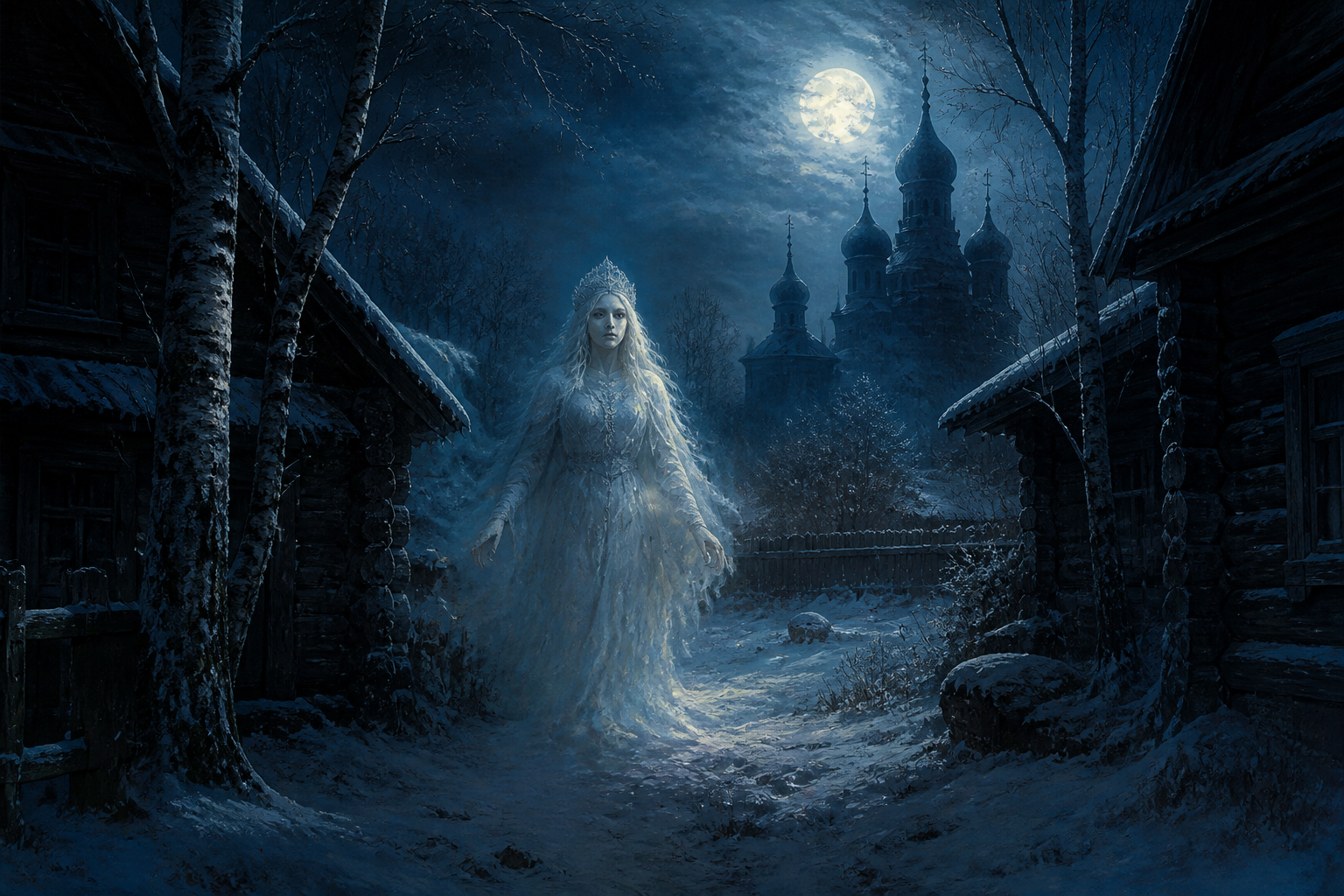
Upyr is, as far as the written record shows, the oldest surviving name for a Slavic vampire. I have spent twenty-five years tracing how cultures explain death, decay, and the fear of the returning dead, and few words carry as much philological weight as this one. Long before “vampire” existed as an English word, East Slavic villagers were already whispering about the upyr, a corpse-demon that rose from its grave to feed on the living. Understanding upyr means understanding the very root system from which all later vampire folklore grew.
The 1047 Manuscript That Changed My Understanding of Upyr
Most popular vampire histories jump straight to eighteenth-century Serbia or Romanian folklore. However, the documentary trail actually begins much earlier, in an Old Church Slavonic manuscript from Novgorod dated to 1047. A scribal colophon in this text names its copyist “Upir Likhyi,” which translates roughly as “Upyr the Wicked” or “Foul Vampire.” Scholars such as Aleksandr Vostokov and later Slavists studying Novgorodian birchbark and parchment traditions have pointed to this colophon as one of the earliest attestations of the word anywhere in written Slavic language.
This is a striking detail. A human scribe, presumably a real historical figure, bore this word as a personal byname nearly a millennium ago. That fact alone tells me the concept of the upyr was already fully formed in the popular imagination by the mid-eleventh century, likely centuries before it was ever written down. Names like this were not chosen carelessly in medieval Slavic society; they reflected existing folk categories familiar enough to use as nicknames. As a result, this single colophon has become a cornerstone for anyone studying Slavic and Eastern European vampire folklore.
Pre-Christian Roots: The Unclean Dead and the Zalozhnye Pokojniki
To understand why the upyr terrified whole villages, I have to go back to the pre-Christian East Slavic dead-cult. Ancestor veneration was central to early Slavic religious life, and a proper burial mattered enormously. Death itself was divided into two broad categories: the “clean” dead, who passed naturally and were buried with correct rites, and the “unclean” or “mortgaged” dead, known as zalozhnye pokojniki.
This second category included suicides, drowning victims, murder victims, sorcerers, the unbaptised, and anyone who died what folklorists call a “wrong death.” Specifically, these were deaths considered premature, violent, or spiritually incomplete. Villagers believed such souls could not pass properly into the ancestral realm. Instead, they lingered, restless and dangerous, tied to the earth until their natural lifespan would have ended. The upyr grew directly out of this belief system, representing the most malevolent possible outcome of an improper death.
In fact, ethnographers working across nineteenth-century Russia and Ukraine recorded remarkably consistent regional variations on this theme. Peasants in Ukrainian, Belarusian, and Russian villages alike described the zalozhny corpse as somehow “unfinished,” still tethered to the world of the living. This is the conceptual soil from which the upyr emerged, long before Church doctrine layered Christian vocabulary onto older pagan fears.
How the Upyr Behaved: Blood, Epidemics, and Nighttime Attacks
Folklore accounts describe the upyr rising from its grave at night to visit its own family first. It would drink blood, spread sickness, and sometimes suffocate sleeping victims. Some regional traditions, notably in parts of Ukraine, held that an upyr could also walk at midday, particularly on days associated with unclean spirits. This detail sets East Slavic tradition apart from later Western European vampire lore, which fixates almost entirely on darkness.
Villagers frequently used the upyr as an explanatory framework for disease clusters. When several family members or neighbours died in quick succession, often from what modern epidemiology would identify as tuberculosis, cholera, or typhus, communities looked for a single cause. The most recently deceased suspicious individual became the prime suspect. As a result, graves were reopened, and corpses were examined for tell-tale “vampire” signs: bloating, lack of decomposition, or blood at the mouth, all of which are now understood as normal features of decomposition under certain soil and temperature conditions.
This pattern is not unique to East Slavic culture, but it is documented there with unusual density. Nineteenth-century collectors recorded dozens of local cases where entire villages participated in exhumation and corpse mutilation to stop a suspected upyr. These accounts sit within the wider history of vampires as some of the clearest evidence for how folk epidemiology and supernatural belief reinforced one another.
Who Became an Upyr: Heretics, Sorcerers, and the Improperly Buried
Not every corpse risked becoming an upyr. Specific categories of the dead were considered especially vulnerable, and East Slavic tradition names them with real consistency across regions. Heretics and apostates topped the list, reflecting the Church’s influence on older pagan categories. Sorcerers, known as koldun in Russian folklore, were another major group, since their power in life was believed to persist, and even intensify, after death.
The cursed dead, those who died under a spoken malediction, also fell into this category. So did anyone buried improperly, without correct rites, or in unconsecrated ground. This is where the figure of the village sorcerer becomes genuinely fascinating to me as a researcher. The koldun occupied a paradoxical role in East Slavic demonology. He could cause vampirism through curses or malicious magic during his lifetime, yet he was often also the very person villagers turned to for protection against an upyr. Folk healers and cunning-folk across Russia and Ukraine were regularly consulted both to identify a suspected upyr and to perform the rituals needed to stop it.
This dual role, poison and cure held in the same hands, appears repeatedly in the ethnographic record. It reflects a broader pattern in Slavic folk religion, where dangerous power and protective power were rarely seen as separate categories.
Stopping the Upyr: Aspen Stakes, Fire, and Scattered Grain
East Slavic villagers developed a fairly detailed toolkit for preventing and destroying an upyr. Prevention often began at burial. Bodies suspected of vampiric tendencies might be buried face down, with a sickle placed across the throat, or with heavy stones pressing down the chest. These measures were meant to trap the corpse physically, preventing it from rising in the first place.
When prevention failed, more drastic measures followed. The aspen stake holds a particularly important place in this tradition, driven through the chest or sometimes through the mouth. Specifically, aspen was chosen over other woods for its folk association with weeping, guilt, and spiritual poison, tied to legends surrounding Judas. Burning the corpse entirely was considered the most reliable method, often carried out publicly as a village event.
One of the most distinctive East Slavic countermeasures involves scattering grain, poppy seeds, or millet along the path from the grave to the village, or directly inside the coffin. Folklore held that an upyr was compelled to stop and count every single seed before continuing its journey. This obsessive-counting motif delayed the creature until sunrise, when it lost its power and had to return to the grave. The same idea appears widely across Slavic and Balkan vampire folklore, connecting the upyr to related figures throughout the region.
- Burial face down with a sickle at the throat
- An aspen stake through the chest or mouth
- Complete burning of the corpse
- Scattered grain or poppy seeds to compel counting
- Heavy stones placed on the chest before burial
From Upyr to Vampire: Tracing the Linguistic Descent
The word “vampire,” now used globally, descends directly from this East Slavic root. Linguists trace a plausible path from upir or upyr through South Slavic intermediaries, eventually reaching Serbian “vampir.” This term entered Western European languages during a wave of eighteenth-century vampire panics in Habsburg-controlled Serbia, most famously the Arnold Paole case of the 1720s, which was documented in official military reports and widely republished across Germany, France, and England.
These reports introduced the word to French and German readers, and from there it spread rapidly into English print. Within decades, “vampire” had become the standard term across Western Europe, largely eclipsing older regional names. However, the upyr itself never disappeared from East Slavic folk practice. It simply continued under its original name in Russian, Ukrainian, and Belarusian village tradition, even as the Western world adopted a Serbian-filtered version of the same concept.
This linguistic history matters because it corrects a common misconception. Many assume “vampire” is fundamentally a Romanian or Transylvanian word, largely due to the enormous cultural influence of Bram Stoker’s Dracula. In fact, the etymological trail runs firmly through East Slavic territory first, with the upyr standing as its direct ancestor.
Afanasyev and the Nineteenth-Century Record of the Upyr
Much of what we know about the upyr in its fuller narrative form comes from nineteenth-century folklore collection efforts. Alexander Afanasyev, often called the Russian equivalent of the Brothers Grimm, gathered hundreds of Russian folktales during the 1850s and 1860s, publishing them in his landmark collection Russian Fairy Tales. Several of these tales feature upyr figures directly, portraying them as reanimated corpses driven by hunger for blood and, notably, by malice toward their surviving relatives.
Beyond Afanasyev, regional ethnographers throughout the Russian Empire and later Soviet folklore institutes recorded oral testimony from villagers describing actual local cases. These accounts, gathered from Ukrainian, Belarusian, and Russian informants, show remarkable consistency in describing burial precautions, exhumation practices, and the specific fear of the zalozhny dead. Taken together, this body of material represents one of the richest demonological records in European folklore studies.
Why the Upyr Still Matters to Vampire Scholarship
After twenty-five years studying these traditions, I keep returning to the upyr as a foundational case study. It shows how folk explanations for disease, death, and grief could crystallize into a coherent demonological system centuries before modern vampire fiction existed. The upyr is not a literary invention. It is a genuine piece of lived folk belief, documented in burial practices, village testimony, and one remarkably old manuscript colophon from 1047. Anyone tracing the true origins of vampire folklore eventually arrives back at this word, and at the East Slavic villages where it first took root.
About This Article

Written by Elias Blackwood. Elias Blackwood has spent 25 years as an obsessive collector of world mythology and folklore, from Greek and Norse epics to Japanese yokai and West African trickster tales — entirely self-taught, for the love of it. His reading draws on comparative mythology, cultural anthropology, and a personal library of translations most people have never heard of. More about this site.
Verify this against a primary source
Specifics change, and your situation may differ from the one described here. These are the authorities worth checking directly:
- Theoi Project — Greek mythology texts with primary source citations
- Perseus Digital Library — classical texts in the original and in translation
- Encyclopaedia Britannica — edited reference for figures and traditions