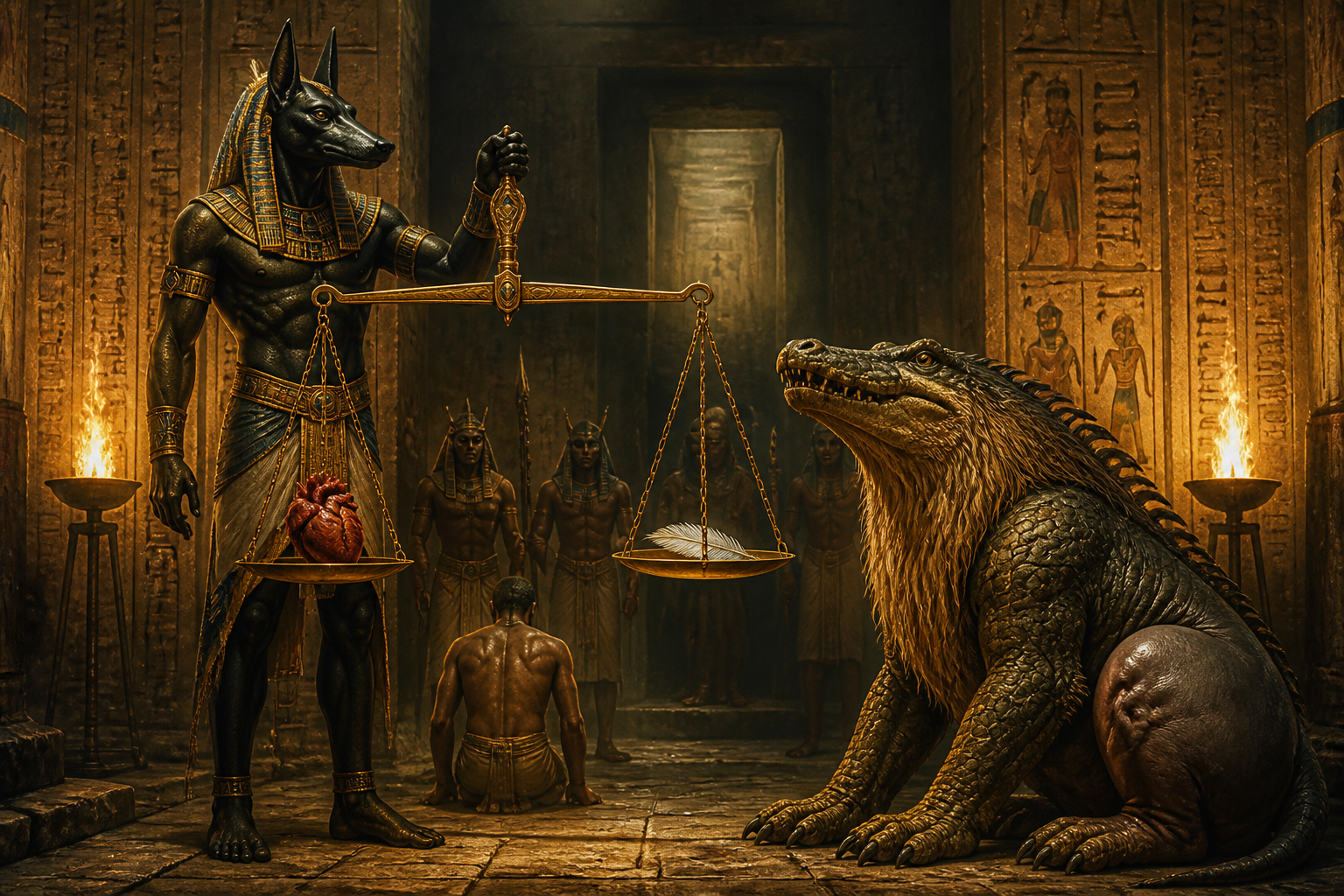
Anubis and the Weighing of the Heart represent the heart of ancient Egyptian afterlife belief. This ceremony—called the “psychostasia” or judgment of the soul—determined whether a deceased person would achieve eternal life or face obliteration. Anubis, the jackal-headed god of mummification and the dead, presided over this cosmic trial. Understanding this ritual reveals why Egyptians were obsessed with living righteously and why the Book of the Dead contains dozens of spells designed to help the heart pass judgment.
Who Was Anubis? The Jackal God of the Dead
Anubis—called Inpu or Anpu in Egyptian—was the oldest death god in the Egyptian pantheon. Depicted with a jackal’s head and a human body, he embodied a profound religious transformation. Originally, jackals were a genuine threat. They prowled desert cemeteries, scavenging human remains and breaking into tombs.
Rather than simply fear jackals, the Egyptians did something brilliant: they transformed the predator into the protector. Anubis became the deity who guarded the dead, who performed embalming, and who escorted souls through the underworld. Making the threat into the guardian is classic ancient religious strategy. Fear converted into devotion.
By the Middle Kingdom (around 2000 BCE), Osiris had become the supreme judge of the dead. However, Anubis retained his crucial role as the psychopomp—the guide who led souls to judgment. Ancient tomb inscriptions call him “Lord of the Sacred Land” and “He Who Is Upon His Mountain.” Anubis was the one who measured and witnessed.
The Hall of Two Truths: Where Judgment Took Place
According to the Book of the Dead, the deceased’s journey culminated in the Hall of Two Truths (also called the Hall of Ma’at or the Hall of Judgment). This was not a physical location. Instead, it was a mythological space—the cosmic courtroom where accountability occurred.
In this hall stood a massive scales. On one side rested the heart of the deceased. On the other sat the feather of Ma’at—a single ostrich feather representing truth, order, and cosmic balance. Anubis stood as the overseer of this weighing. Thoth, the ibis-headed god of wisdom and writing, recorded the result with meticulous precision.
Osiris presided as the ultimate judge, seated on a throne. Sometimes Isis and Nephthys—the divine sisters associated with death and mourning—attended as witnesses. The forty-two divine assessors lined the hall, each representing a different divine principle or moral law. These were not mere symbols. Egyptians believed these entities actually existed.
The deceased was led by Anubis into this assembly. The soul had to face judgment. It was the ultimate accountability before gods and cosmos. No escape existed. No bribes worked. Only truth mattered.
The Negative Confession: Declaring Innocence
Before the weighing itself, the deceased had to recite the “Negative Confession”—a declaration of innocence found throughout Book of the Dead papyri. This was not a prayer requesting forgiveness. Instead, it was a formal statement denying specific sins.
The deceased addressed each of the forty-two assessor gods in turn, making proclamations like:
- “I have not killed”
- “I have not stolen”
- “I have not told lies”
- “I have not caused pain”
- “I have not been angry without cause”
The declarations were remarkably ethical. They covered murder, theft, sexual misconduct, disrespect to gods, cruelty to animals, and even abuse of authority. In fact, studying the Negative Confession offers genuine insight into Egyptian moral values—what they considered justice and virtue.
Importantly, the deceased was not confessing guilt and seeking absolution. Rather, they were asserting that their heart—the seat of conscience, intellect, and memory in Egyptian thought—had not transgressed. The heart was thought to record every deed. It would testify. This is why the heart was weighed, not the brain.
The Scale: Heart Against Feather
Once the Negative Confession was complete, the actual weighing began. Anubis placed the deceased’s heart on the left pan of the scales. On the right pan, he placed a single ostrich feather. No heavy counterweight was needed. The feather of Ma’at weighed infinitely more than a heavy heart.
The balance measured spiritual weight, not physical mass. A heart burdened by sin, deception, and cruelty sank downward. A light, truthful heart rose to meet the feather. The scale’s movement revealed everything about the soul’s past life.
Thoth stood nearby with his writing implements, recording the result on a papyrus scroll. Osiris watched from his throne. The assembled deities observed in silence. Anubis controlled the mechanism. Everything depended on this moment.
In the papyrus of Hunefer (Nineteenth Dynasty), the scene is depicted with vivid detail. We see Anubis adjusting the scales, Thoth recording, and Osiris awaiting the verdict. The artwork reflects a scene Egyptians believed was literally happening in the afterlife.
The Two Possible Outcomes: Devouring or Eternity
If the scales balanced perfectly—if heart and feather weighed equally—the deceased was declared “true of voice” (maa-kheru in Egyptian). This was the verdict everyone hoped for. The Duat’s gates opened. Horus, the falcon-headed god, took the deceased’s hand and led them before Osiris.
Osiris granted eternal life in the Field of Reeds (Aaru)—a paradise that mirrored the earthly Nile Valley. The deceased would work fields, sail boats, feast with gods, and exist in peace forever. This was genuine immortality. Existence eternal and blessed.
However, if the heart was heavier than the feather—if sin weighed it down—a different fate awaited. A creature called Ammit stood beside the scales, waiting. Ammit’s name means “Devourer of the Dead,” and her appearance was deliberately terrifying. She had the head of a crocodile, the body and mane of a lion, and the hindquarters of a hippopotamus.
When the scales tipped against the deceased, Ammit consumed the heart. She devoured it entirely. For Egyptians, this meant something far worse than simple death. The heart was consumed. The soul was obliterated. No afterlife followed. No Field of Reeds. No resurrection. Complete non-existence—the “second death”���awaited.
Egyptians feared this outcome far more than physical death. Physical death was natural and inevitable. The second death meant true erasure. The deceased’s name would be forgotten. Their soul would cease. No one would remember them. This existential terror motivated much of Egyptian religious practice.
Why This Judgment Mattered: The Living Consequences
Understanding the Weighing of the Heart explains ancient Egypt’s remarkable moral and legal systems. The ceremony was not mere myth divorced from daily life. It was theology with teeth. Real consequences attached to behavior.
Egyptians believed they would be held accountable after death. Living righteously—following Ma’at (cosmic order and truth)—was not optional. The fear of Ammit’s jaws influenced how people treated others, conducted business, and wielded power. Kings, officials, and commoners all faced the same ultimate judgment.
This belief system profoundly shaped Egyptian ethics. Unlike some religions emphasizing divine grace or redemption, Egyptian judgment was based on deeds and truthfulness. You lived a good life. Your heart remained light. You passed. No intervention, no appeal.
Consequently, the Book of the Dead contains numerous spells specifically designed to help the heart pass judgment. Spell 30B is titled “A Spell for Not Letting the Heart Create Opposition in the Duat.” Other spells were meant to silence the heart if it threatened to testify against its owner—essentially magical insurance policies against self-incrimination.
Wealthy Egyptians spent enormous resources ensuring these spells accompanied them into tombs. They purchased complete copies of the Book of the Dead. They commissioned elaborate tomb paintings depicting the Weighing of the Heart. They wanted visual reminders that judgment awaited. That accountability was real. That Ma’at could not be deceived.
The Enduring Power of Anubis and the Weighing
The image of Anubis overseeing the Weighing of the Heart became iconic throughout Egyptian history. It appeared in tombs, on coffins, and in temple reliefs for over two thousand years. The consistency of this imagery—the jackal god, the scales, the feather, Ammit waiting—demonstrates its spiritual centrality.
This judgment scene influenced later religions too. Some scholars see echoes of the Weighing of the Heart in Christian imagery of the Last Judgment, Islamic concepts of the Scale of Deeds, and Hindu karma concepts. Whether direct transmission or parallel theological development remains debated, but the similarity is striking.
What made the Egyptian vision unique was its precision and moral specificity. The Negative Confession lists concrete sins—not abstract spiritual failings. The feather of Ma’at represents cosmic order, not divine mercy. Anubis remains the neutral observer and guide, not an advocate for the soul. The Egyptians imagined justice as balance, mathematics, and impersonal law.
For Egyptians, Anubis and the Weighing of the Heart were not comforting myths. They were warnings and promises simultaneously. A warning that every deed matters. That deception is futile. That Ammit awaits the unrighteous. A promise that living truthfully and justly brings eternal reward. That accountability is real. That the universe enforces Ma’at. This is why the ritual became foundational to Egyptian religious consciousness and why we still find it fascinating today.
About This Article

Written by Elias Blackwood. Elias Blackwood has spent 25 years as an obsessive collector of world mythology and folklore, from Greek and Norse epics to Japanese yokai and West African trickster tales — entirely self-taught, for the love of it. His reading draws on comparative mythology, cultural anthropology, and a personal library of translations most people have never heard of. More about this site.
Verify this against a primary source
Specifics change, and your situation may differ from the one described here. These are the authorities worth checking directly:
- Theoi Project — Greek mythology texts with primary source citations
- Perseus Digital Library — classical texts in the original and in translation
- Encyclopaedia Britannica — edited reference for figures and traditions