Among the Norse gods, Odin stands apart. Thor embodies strength. Freyr represents fertility and peace. But Odin’s entire character revolves around a single, driving obsession: the relentless pursuit of wisdom, no matter what the cost. He is a god willing to mutilate himself, starve himself, and risk his life—again and again—for knowledge that no one compelled him to seek. This hunger for wisdom defines him more than any other trait, and it finds its most powerful expression in two extraordinary myths from the Poetic Edda: his sacrifice of his eye at Mimir’s Well, and his nine-day ordeal hanging pierced upon Yggdrasil to win the runes. Both stories reveal something unsettling about how the Norse imagined wisdom itself—not as a gift or a reward, but as something purchased only through suffering and irreversible loss.
The Price of a Single Eye: Odin at Mimir’s Well
At the roots of Yggdrasil, the World Tree that holds all nine Norse worlds in its branches, lies a sacred well. Its waters shimmer with wisdom—not the wisdom of practical strategy or martial skill, but deep cosmological knowledge: understanding of fate, of past and future, of the hidden currents that move through existence itself. According to the Prose Edda, this is Mimir’s Well, or sometimes called the Well of Urd, and it is guarded by Mimir, a being of ancient power whose name means “memory” in Old Norse.
Odin came to this well alone. He did not come as a god demanding tribute. Instead, he came as a seeker—and Mimir demanded payment. The price was not gold or treasure. It was not even a year of service or a quest completed. Mimir demanded Odin’s eye.
Without hesitation, Odin plucked out his own eye and dropped it into the well’s dark waters. As the Prose Edda recounts it, he drank deeply from the well afterward, and the wisdom of all ages flooded into him. This act was not metaphorical. It was brutal, final, and irreversible. Odin became and remains the one-eyed god—a permanent visible scar of his hunger for knowledge.
What makes this sacrifice so striking is its voluntary nature. No one forced Odin’s hand. He chose to blind himself. The cost was paid knowingly, accepted fully. In a cosmos where gods possess tremendous power, Odin alone seems willing to surrender something essential—his own physical wholeness—for something intangible. His eye sits at the bottom of the well still, gleaming in the depths, a permanent reminder that wisdom is never free.
The Nine Nights on Yggdrasil: The Ordeal of the Runes
Yet Odin’s thirst for knowledge was not satisfied. The wisdom of Mimir’s Well was vast, but it was not enough. In the Havamal—a collection of wisdom poetry and proverbs preserved in the Poetic Edda—Odin himself describes an ordeal far more harrowing than the loss of an eye. This is the myth of how he won the runes, the sacred symbols believed to hold magical power and the secrets of language, healing, cursing, and fate itself.
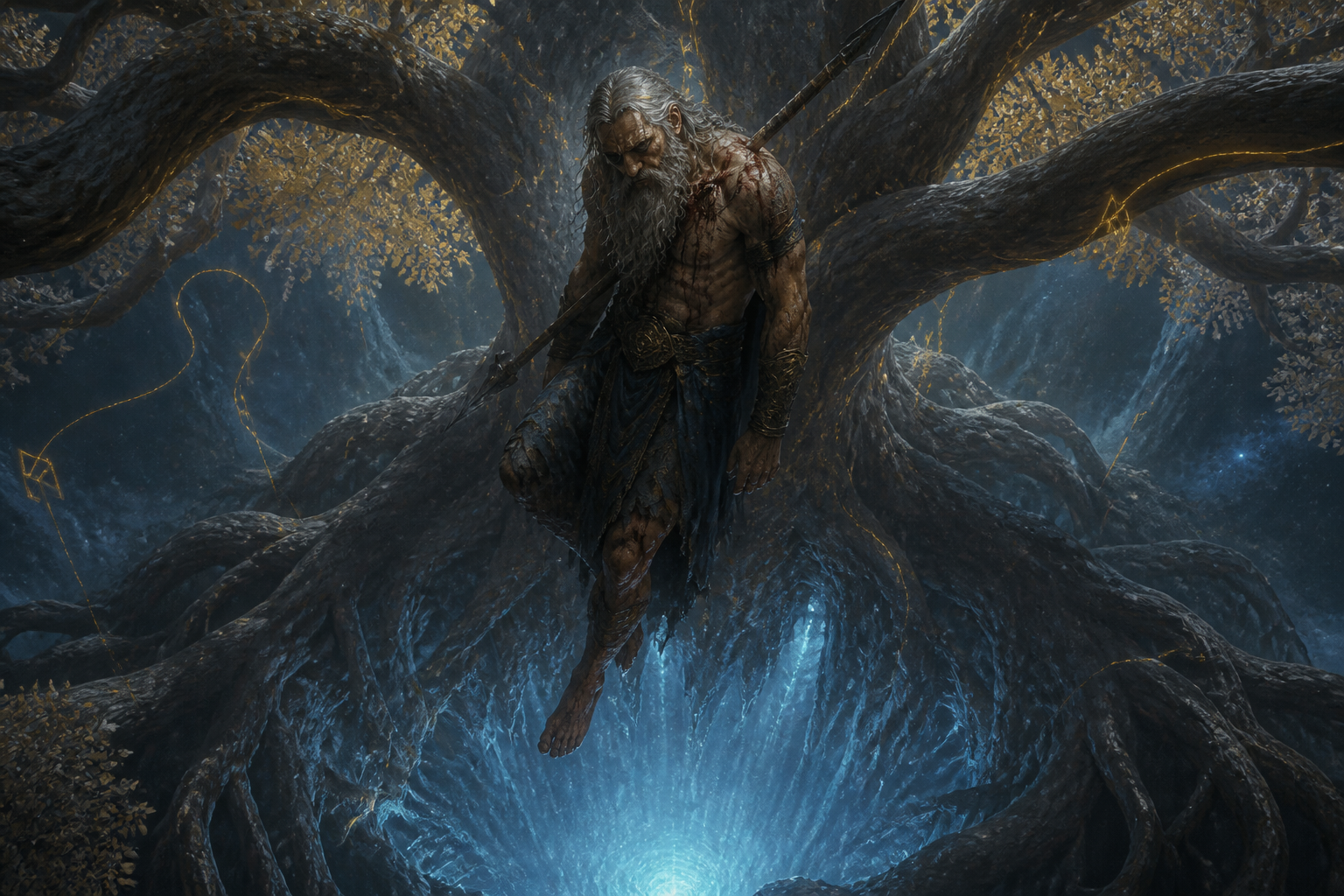
Stanza 138 of the Havamal states (in translation): “I know that I hung on the windswept tree, nine long nights, wounded by my own spear, given to myself as a sacrifice to myself.” Here, Odin describes an act of supreme self-violation. He seized his own spear, Gungnir, and drove it through his own body. Then he hung himself upon Yggdrasil, the World Tree—the axis around which all existence turns.
For nine days and nine nights, Odin hung there. He took no food. He drank no water. Wind tore at him. Pain consumed him. The number nine held mystical significance in Norse cosmology—there were nine worlds held in Yggdrasil’s branches, and Odin’s ordeal lasted nine times the length of a day and night. In suffering, he descended into a trance state, “peering down” into the depths beneath the tree, searching in the darkness for something lost long ago.
Then it came. In stanza 139, Odin describes the moment of breakthrough: “I perceived the runes, and took up the runes, screaming, I fell from the tree.” The runes—those carved symbols that would become both alphabet and instrument of magic—revealed themselves in his extremity. As consciousness left him and he plummeted from the tree, he seized them, claimed them, and brought them back from the threshold of death itself.
What Were the Runes?
Modern readers often assume runes were simply an alphabet—a practical writing system used by Norse peoples. That is partly true. But in the Norse religious imagination, runes were far more. They were vessels of magical power. Each rune carried meaning and potency. Through knowledge of the runes, a person could heal wounds, protect travelers, curse enemies, calm violent seas, or bind the will of another.
In fact, the use of runes for magical purposes was closely connected to seidr, the Norse form of shamanic magic. Odin’s ordeal on the tree was mythologically presented as the source of this power—not only for the god himself, but for all humanity. By hanging himself and winning the runes through suffering, Odin made it possible for humans to access this knowledge afterward. His sacrifice was not merely personal; it was cosmically productive.
Stanza 141 emphasizes this: “I learned nine mighty songs from the famous son of Bolthorn…and I drank the precious mead.” After his ordeal, Odin gains access to knowledge of poetry, magic, healing, and the deeper mysteries of existence. Poetry itself—the power to shape reality through language—flows from the runes he seized in his moment of death-like extremity.
The Pattern: Wisdom Through Irreversible Loss
If we place these two myths side by side, a clear pattern emerges. In Norse cosmology, wisdom is not a commodity to be traded fairly or earned through merit. Wisdom is something that must be purchased with permanent, irrevocable loss. An eye. Physical safety. Nearly life itself. The cost must be real. It must hurt. It must leave a mark.
This is strikingly different from other mythological traditions. In many cultures, wisdom is portrayed as enlightenment—a gaining, an addition, a moment of sudden clarity after which you are somehow “more.” In Norse mythology, wisdom is explicitly a subtraction. You must lose something essential to gain it. Odin is forever one-eyed because wisdom costs vision. He carries scars from Gungnir’s thrust because knowledge exacts its price in blood.
Moreover, both sacrifices are self-inflicted. Odin did not lose his eye in battle against an enemy. Mimir did not steal it; Odin offered it. He did not fall from Yggdrasil accidentally; he threw himself upon the tree and drove his own spear through his flesh. This emphasis on voluntary self-harm is crucial. Odin is not a victim. He is an active agent in his own suffering, choosing pain because he values what lies on the other side of it more than his own physical comfort.
Mimir’s Head: Wisdom That Never Dies
Interestingly, the story of Mimir does not end with Odin drinking from the well. In some versions of Norse mythology—particularly in the Prose Edda and in the account of Ragnarok in the Voluspa—Mimir meets a darker fate. When Mimir is decapitated by enemies, Odin retrieves his head and preserves it with magical herbs, keeping it alive through sorcery. Even severed, the head of Mimir continues to speak to Odin, offering counsel and wisdom.
This detail reinforces the broader theme: once wisdom is purchased through sacrifice, it does not diminish or run out. The price Odin paid for knowledge at the well was permanent, yes—he never regained his eye. But the wisdom he gained continued to flow to him, sustained through his relationship with Mimir’s preserved head. Sacrifice does not exhaust wisdom; it unlocks an endless source.
Why This Matters: Odin as a Tragic Figure
Understanding Odin’s two great sacrifices for wisdom reshapes how we see him among the Norse gods. He is not a ruler presiding over the cosmos with comfortable authority. He is restless, driven, almost desperate in his hunger for knowledge. Later medieval and modern writers have sensed something tragic in him—a god who cannot rest, who wanders disguised among mortals, who sacrifices everything because he knows (through his own hard-won wisdom) that catastrophe is coming. Ragnarok will destroy the Nine Worlds. Even the gods will fall.
In this context, Odin’s sacrifices take on an additional weight. He pursues wisdom not for glory or comfort, but because he desperately needs to understand the forces arrayed against him. His one eye peers into darkness seeking answers. His scars from Gungnir are badges not of heroism but of his willingness to endure anything—to become ugly, diminished, traumatized—if it means gaining one more piece of the cosmic puzzle.
This is why Odin’s sacrifice of wisdom remains so compelling nearly a thousand years after the Norse peoples abandoned these myths. It speaks to something true about the pursuit of knowledge itself: that it is never painless, never complete, and never undertaken by the comfortable. Those who pursue truth seriously must be willing to lose things along the way—certainty, innocence, wholeness of self. Odin, hanging on Yggdrasil with his own spear through his body, screaming as he seizes the runes, is the mythological embodiment of that terrible cost. His empty eye socket and his permanent scars remind us that wisdom, in the Norse imagination, is not a luxury good. It is something purchased only by those desperate enough, or brave enough, or broken enough to pay the price.
About This Article

Written by Elias Blackwood. Elias Blackwood has spent 25 years as an obsessive collector of world mythology and folklore, from Greek and Norse epics to Japanese yokai and West African trickster tales — entirely self-taught, for the love of it. His reading draws on comparative mythology, cultural anthropology, and a personal library of translations most people have never heard of. More about this site.
Verify this against a primary source
Specifics change, and your situation may differ from the one described here. These are the authorities worth checking directly:
- Theoi Project — Greek mythology texts with primary source citations
- Perseus Digital Library — classical texts in the original and in translation
- Encyclopaedia Britannica — edited reference for figures and traditions