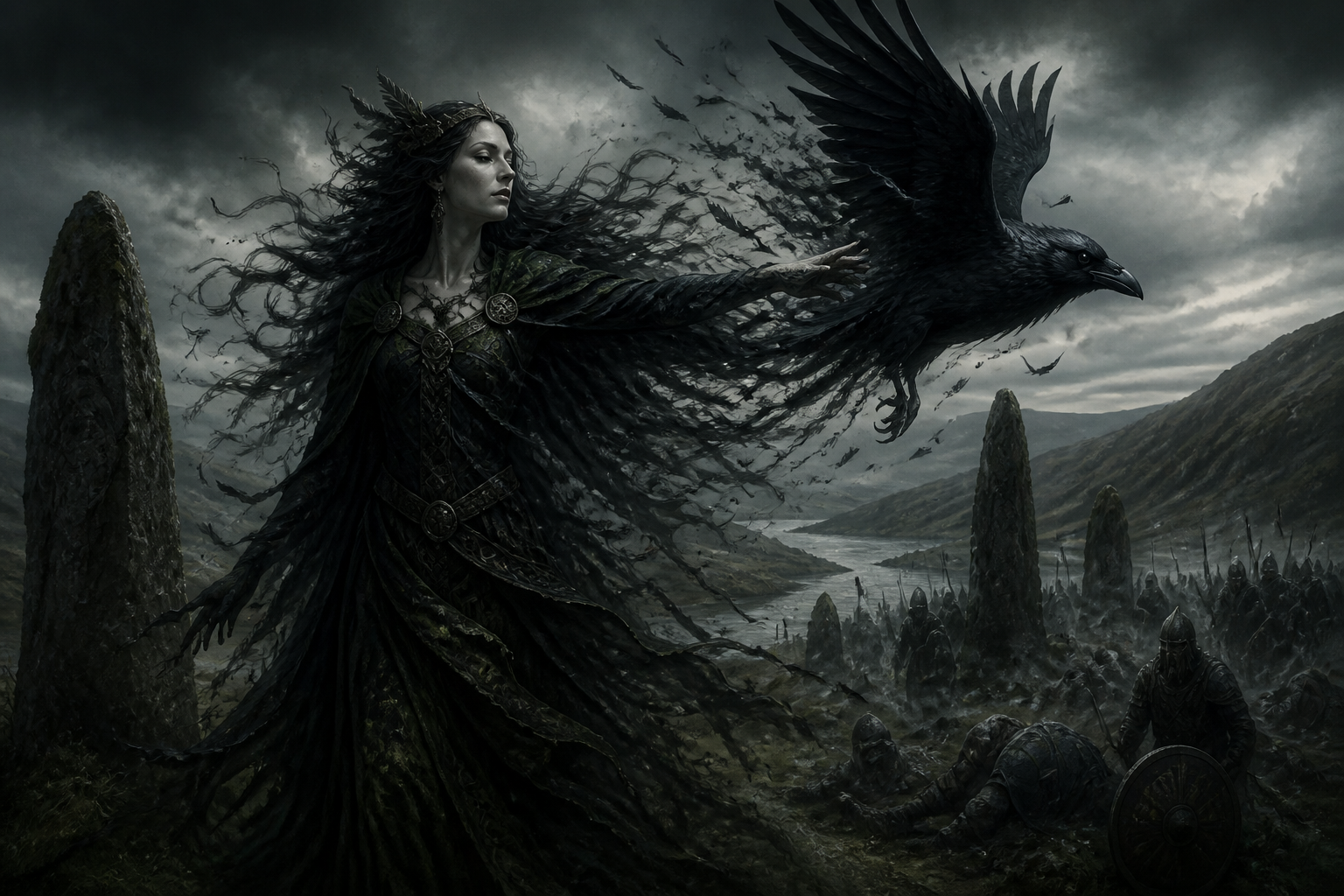
The Morrigan goddess stands as one of Celtic mythology’s most enigmatic and terrifying figures. Often described as a triple deity—or three aspects of a single, shape-shifting being—she embodied war, death, fate, and the sovereignty of the land itself. Her name possibly derives from Old Irish *Mór-Ríghan*, meaning “Great Queen,” though some scholars propose “Phantom Queen.” In the surviving texts of the Ulster Cycle and Mythological Cycle, preserved in manuscripts like the Book of Leinster and the Book of Invasions, the Morrigan emerges not as a straightforward warrior goddess like the Greek Athena, but as something far more unsettling: a force of nature that could not be controlled, only acknowledged and feared.
Who Was the Morrigan? A Goddess of Three Forms
Ancient Irish writers treated the Morrigan with deliberate ambiguity. She appears sometimes as a single entity, sometimes as three goddesses: the Morrigan herself, Badb (whose name means “crow”), and Macha (meaning “plain”). In fact, later medieval texts suggest these three were interchangeable aspects of one consciousness rather than separate divine beings.
This triple nature reflected how Celtic peoples conceived of divine power. Triplication was not multiplication; it was intensification. A threefold goddess represented totality, paradox, and forces that transcended simple categorization. The Morrigan could not be pinned down to a single domain or moral alignment, which made her supremely dangerous.
Her primary associations were war and death—but not heroic glory. She represented the chaotic, inevitable carnage of conflict. Warriors might pray for her favor, but they knew she answered to no human agenda. In that sense, the Morrigan was less a patron and more a cosmic principle: the collision of bodies, the spilling of blood, the arrival of fate itself.
The Raven’s Flight: Shapeshifting and Battlefield Omens
One of the most distinctive features of the Morrigan goddess in early texts is her ability to shapeshift. However, she did not transform into whatever she pleased; her changes followed a pattern rooted in death and prophecy.
Most famously, she appeared as a crow or raven circling above battlefields. This image was not metaphorical. In the *Cath Maige Tuired* (the Second Battle of Moytura), we read that the Morrigan literally perched over the battlefield, crying out to summon warriors. Her raven form made her a psychopomp—a guide of souls between the living and the dead.
The connection between Badb and “crow” is linguistic and symbolic. Badb, as crow, fed on corpses. That same word—*badb*—also meant a shrieking woman or a banshee-like harbinger of death. Language itself collapsed multiple meanings into one: the bird, the death-cry, and the goddess were inseparable.
Warriors understood these sightings as omens. To see the Morrigan circling meant death was near—not necessarily one’s own, but death was coming. She did not cause the battle; she announced it, witnessed it, fed upon it. In this way, she embodied a cosmic indifference to human suffering that made her far more uncanny than any malevolent demon.
The Dagda’s Sovereignty: Sex, Land, and Prophecy at Moytura
One of the strangest and most revealing scenes in Irish mythology occurs in the *Cath Maige Tuired*. Before the Tuatha Dé Danann fought the Fomorians, the Morrigan encountered the Dagda (“the Good God”) beside the river Unius in County Connacht.
She stood upon a rock in the water. The Dagda approached her, and they coupled—not in passion, but in a ritual union heavy with mythic significance. This act was not random seduction. It represented the god-king joining with the sovereignty of the land itself. The Morrigan, in this moment, was the land personified, and her union with the Dagda ensured the Tuatha Dé Danann’s victory.
After their union, the Morrigan ascended to a hilltop and proclaimed the outcome of the coming battle to both armies. She prophesied victory for the Tuatha Dé Danann. That said, her prophecy was no simple promise; it was an announcement of fate already woven into the fabric of the world.
This episode reveals how Irish myth linked sexuality, sovereignty, and divine power. The land itself was feminine and had to be won or honored through ritual and union. A king’s legitimacy depended on his relationship with the sovereignty goddess. To reject or dishonor her meant disaster for the kingdom. The Morrigan embodied this principle in its most primal form.
Cú Chulainn’s Torment: The Trickster’s Revenge
The most psychologically complex interaction between the Morrigan goddess and a mortal hero occurs in the *Táin Bó Cuailnge* (the Cattle Raid of Cooley). The Ulster Cycle’s greatest hero, Cú Chulainn, encounters her in multiple forms across his series of single combats.
At the ford, a young woman approaches him. She offers her love and her aid in battle. Cú Chulainn rejects her—harshly. He is focused on his combat. He has no time for divine attachment or obligation. This rejection is crucial. He has refused not merely a woman, but the sovereignty goddess herself.
As punishment, she torments him. During his next combat, an eel rises from the ford and tangles around his feet, nearly drowning him. Later, a white heifer with red ears drives a stampeding herd at him. Then, as he stands weakened, an old woman perches above him, milking a cow with three teats.
Only at the end does he realize the truth. The eel, the heifer, the old woman—all were the Morrigan. In her guise as the old milkmaid, she asks for his help. In his weakened state, he heals her wounds without recognizing what he is doing. In this way, their conflict resolves, bound by fate and trickster logic that transcends morality.
This narrative reveals the Morrigan not as an enemy to be defeated, but as a force interwoven with destiny itself. Cú Chulainn cannot escape her. He can only wound her, and unknowingly heal her. Their bond is neither friendly nor hostile—it simply is.
The Washer at the Ford: Death’s Harbinger in Folklore
Beyond the formal mythological cycles, a haunting folkloric image emerged from the Morrigan: the Washer at the Ford. In Irish and Scottish folklore, travelers reported seeing a spectral woman at river crossings, washing bloodstained armor or clothing.
The sight was always an omen. If you saw her washing the armor of your warriors, death was imminent. Specifically, it meant your side would fall in the coming conflict. She washed the garments of the dead before they died, as though preparing them for their fate.
Whether this figure was explicitly called the Morrigan or was a related banshee-like entity, the connection is clear. The image combines the Morrigan’s associations: prophecy, death, the battlefield, and a liminal presence that exists between worlds. For centuries after the mythological texts were written down, ordinary Irish people carried this image forward in oral tradition, testament to how deeply the goddess had embedded herself in cultural memory.
Sovereignty and the Land: The Morrigan’s Deeper Domain
To understand the Morrigan goddess fully, one must grasp the Irish concept of sovereignty as a divine feminine force. The land itself was not a backdrop for human action; it was alive, conscious, and personified as a woman.
A rightful king had to be wedded, in a spiritual or ritual sense, to the sovereignty of his realm. She tested him, challenged him, and either accepted or rejected him. If rejected or dishonored, she would withdraw her blessing. Crops would fail. Warriors would fall. The kingdom itself would sicken.
The Morrigan represented this principle in its most primal and uncompromising form. She was not the gentle, nurturing sovereignty goddess that some texts portray. She was sovereignty at its most ancient and terrible: the land’s right to demand blood, the necessity of death, the inevitability of suffering. To rule, one had to accept her completely.
This explains why she could couple with the Dagda before a crucial battle, why she could torment Cú Chulainn, why she demanded to be acknowledged. She was not being capricious. She was asserting the fundamental principle that no human power—no hero, no king—could operate outside the constraints of fate, death, and the land itself.
Why the Morrigan Remains Unforgettable
Modern readers often try to categorize the Morrigan goddess as “good” or “evil.” That framework fails. She transcends it. She is not a character with motivations and emotions we can sympathize with or condemn. Rather, she is an embodiment of forces that exist beyond human morality: fate, inevitability, the necessary darkness that underlies all life.
Her shapeshifting, her prophecies, her refusal to be pinned down—these qualities make her genuinely uncanny in the deepest sense. She is liminal: between life and death, between human and animal, between order and chaos. She cannot be controlled, negotiated with in good faith, or truly defeated.
Warriors in the Ulster Cycle did not worship the Morrigan goddess as a patron deity offering comfort. They acknowledged her as one acknowledges gravity or winter: with respect, with fear, with the understanding that she will do what she does regardless of human preference. In that stark recognition lies the power of her myth, preserved in fragmentary form across centuries of Irish manuscripts. She remains one of mythology’s most compelling figures precisely because she refuses to be domesticated into the role of savior or demon.
About This Article

Written by Elias Blackwood. Elias Blackwood has spent 25 years as an obsessive collector of world mythology and folklore, from Greek and Norse epics to Japanese yokai and West African trickster tales — entirely self-taught, for the love of it. His reading draws on comparative mythology, cultural anthropology, and a personal library of translations most people have never heard of. More about this site.
Verify this against a primary source
Specifics change, and your situation may differ from the one described here. These are the authorities worth checking directly:
- Theoi Project — Greek mythology texts with primary source citations
- Perseus Digital Library — classical texts in the original and in translation
- Encyclopaedia Britannica — edited reference for figures and traditions