Loki’s bound punishment stands as one of Norse mythology’s most visceral and unsettling punishments—not a final damnation, but a temporary torment with an apocalyptic expiration date. After engineering the death of Baldur the Beautiful and then mocking the gods relentlessly at their feast, Loki faced capture, binding with the entrails of his own son, and eternal torture beneath a dripping serpent’s venom. Yet even this agonizing fate is not permanent. In Norse cosmology, all things—even punishment itself—are subject to wyrd, the inexorable force of fate. When Ragnarok comes, Loki will break free, and his escape will herald the end of the world.
Why the Gods Turned Against Loki
To understand Loki’s bound punishment, we must first understand what drove the gods to capture him. The immediate trigger was the death of Baldur. In the Prose Edda‘s Gylfaginning, Snorri Sturluson recounts how Loki, out of pure malice, tricked the blind god Hodr into throwing a dart of mistletoe at Baldur. That dart killed the fairest of all gods—a death so catastrophic that the sun itself wept.
However, the death alone did not seal Loki’s fate as a captive. What exhausted the gods’ patience was what came after. In the Lokasenna, the Poetic Edda poem that captures Loki’s words at a feast of the gods, the trickster hurled abuse and mockery at nearly every deity present. He mocked Odin’s shamanic practices, questioned Frigg’s fidelity, and insulted the very nature of divine order itself.
The gods had long tolerated Loki’s chaos. But mockery combined with Baldur’s murder crossed an uncrossable line. As the Prose Edda states, “the gods could no longer endure his words.”
The Hunt and Capture of Loki
After the feast, Loki fled. The gods pursued him relentlessly. In a desperate bid for escape, Loki transformed himself into a salmon and hid in a waterfall called Franangr. This is where the actual binding myth truly begins—not in the heavens or in Asgard, but in a remote place of running water and stone.
The gods were clever hunters. According to the Prose Edda, they used a net to catch Loki in salmon form. The god Thor seized him with his bare hands. Now captured and helpless, Loki faced the full weight of divine retribution.
The gods took Loki to a cave deep underground. They would bind him there, and there he would remain until the end of the world. What happened next would become one of mythology’s most haunting punishments.
The Binding: Entrails and Iron
Here is where the myth becomes genuinely disturbing. The gods did not use iron chains or magical fetters—not at first. Instead, they used something far more grotesque: the entrails of Loki’s own son.
The account in Gylfaginning is stark. Loki had fathered two sons with his wife Sigyn: Narfi and Vali. In a terrifying act of divine vengeance, the gods transformed Vali into a wolf. In this savage form, he attacked and killed his own brother Narfi. The gods then took Narfi’s entrails and used them as binding cords.
As soon as the entrails touched Loki, they hardened. They became as strong as iron. In some versions, the cords are said to transform directly into iron. Either way, the symbolic weight is identical: Loki’s punishment is forged from his own family’s suffering and death.
Three cords bound him. One secured him to a rock beneath the earth. Another bound his shoulders. A third bound his waist. He was immobilized, helpless, underground—entombed in a prison of family tragedy.
Skadi’s Venomous Curse
But the binding alone was insufficient punishment. The gods wanted Loki to suffer every moment of his captivity. The goddess Skadi—herself a figure with her own grievances against Loki—took action.
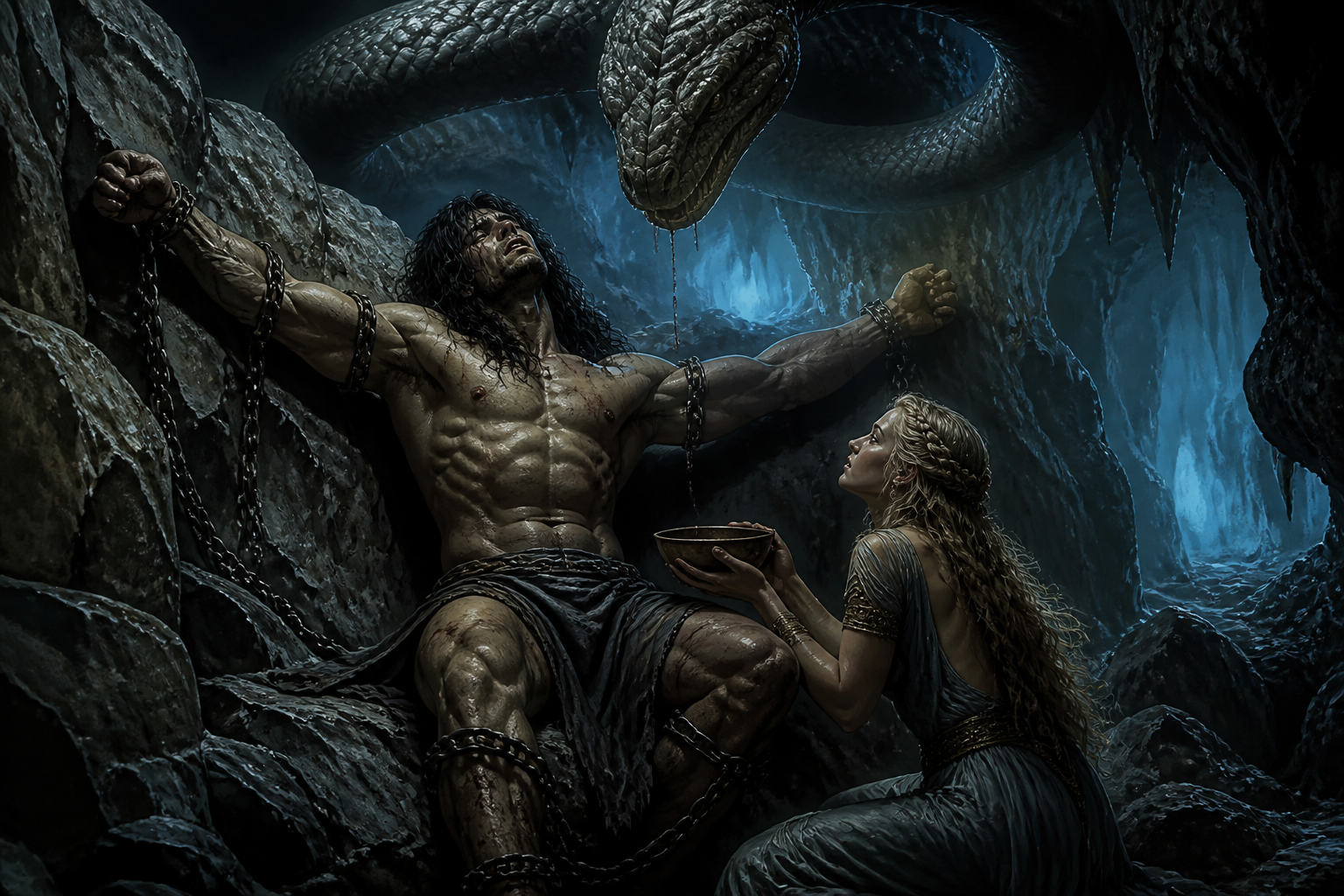
She took a venomous serpent and suspended it directly above Loki’s face. The creature coiled in the darkness, dripping venom continuously. Drop after drop fell toward the bound god’s face. There was no escape. The venom burned. It caused indescribable agony.
This detail matters. In Norse punishment mythology, physical suffering is rarely the worst element. What makes Loki’s torment distinctive is that it is endless and inescapable. He cannot move away from the venom. He cannot dodge or shield himself. He must simply endure.
Sigyn and the Earthquakes of Midgard
Here enters one of mythology’s most poignant figures: Sigyn, Loki’s devoted wife. Though Loki had betrayed the gods and brought death to Baldur, Sigyn remained loyal to her husband. She positioned herself beside him in that dark cave, holding a bowl above his face to catch the falling venom.
As long as she holds the bowl steady, Loki is safe from the worst of the poison. But no human—even a goddess—can stand forever. Eventually, her arms grow tired. She must empty the bowl. When she does, venom strikes Loki’s face directly.
According to the Eddas, when Loki writhes in agony from the venom striking his face, he thrashes with such violence that the earth shakes. Earthquakes, in Norse belief, are quite literally Loki’s suffering. Every tremor and quake you feel in Midgard is the bound god’s anguished struggle.
This explains natural disasters in purely mythological terms. But it also reveals something profound about Norse cosmology: the suffering of the punished directly impacts the living world. There is no separation between divine punishment and mortal experience.
The Temporary Nature of Divine Punishment
Here lies the crucial difference between Loki’s punishment and concepts of eternal damnation in other religious traditions. Norse punishment is not permanent. Even gods cannot escape fate. Wyrd binds everyone—including those who bind others.
The Eddas are explicit about this. Loki will not remain bound forever. At Ragnarok, when the world ends, his chains will snap. The Prose Edda describes how “Loki breaks loose” and joins the forces arrayed against the gods. He will captain the ship Naglfar, a vessel constructed from the fingernails of dead men—a horrifying image of death made manifest.
In some accounts, Loki is fated to meet Heimdall, the watchman of the gods, and the two will slay each other in their final confrontation. Neither god nor trickster escapes their doom. Both die in the end.
This is fundamentally different from Christian concepts of eternal punishment. In Norse belief, even the worst punishment has an endpoint. Even the most terrible crime has a predetermined moment of reckoning and release.
Wyrd and the Limits of Divine Power
Wyrd—usually translated as “fate”—is the ultimate authority in Norse cosmology. Even Odin, king of the gods, cannot escape it. He knows he will fall at Ragnarok. He knows what his fate will be. Yet he acts anyway, knowing the futility of resistance.
Loki’s binding illustrates this principle perfectly. The gods bind him. They make him suffer. But they cannot make it permanent. The same inexorable force that governs mortal life governs divine punishment as well. Everything ends. Everything changes.
What Loki’s Binding Reveals About Norse Cosmology
Norse mythology does not offer the comfort of eternal stability or final justice. The world is not built to last. The gods themselves are mortal. Order is constantly threatened by chaos. Punishment is real, but temporary.
Loki’s bound state symbolizes the gods’ attempt to impose order on chaos. But it is an imperfect, unstable order. Sigyn stands beside him, not in triumph, but in compassion. She eases his suffering because she loves him, even though he destroyed the world’s greatest god.
This suggests something profound about the Norse worldview: loyalty and love persist even in a cosmos destined to end. Punishment is just. But pity is possible. Duty and compassion coexist.
The binding also explains suffering in the natural world without suggesting divine cruelty. Earthquakes are not acts of god—they are the inevitable result of one god’s torment. Suffering serves a cosmic function. It is not random or meaningless.
Loki’s Binding in Modern Culture
The image of Loki bound, with venom dripping on his face and Sigyn holding her bowl, has lost none of its power over centuries. Modern adaptations—from Marvel Comics to television to novels—consistently return to this myth. Why?
Perhaps because the myth contains genuine moral complexity. Loki is punished justly for his crimes. But his punishment is brutal. His wife loves him. His sons suffer for his actions. There are no easy answers. In our modern age of ambiguous morality and complicated justice, Loki’s bound punishment speaks directly to contemporary concerns.
The image also endures because it is visceral and memorable. Venom dripping. Chains of entrails turning to iron. A devoted wife holding a bowl against infinite suffering. These are not abstract concepts. They burn themselves into the mind.
Loki’s bound punishment remains one of mythology’s most vivid representations of divine retribution combined with inescapable fate. It shows us a cosmos where even the gods cannot create permanent order, where punishment is real but not eternal, and where love persists even in darkness. That is why, more than a thousand years after the Norse peoples carved these stories into memory, we still find ourselves drawn to Loki beneath the earth, bound by the entrails of his son, tortured by a serpent’s venom, awaiting the day when fate itself will set him free.
About This Article

Written by Elias Blackwood. Elias Blackwood has spent 25 years as an obsessive collector of world mythology and folklore, from Greek and Norse epics to Japanese yokai and West African trickster tales — entirely self-taught, for the love of it. His reading draws on comparative mythology, cultural anthropology, and a personal library of translations most people have never heard of. More about this site.
Verify this against a primary source
Specifics change, and your situation may differ from the one described here. These are the authorities worth checking directly:
- Theoi Project — Greek mythology texts with primary source citations
- Perseus Digital Library — classical texts in the original and in translation
- Encyclopaedia Britannica — edited reference for figures and traditions