Most modern retellings—whether in video games like Hades or popular adaptations of Greek myths—portray Dionysus as the easygoing, wine-loving party god who exists for a good time. But that flattened version bears almost no resemblance to what the ancient sources actually describe. When you turn to Euripides’ Bacchae, Hesiod’s Theogony, or the Homeric Hymns, what emerges is something far darker, stranger, and theologically far more demanding than any carefree revelry.
Over the past quarter-century, tracing mythological traditions across libraries, archives, and conversations with regional storytellers from Greece to Scandinavia to West Africa, I have come to recognize the Dionysus material as among the most persistently misread in classical studies. The popular image—a cheerful, somewhat rumpled deity presiding over wine and excess—strips away nearly everything that rendered Dionysus authentically perilous, theologically intricate, and fundamental to ancient Greek religious thought.
Let me set the record straight.
The Wine Reduction: Why That Frame Misses Everything
Certainly, Dionysus carries strong associations with wine. I will not deny this basic fact. Yet to confine him within that single attribute is akin to characterizing Poseidon as “the trident fellow”—technically defensible on the surface, yet profoundly deceptive in substance.
Across the ancient texts—Euripides’ Bacchae, Hesiod’s Theogony, the Homeric Hymns, and the later accounts preserved by Pausanias and Diodorus Siculus—Dionysus emerges as fundamentally a god of metamorphosis, altered perception, and the fracturing of categorical boundaries. Wine functioned as the medium through which that state materialized, not as the ultimate goal. The ancient Greeks conceptualized alcohol not as a casual indulgence but as something approaching the sacred. When wine was consumed at a symposium, the act itself constituted ritual observance. The deity inhabited the vessel itself.
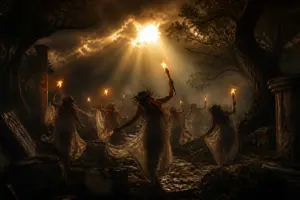
Equally vital: Dionysus presided over what scholars designate enthusiasmos—the condition of hosting divinity within oneself. The Maenads, his female devotees rendered across vase paintings and recounted with visceral intensity in the Bacchae, were far more than intoxicated women careening through wilderness. They inhabited an altered condition that the Greeks construed as godly possession itself. Euripides renders the catastrophe: when such force encounters denial or ridicule, its consequences turn apocalyptic.
The Origin Narratives: Layers Rarely Acknowledged
A widespread account circulates in condensed form: Dionysus originated through birth from the thigh of Zeus, his mother Semele having perished in the sight of Zeus’s uncloaked divinity. This much carries historical grounding, yet it occludes two dimensions of critical importance.
The first involves the Orphic corpus, which transmits an altogether divergent narrative. Within Orphic texts—surviving fragments stemming from approximately the fifth century BCE onward—Dionysus connects with the figure of Zagreus, offspring of Zeus and Persephone. The Titans, their bodies dusted with white powder (particulars that have preoccupied classical scholars across generations), seduce this child with playthings before tearing his form to fragments and consuming them utterly. Athena retrieves the organ of his heart. Zeus consumes it, or transfers it to Semele, and Dionysus emerges in renewed form. This narrative carries no festive tone. Rather, it concerns itself with obliteration, fragmentation, and return to existence—themes that numerous scholars detect resurfacing in mystery-cult observances and potentially influencing theological developments in early Christian doctrine.
The second complication runs geographically deep. Surviving testimonies diverge sharply: was his origin Thracian? Phrygian? Lydian? Or did Greek lands claim him natively? Herodotus treated him with palpable reservation as a tradition arriving from abroad. Mycenaean inscriptions from Linear B tablets recovered at Pylos—dateable to approximately 1200 BCE—may contain a name-form potentially linked to Dionysus, which would situate him within Greek religion far earlier than the classical era typically permits. Scholarly consensus here remains fractured; the evidence admits no singular interpretation. I will be candid: anyone presenting a definitive account of Dionysus’s entry into the Greek religious establishment is engaging in oversimplification.
Theater and Dionysus: The Overlooked Spiritual Axis
This particular connection generates genuine astonishment whenever I raise it in public settings or research conversations. The tragic dramas of Athens—the canonical works of Aeschylus, Sophocles, and Euripides—debuted within the framework of a ceremonial gathering termed the City Dionysia. These performances unfolded within the theater of Dionysus itself, constructed upon the Acropolis’s southern face. Every performance reserved a ceremonial seat for the priest occupying Dionysus’s sanctuary.
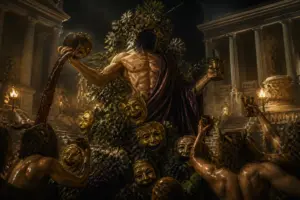
Theater was not mere spectacle that incidentally bore Dionysus’s name. Rather, it constituted a sacred observance consecrated to Dionysus himself. The Greek term theatron—denoting the viewing space—took shape around the action of observing metamorphosis. Masks adorned the performers’ faces. They inhabited alternate identities. The spectators underwent what Aristotle would term catharsis—that celebrated emotional catharsis which tragic representation generates. Every dimension—the concealment through masks, the inhabitation of transformed selfhood, the discharge of contained psychological experience—belongs wholly to the Dionysian sphere.
Once this relationship comes into focus, Euripides’ Bacchae transforms into something far more audacious. It transcends a narrative of divine punishment meted out to a skeptical monarch. It becomes a dramatic piece enacted at a festival honoring that very god, wherein that deity materializes as a speaking figure, effectively challenging the assembled spectators to repudiate his authority. The theological boldness residing in this design becomes nearly invisible should Dionysus reduce to a wine-dispensing deity.
Intoxication and Brutality: The Unresolved Tension
The most candid statement I can offer, given my extended engagement with these sources, concerns this: Dionysus occupies a space that conventional frameworks cannot contain. The ancients grasped this reality with clarity. Walter Otto, whose 1933 monograph Dionysus: Myth and Cult remains—notwithstanding the decades intervening—foundational to the field, rendered Dionysus as the god of simultaneous “supreme felicity and supreme dread.” That fundamental contradiction constitutes the core.
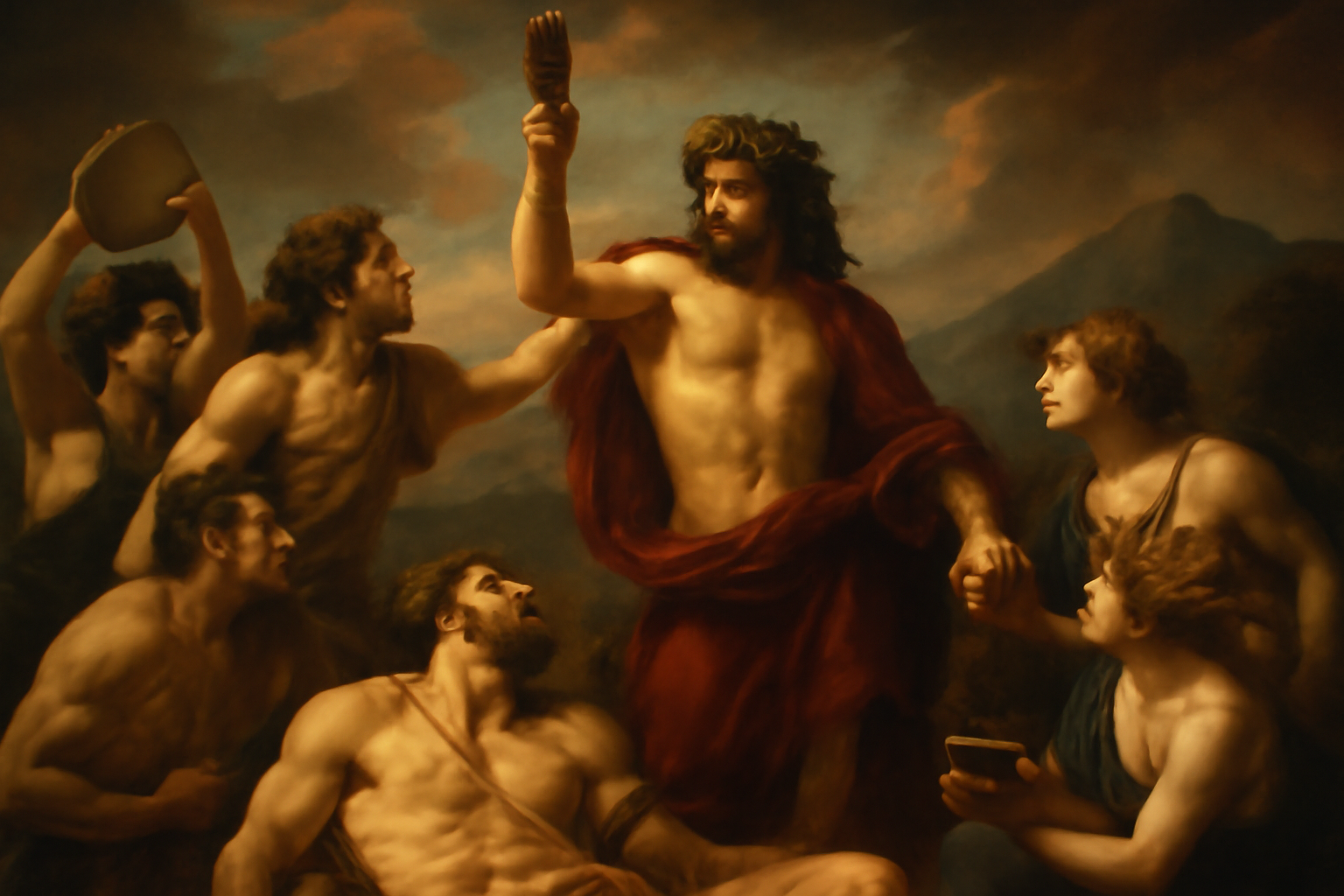
He bestows wine, which yields happiness. Simultaneously, he unleashes frenzy. He manifests as the great liberator—Eleutherios served as one of his recognized cult epithets. Conversely, he annihilates. In the Bacchae, his own progenitor Agave, seized by godly derangement, dismembers her biological offspring Pentheus with bare force, imagining him to be a beast of the mountain ranges. Dionysus precipitates this outcome. The narrative does not cast him as morally culpable. Rather, the Greeks perceived such devastation as the inevitable consequence of rejecting the divine, of imposing rational governance upon something inherently unreasonable and wild.
This does not represent a deity of festivity. What emerges is something far antiquated, far uncanny, and far more terrifying.
Building a Stronger Foundation: Sources Worth Your Time
Should you wish to transcend cursory accounts and genuinely immerse yourself in the Dionysus tradition as antiquity preserved it, beginning with accessible yet rigorous secondary literature makes sense before engaging the primary texts themselves. Three works merit consistent mention in my recommendations:
- Greek Mythology: The Gods, Goddesses, and Heroes Handbook — Part of the World Mythology and Folklore Series, this is a solid profile-based reference that covers the major figures clearly and accurately. Good for getting your bearings on who’s who before diving into the messier, more complex primary accounts.
- Mythology: Timeless Tales of Gods and Heroes (75th Anniversary Illustrated Edition) — Edith Hamilton’s classic, now in a beautiful illustrated edition. Hamilton has her critics in academic circles, and I share some of those reservations, but as an entry point into Greek myth this remains one of the most readable introductions available.
- Ancient Greece: The Definitive Visual History (DK Classic History) — If you want the cultural and historical context for why the myths developed the way they did, this DK volume provides an excellent visual grounding in the world that produced them. Understanding the City Dionysia, the symposium culture, and the mystery cults is impossible without that context.
Once you have worked through these, I would urge you to sit with Euripides’ Bacchae employing a dependable rendering—the Seaford or Kovacs translations are suited for attentive reading—and then reassess the assumptions you harbored about Dionysus from the outset. Your comprehension will undergo transformation.
Final Reflection
What the ancient sources transmit regarding Dionysus resists reduction to a cheerful anecdote concerning a wine-loving god. Instead, the material reveals one of classical antiquity’s most theologically demanding figures—a being commanding transformation, derangement, death, renewal, theatrical expression, and the vertiginous ecstasy attendant upon the dissolution of rational consciousness into something boundless. The Greeks deemed him consequential enough to construct their most magnificent artistic enterprise around his veneration.
We would be wise to accord him considerably greater respect than a fraternity drinking ritual merits.
The Reference Guide That Moves Past the Clichéd Dionysus
Has this investigation fundamentally altered your conception of Dionysus? This reference guide furnishes the framework for reconstructing that understanding—one anchored in how ancient peoples genuinely encountered him, moving decisively beyond the reductive “party god” shorthand into genuine theological depth.
Where it succeeds
- Offers substantive coverage of Dionysus with grounding in verifiable historical sources, situating his religious function within contexts far exceeding wine consumption and festive behavior
- Uses clear formatting and accessible language structures that enable straightforward navigation between deities and mythic material when you encounter contradictions or pursue connected ideas
- Pitched at readers who have moved past juvenile myth summaries yet lack the background required to engage scholarly translations of Greek dramatic works unassisted
Where it falls short
- Should you maintain active familiarity with primary materials—the Bacchae, Frogs, and comparable texts—this work will strike you as foundational in scope rather than offering substantive advancement
- Encompasses Greek mythological material more broadly rather than furnishing the concentrated, monographic treatment reserved for Dionysian religious studies exclusively
If you’re still building your foundation in Greek mythology and want a reliable reference that won’t perpetuate the “party god” myth, this is exactly where to start. Greek Mythology: The Gods, Goddesses, and Heroes Handbook
About This Article

Written by Elias Blackwood. Elias Blackwood has spent 25 years as an obsessive collector of world mythology and folklore, from Greek and Norse epics to Japanese yokai and West African trickster tales — entirely self-taught, for the love of it. His reading draws on comparative mythology, cultural anthropology, and a personal library of translations most people have never heard of. More about this site.
Verify this against a primary source
Specifics change, and your situation may differ from the one described here. These are the authorities worth checking directly:
- Theoi Project — Greek mythology texts with primary source citations
- Perseus Digital Library — classical texts in the original and in translation
- Encyclopaedia Britannica — edited reference for figures and traditions