
The churel is one of the most feared revenants in South Asian folklore, a vengeful spirit born from injustice rather than simple death. She rises specifically from women who died during pregnancy, childbirth, or menstruation, or from those neglected and abused by their own families. In more than two decades of studying comparative folklore, I have found few figures as psychologically loaded as the churel. She is not a random monster. She is a grievance made flesh, and her legend spans Pakistan, India, Bangladesh, and Nepal.
What Is a Churel? Defining a Vengeful Death
In Hindi and Urdu, the churel is often called chudail, and both names describe the same restless dead. She is the ghost of a woman whose death was considered ashaudh, or ritually impure. William Crooke, the British folklorist who documented North Indian belief systems in his 1896 study “The Popular Religion and Folk-Lore of Northern India,” recorded dozens of local accounts describing her origin. According to Crooke’s informants, a woman who died in childbirth, during her period, or through cruelty from in-laws was believed unable to pass peacefully into the ancestral world. As a result, she lingered, angry and unsatisfied, bound to the household that failed her.
This is a crucial distinction from many Western revenants. The churel is not created by a vampire’s bite or a curse from outside. Instead, she is manufactured by her own community’s failure. Her death is the crime, and her haunting is the consequence.
Her Appearance: The Beauty That Hides Backward Feet
Descriptions of the churel’s true form are consistently unsettling across regional collections. She typically appears with unbound, wild hair, sagging or pendulous breasts, and skin described as dark or ash-colored. Her most distinctive feature, however, is her feet. In account after account, from Punjab to Bengal, her toes point backward, with heels facing forward. H.A. Rose, in his early twentieth-century “Glossary of the Tribes and Castes of the Punjab and North-West Frontier Province,” noted this reversed-foot detail as a near-universal identifier among villagers describing her.
Despite this grotesque true shape, the churel possesses a dangerous gift. She can disguise herself as a strikingly beautiful young woman, often appearing at dusk near wells, crossroads, or lonely fields. Men are drawn to her before realizing, often too late, that her feet betray her nature. This shapeshifting talent places her firmly among the vampires of East and South Asia, where beauty frequently masks a predatory hunger.
Blood, Youth, and Revenge: How the Churel Feeds
The churel’s hunger is not random. She targets, above all, the male relatives who wronged her in life. A husband, a brother-in-law, or a father-in-law who mistreated her becomes her preferred prey. In many recorded tales, she lures such men with her disguised beauty, then drains their blood, breath, or vital essence over repeated encounters.
Crucially, her victims do not simply die. Instead, they wither. Folklore from rural Uttar Pradesh and parts of Bihar describes men aging rapidly after these encounters, their hair graying and their strength failing within weeks. Sarat Chandra Mitra, an early twentieth-century Bengali folklorist, documented similar cases in his journal contributions on Bengali demonology, noting that the churel’s victims were often young, virile men who grew suddenly frail. This slow, degenerative feeding pattern separates her from Western vampires that kill outright. Her revenge is patient, and it is personal.
Burial Precautions Against a Rising Churel
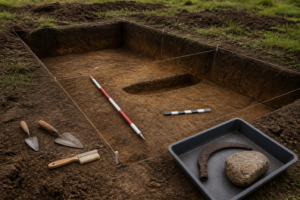
Because the danger of a churel was taken seriously, communities developed elaborate burial precautions rather than relying on cremation, the standard Hindu funerary practice. Women who died in the conditions associated with churel transformation were frequently buried instead of cremated, a significant deviation meant to contain rather than release the spirit.
Specific methods appear repeatedly across regional accounts. Bodies were buried face-down, so that if she attempted to claw her way upward, she would dig herself deeper into the earth. Iron nails were driven through her palms, hands, or feet, iron being widely regarded across South Asian folklore as repellent to spirits. Her toes were sometimes tied together, deliberately restricting the very appendages believed capable of carrying her far from the grave. Mustard seeds were scattered over the burial site or the path leading to it, forcing her, according to belief, to stop and count every single seed before continuing.
Burial at a crossroads was another common precaution, intended to confuse a rising spirit about which direction led home. These practices bear a striking resemblance to European treatment of the “unclean dead,” documented by folklorist Paul Barber in his 1988 study “Vampires, Burial, and Death.” Barber described strikingly similar precautions taken against suspected vampires in Eastern Europe, including face-down burial, staking, and burial at crossroads. This parallel suggests a shared human anxiety about improper death, expressed independently across distant cultures within the wider history of vampires.
- Face-down burial to redirect any attempt to rise
- Iron nails driven through palms or feet
- Toes bound tightly together
- Mustard seeds scattered along burial paths
- Interment at crossroads to disorient the spirit
From Persia to Bengal: Tracing the Churel’s Older Roots
The churel’s regional spread is remarkably wide. She appears under regional names throughout India, Pakistan, Bangladesh, and Nepal, with local variations in her methods but consistent core traits. In Punjab she is often called chudail, while in parts of Bengal she carries the name shakchunni, a related but distinct figure tied to similar anxieties about wronged wives. Additionally, several folklorists have traced older Persian threads within this belief complex. Crooke himself speculated that childbirth-demon figures from Persian and Central Asian tradition, particularly the Al or Almasti described in Turkic and Persian folk religion, may have influenced South Asian conceptions of dangerous female spirits tied to birth. Trade routes and shared Indo-Iranian linguistic heritage likely carried these motifs eastward over centuries. This does not make the churel a borrowed figure. Instead, it suggests a deep, cross-regional preoccupation with the dangers surrounding childbirth and the spirits believed to emerge from it.
The Churel as Social Memory and Guilt
Folklorists studying the churel consistently read her as more than a scare story. Specifically, she functions as an expression of communal guilt. Women who died in childbirth were often victims of poor medical care, exhausting domestic labor, and neglect by families who prioritized sons and husbands. Her legend, in this reading, encodes an uncomfortable truth: these women were failed long before their deaths. Her targeting of male in-laws is particularly telling. Folklore rarely punishes strangers in these tales. Instead, it punishes fathers-in-law who overworked her, husbands who ignored her suffering, and brothers-in-law who mistreated her. As a result, the churel becomes a vehicle for a suppressed communal conscience, allowing storytellers to voice anger at domestic abuse and neglect without directly accusing living relatives. Her wrath is narrative justice, delivered by the dead when the living failed to provide it.
The Churel in Modern Film and Television
Contemporary South Asian media has kept the churel firmly alive. Bollywood horror films have repeatedly drawn on her backward feet and shapeshifting beauty, often blending her with broader chudail tropes for dramatic effect. Pakistani television dramas have likewise featured churel-inspired antagonists, frequently using her tragic origin as a subtext for stories about domestic mistreatment. Nepali and Bangladeshi horror cinema have produced their own regional interpretations, typically preserving her core traits while adapting details to local settings. These modern portrayals sit within a much larger cinematic tradition exploring the vampires of East and South Asia, where female revenants frequently embody both horror and social critique. Even as special effects modernize her image, filmmakers rarely abandon her defining backward feet, a detail too iconic and too rooted in oral tradition to discard.
Why the Churel Still Matters
After twenty-five years of studying revenant folklore worldwide, I keep returning to the churel as one of the clearest examples of a monster born from injustice rather than malice alone. She is frightening, certainly, with her wild hair and reversed feet. However, her true power lies in what she represents: a community’s uneasy memory of the women it failed. The churel endures not because she is simply terrifying, but because her grievance still resonates.
The churel belongs to a much wider family of the undead. I place her beside the vetala, the jiangshi, and others in my guide to the vampires of East and South Asia — itself part of a broader look at the history of vampires across the world.
About This Article

Written by Elias Blackwood. Elias Blackwood has spent 25 years as an obsessive collector of world mythology and folklore, from Greek and Norse epics to Japanese yokai and West African trickster tales — entirely self-taught, for the love of it. His reading draws on comparative mythology, cultural anthropology, and a personal library of translations most people have never heard of. More about this site.
Verify this against a primary source
Specifics change, and your situation may differ from the one described here. These are the authorities worth checking directly:
- Theoi Project — Greek mythology texts with primary source citations
- Perseus Digital Library — classical texts in the original and in translation
- Encyclopaedia Britannica — edited reference for figures and traditions