Most of what we know about vampire belief comes from written sources: trial records, church complaints, travellers’ reports, the folklorists who arrived in the nineteenth century with notebooks. All of it is filtered through someone. Archaeology is the one line of evidence that is not — a grave is a thing people did, not a thing people said, and the ones archaeologists call deviant burials are the closest we get to watching the belief in action.
What Counts as a Deviant Burial
The term is deliberately neutral. A deviant burial is simply one that departs from the normal funerary practice of its own cemetery and period — and the comparison is local, which is the whole point. A prone burial in a community that always buried prone is not deviant. The same burial in a churchyard of two hundred supine, east-facing graves is a decision someone made.
The recurring departures across European sites are consistent enough to list:
- Prone burial — face-down, sometimes with the head turned further into the ground.
- Weighting — stones, slabs or bricks laid over the chest, pelvis or head.
- Bindings — evidence of the ankles, knees or wrists tied.
- Pinning — iron stakes, nails or rods driven through the torso or limbs into the grave floor.
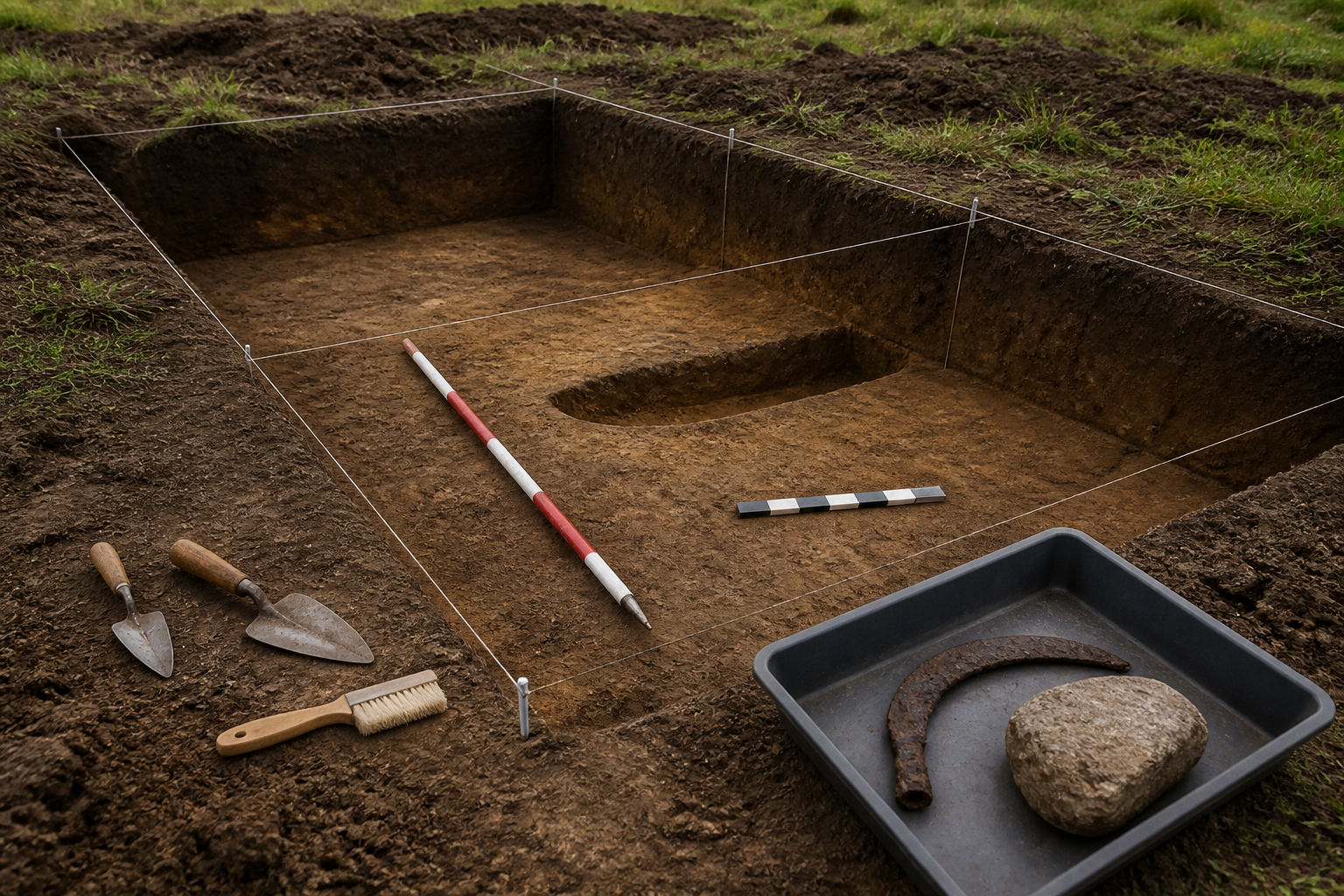
- Bladed grave goods placed against the body rather than beside it — most famously sickles across the throat or abdomen.
- Interference with the mouth — a stone, brick or tile inserted between the jaws.
- Decapitation or dismemberment, sometimes with the head placed between the legs or at the feet.
- Location — burial outside consecrated ground, at a boundary, or at a crossroads.
Venice, 1576: The Woman with the Brick
The most widely reported single find comes from a mass grave on the island of Lazzaretto Nuovo in the Venetian lagoon, used during the plague epidemic of 1576. Excavation in 2006 recovered the skeleton of an elderly woman with a brick wedged in her mouth. Matteo Borrini, who led the work, published the find in 2010 and argued it reflected the nachzehrer or shroud-eater belief: the notion that a corpse chewing its own shroud spread plague, and that blocking the mouth stopped it.
The interpretation was contested almost immediately — other researchers pointed out that bricks and rubble were abundant in that grave and that a fragment can enter an open jaw by accident during a mass interment. I find the deliberate reading persuasive on balance, given how precisely the brick sits, but it is a good example of the central difficulty in this field: a single grave rarely proves intent. Patterns do.
Drawsko, Poland: Sickles and Stones
Drawsko 1 is a much stronger case, and it is my usual answer when someone asks whether vampire burials are real. The seventeenth- to eighteenth-century cemetery in north-western Poland produced six burials with sickles laid across the throat or abdomen and several with stones placed under or against the chin.
What makes the site valuable is that the team, led by Lesley Gregoricka and Tracy Betsinger, went further than describing the graves. They ran strontium isotope analysis on the tooth enamel to test the standard assumption that suspected revenants were outsiders — migrants, strangers, the unfamiliar dead. The 2014 results in PLOS ONE did not support it. The individuals given apotropaic treatment were local, matching the isotope signature of the surrounding population.
That is a genuinely useful finding, and it changed how I think about the whole subject. The suspected vampire was not the stranger from over the hill. She was a neighbour — someone the community knew, who died in a way that made them uneasy.
Bulgaria: The Iron-Pinned Dead
Bulgarian sites have produced some of the most literal cases: skeletons with iron rods or ploughshares driven through the chest cavity. Bozhidar Dimitrov, then director of the National History Museum in Sofia, announced finds at Sozopol in 2012 that drew heavy international coverage, and he estimated that around a hundred such burials were known from Bulgaria.
The Bulgarian material is also where the treatment is best attested for people of status — the graves are not confined to the marginal or the poor. Whatever drove the practice, it was not simply contempt for the socially unwanted.
Britain and the Anglo-Saxon Record
Deviant burial is not a purely eastern European phenomenon, and I think the British material is underrated in popular accounts. Andrew Reynolds’s Anglo-Saxon Deviant Burial Customs (2009) catalogues execution cemeteries and boundary burials across England, and sites such as Southwell in Nottinghamshire have produced bodies pinned with iron.
The complication is that in the English record it is genuinely hard to separate fear of the restless dead from ordinary judicial punishment and denial of Christian burial. A body face-down at a boundary might be a suspected revenant or an executed criminal denied the churchyard. Sometimes the honest answer is that we cannot tell.
Why the Bodies Looked Wrong
The natural question is what the community saw that made them do this. Decomposition is the short answer, and it is worth knowing what it actually does, because almost every classic vampire sign maps onto it.
- Bloating from gas produced by gut bacteria makes a corpse look well fed rather than wasted.
- Purge fluid — decomposition liquid forced out of the nose and mouth — reads convincingly as fresh blood.
- Skin slippage retracts the gums and nail beds, so teeth and nails appear to have grown.
- Gas pressure can produce sound when a body is moved or staked, which is where the groaning corpse of the accounts comes from.
- Variable decay rates — cold ground, clay soil, deep burial — mean an exhumed body may be far better preserved than a neighbour’s, with no explanation available to the people looking at it.
None of this makes the villagers foolish. Given the evidence in front of them and no theory of bacterial decomposition, the conclusion that this particular corpse was not behaving like the others was a reasonable reading of the data.
How to Read a Vampire Grave Without Overreading It
Three cautions I would apply to any headline announcing a vampire burial.
- Deviant does not mean vampire. The same treatments were used against witches, suicides, the excommunicated, criminals and the plague dead. Archaeologists can identify unusual treatment; the belief behind it usually has to come from documents.
- Taphonomy first. Objects shift, soil moves, graves are disturbed and reused. A stone in a mouth is only meaningful once accidental deposition has been ruled out.
- The word ‘vampire’ is ours. It appears in English in the 1730s. Applying it to a fourteenth-century Italian grave imports a whole later mythology into a burial that predates it.
With those caveats in place, what survives is still substantial. Across a large part of Europe, over several centuries, communities repeatedly opened graves or prepared bodies in ways designed to keep a specific dead person in the ground. They were locals. They were sometimes people of standing. And someone in that community was frightened enough to bring a sickle to a funeral.
Related from Legendary Mythics
- The Complete History of Vampires: From Ancient Corpses to Count Dracula
- Slavic & Eastern European Vampires: Strigoi, Upyr, and the Real Vampire Panics
- Strigoi: Romania’s Restless Dead and the Root of Dracula
About This Article

Written by Elias Blackwood. Elias Blackwood has spent 25 years as an obsessive collector of world mythology and folklore, from Greek and Norse epics to Japanese yokai and West African trickster tales — entirely self-taught, for the love of it. His reading draws on comparative mythology, cultural anthropology, and a personal library of translations most people have never heard of. More about this site.
Verify this against a primary source
Specifics change, and your situation may differ from the one described here. These are the authorities worth checking directly:
- Theoi Project — Greek mythology texts with primary source citations
- Perseus Digital Library — classical texts in the original and in translation
- Encyclopaedia Britannica — edited reference for figures and traditions