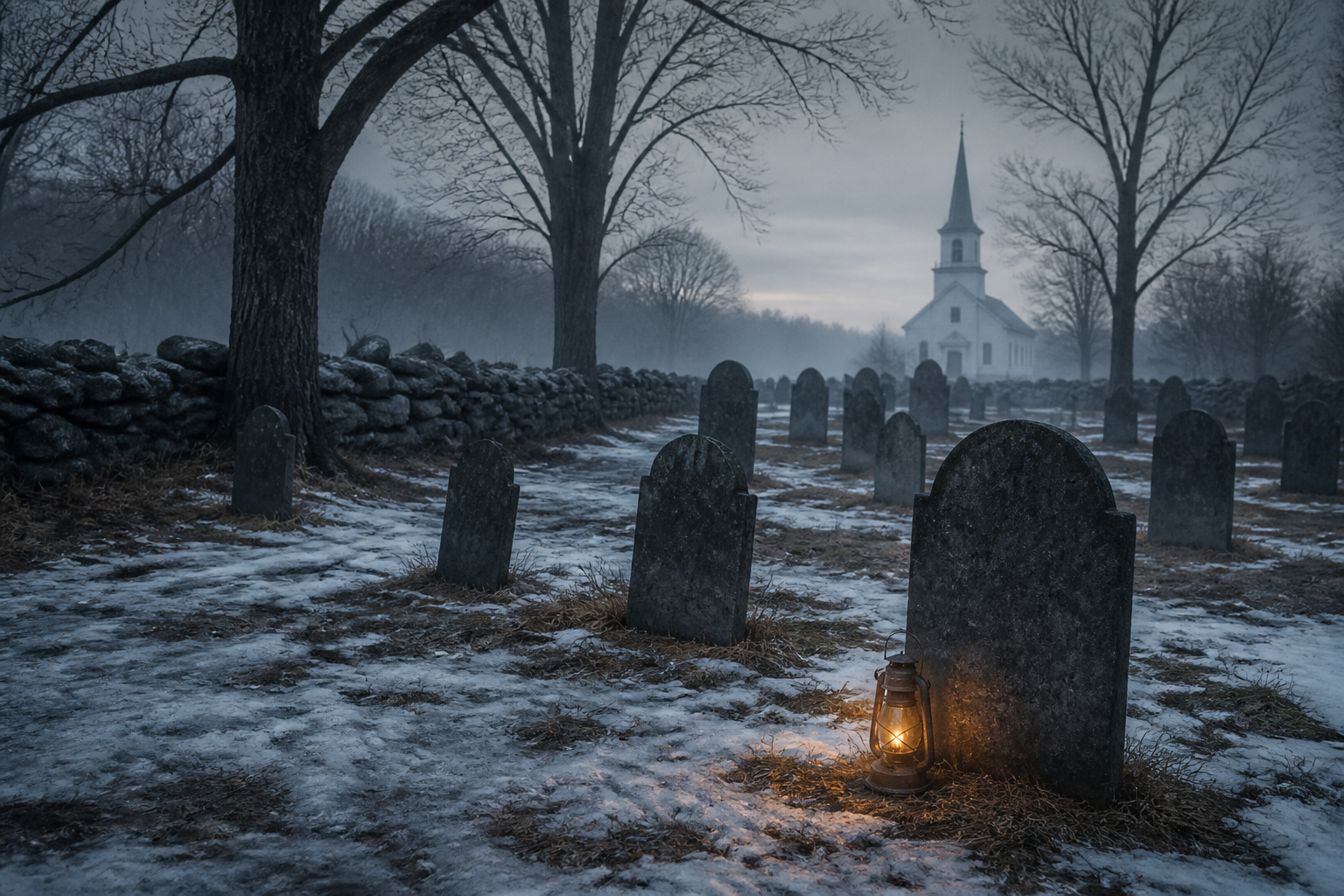
The last well-known vampire exhumation in the United States happened in 1892, in Exeter, Rhode Island, and it was reported in the newspapers. That fact still stops me. We tend to file vampire panics away in a distant Balkan past, comfortably remote. Mercy Brown was disinterred nine years after the Brooklyn Bridge opened.
What Actually Happened in Exeter
George Brown, a farmer in Exeter, lost his wife Mary to tuberculosis in 1883, his eldest daughter Mary Olive the following year, and by the winter of 1891–92 his daughter Mercy as well. His son Edwin was dying of the same disease. Neighbors pressed Brown to act on an older explanation: that one of the dead was feeding on the living and would keep doing so until the family intervened.
In March 1892 the bodies were exhumed. The two long-buried women had decomposed as expected. Mercy, dead only a few months and stored above ground through a New England winter, had not. There was liquid blood in her heart. To the men standing at the grave, that was the confirmation. Her heart and liver were burned, and the ashes were mixed with water for Edwin to drink. He died anyway, roughly two months later.
The Mistake That Made It Persuasive
This is the part I think is genuinely important, and Paul Barber makes the case at length in Vampires, Burial, and Death: Folklore and Reality (1988): the villagers were not hallucinating. They were reasoning correctly from a false premise about decomposition.
A body kept near or below freezing decomposes very slowly. Blood remains liquid rather than clotting into the state a layperson expects. Bodies bloat, shift, and can produce sounds and fluids that look, to someone without a forensic frame of reference, exactly like the signature of something still alive. Every observation the Exeter men made was accurate. Only the interpretation was wrong — and it was wrong in a way that was very hard to detect from inside their knowledge of the world.
This Was Not an Isolated Incident
Michael Bell’s Food for the Dead: On the Trail of New England’s Vampires (2001) documents a pattern of these exhumations across Rhode Island, Connecticut, Vermont and Massachusetts, running from the late eighteenth century well into the nineteenth. Mercy Brown is simply the best-recorded case because she was the last prominent one and because the press covered it.
The trigger is consistent across the cases: consumption — pulmonary tuberculosis — moving through a household one member at a time. The disease’s slow wasting, the pallor, the coughing of blood, and above all its habit of taking family after family member in sequence made the vampire explanation feel like it fit the evidence.
The Graves Archaeologists Can Still Read
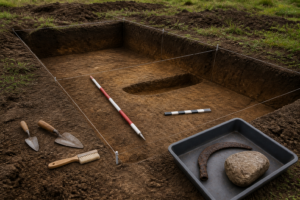
In 1990, children playing in a gravel quarry in Griswold, Connecticut, uncovered a colonial-era burial ground. One burial, catalogued as JB-55 from brass tacks on the coffin lid, had been reopened years after death and rearranged: the femurs removed and laid across the chest in a skull-and-crossbones arrangement. Analysis of the remains showed lesions consistent with tuberculosis.
JB-55 is the material counterpart to the newspaper accounts — direct physical evidence that people in New England opened graves and interfered with the dead in response to this disease. Later DNA and genealogical work has proposed an identification for the individual, though I would treat any specific naming with the caution such reconstructions deserve.
The Remedies People Actually Used
The treatments recorded across the New England cases vary by community, which is itself evidence that this was living folk practice rather than a single imported ritual:
- Burning the heart, sometimes with the liver and lungs — the most frequently recorded remedy, and the one used at Exeter.
- Inhaling the smoke of the burning organs, or drinking the ashes in water or medicine, as Edwin Brown was made to do.
- Turning the body face down in the coffin.
- Rearranging the bones, as at Griswold, so the dead could not rise in an ordered form.
- Simply reburying after inspection, when the corpse showed the decomposition people expected.
That last point matters and is easy to miss. These exhumations were tests, not foregone conclusions. When a body looked the way the community expected a months-old corpse to look, it was reburied and the family was told to look elsewhere for the cause. The procedure had a negative result available to it.
Why the New England Cases Matter
Two reasons, for me. First, they demolish the idea that vampire belief is a medieval or exclusively Eastern European phenomenon; it is a response people reach for under a particular kind of pressure, and colonial New England supplied that pressure in the form of tuberculosis. Second, no one in these accounts uses the word vampire. That was the newspapers’ framing. The families were doing something older and simpler: trying to stop a dead relative from taking the rest of them.
Consumption: What People Were Actually Watching
To understand why anyone reached this conclusion you have to understand what pulmonary tuberculosis looked like from inside a farmhouse in 1850, without a germ theory to hang it on.
It moved slowly — months, often years. It hollowed the sufferer out: weight loss so severe the disease was called consumption because the patient appeared to be consumed from within. It brought pallor, then a hectic flush, then coughing up blood. And it passed from one family member to the next in sequence, often striking hardest at the young and the recently bereaved, because those were the people who had nursed the previous case in a small, closed, unventilated room.
Set that beside the vampire hypothesis and the fit is uncomfortably good. Someone dies. A surviving relative begins to waste, grows pale, complains of a weight on the chest at night, and coughs blood. Another follows. The dead person is, in a real and observable sense, taking the family with them. The wrong explanation was not a stupid one — it was a reasonable inference from an accurate observation with a critical piece missing.
The Newspapers, and Why This Is So Well Documented
A great deal of vampire folklore reaches us third-hand through folklorists. The New England cases are different: they happened inside a literate society with local newspapers, and they were reported at the time — often by writers appalled at their neighbours.
George Stetson’s 1896 article in American Anthropologist, “The Animistic Vampire in New England,” surveyed the Rhode Island cases while they were still within living memory. Contemporary press coverage of the Brown exhumation was widely reprinted. Michael Bell, whose Food for the Dead (2001) remains the standard modern account, worked from town records, diaries and newspaper morgues to document dozens of cases across Rhode Island, Connecticut, Vermont, Massachusetts and Maine.
That paper trail is why I keep returning to this episode. For most of the folklore on this site we have the belief and must infer the practice. Here we have names, dates, printed objections, and in the Walton case a body in the ground with the evidence still arranged on the coffin lid.
Mercy Brown and the Dracula Question
It comes up every time, so it is worth addressing. Stoker began serious work on Dracula in the early 1890s and published in 1897; the Brown exhumation was March 1892 and was carried on by the American and British press. A newspaper clipping about the case is sometimes said to have been among Stoker’s working papers.
I would treat that as plausible and unproven. The clipping’s presence in his notes is reported rather than firmly established in the surviving material, and the core of Dracula is demonstrably built from Emily Gerard’s essay on Transylvanian superstitions and from Stoker’s reading on eastern Europe. If Mercy Brown reached him at all, she reached a book already largely designed. It is a good story, and it is not evidence.
Related from Legendary Mythics
- The Complete History of Vampires: From Ancient Corpses to Count Dracula
- Slavic & Eastern European Vampires: Strigoi, Upyr, and the Rest
- Vrykolakas: The Greek Vampire and the Curse of the Incorrupt Corpse
About This Article

Written by Elias Blackwood. Elias Blackwood has spent 25 years as an obsessive collector of world mythology and folklore, from Greek and Norse epics to Japanese yokai and West African trickster tales — entirely self-taught, for the love of it. His reading draws on comparative mythology, cultural anthropology, and a personal library of translations most people have never heard of. More about this site.
Verify this against a primary source
Specifics change, and your situation may differ from the one described here. These are the authorities worth checking directly:
- Theoi Project — Greek mythology texts with primary source citations
- Perseus Digital Library — classical texts in the original and in translation
- Encyclopaedia Britannica — edited reference for figures and traditions