People often tell me the vampire is a Slavic invention that Bram Stoker dressed up in evening wear. The Slavic part is where the word comes from, and Stoker certainly did the dressing. But the creature — a night-flying, blood-drinking, child-threatening female figure — was already fully formed in Greek and Roman sources more than a thousand years earlier, and the classical versions are stranger and less tidy than the modern one.
The Lamia: From Wronged Queen to Nursery Threat
The lamia begins as a story about grief. In the version transmitted through later Greek sources she was a Libyan queen loved by Zeus, whose children were destroyed by a jealous Hera; maddened by loss, she began taking the children of others. The transformation from victim to monster is explicit in the myth, which is not something you can say about most later vampires.
By the classical and Hellenistic periods the lamia had become plural and generic — lamiai, a category of predatory female spirits invoked to frighten children. Aristophanes uses the figure comically, which tells you it was common enough currency for a joke to land. That drift from named individual to nursery bogey is one of the most reliable patterns in folklore, and you can watch it happen here in the surviving texts.
The Empusa and the Shape That Will Not Stay Still
The empusa is the shapeshifter of the group. Described as a servant or companion of Hecate, she is said to appear with mismatched legs — one of bronze, one of an ass — and to change form freely, often taking the shape of a beautiful woman in order to approach young men.
The fullest surviving treatment is in Philostratus’s Life of Apollonius of Tyana, written in the third century CE, where the sage Apollonius exposes an empusa who has seduced a young man named Menippus and intends to consume him. It is worth reading if you have any interest in how old the seduction-then-predation structure is. The Romantic poets certainly read it: Keats’s Lamia takes the episode more or less wholesale.
The Strix: The Bird That Gave Us a Word
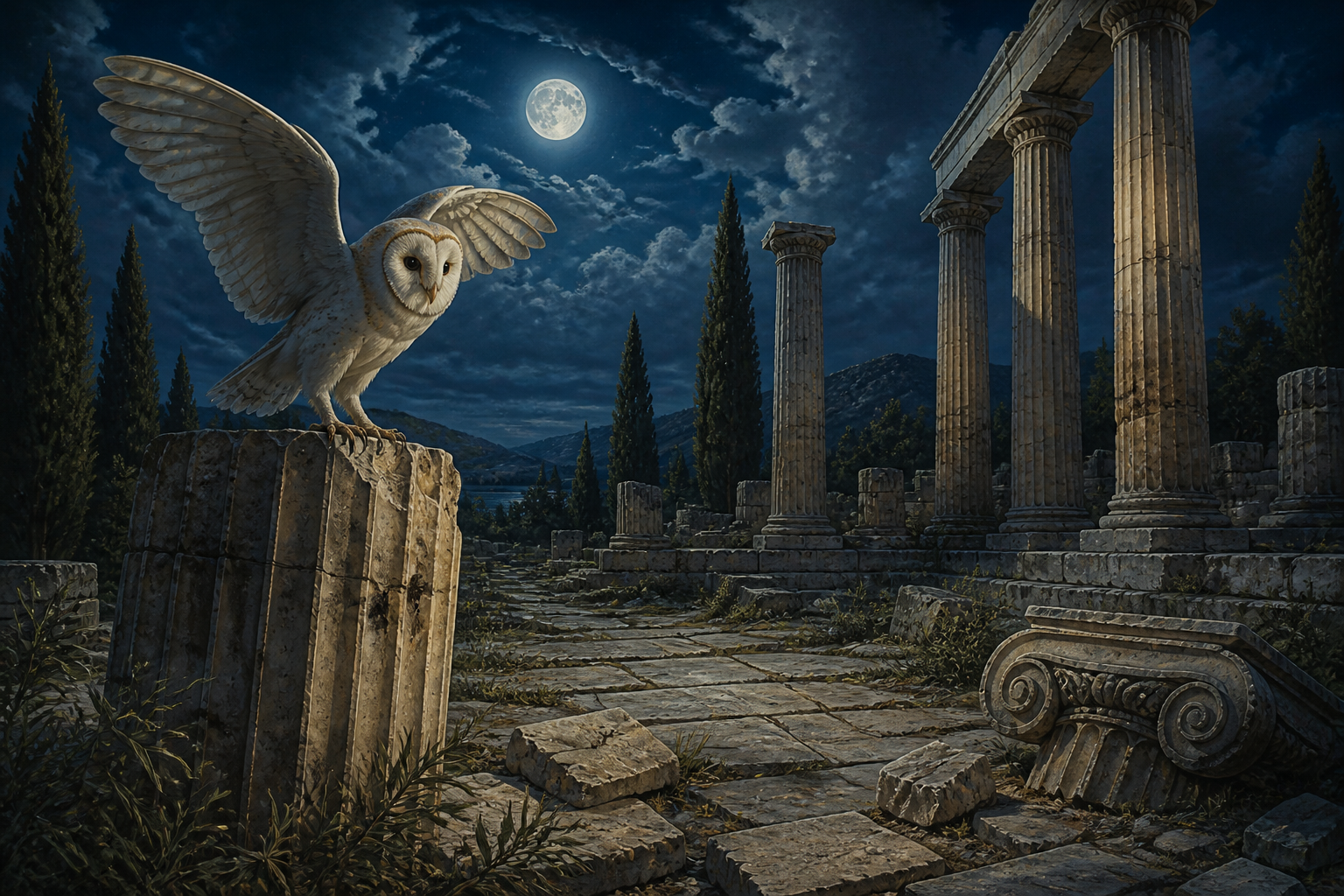
The strix is the one I would point to as the closest true ancestor. A screech-owl or owl-like night bird believed to attack infants in their cradles and drink their blood, the strix appears across Roman literature as a genuine object of household anxiety rather than a literary conceit.
Ovid gives the fullest account in the Fasti, describing striges attacking the infant Proca and the rite used to protect him — arbutus branches, water sprinkled with laurel, and the substitution of a pig’s entrails offered in the child’s place. Pliny and Horace both mention striges as well. The protective ritual is the giveaway: you do not develop a household ceremony against a purely literary monster.
The word itself is the strongest evidence of continuity. Latin strix becomes Romanian strigoi, Italian strega, Albanian shtrigë. When Romanian villagers in the nineteenth century told Agnes Murgoci about the strigoi, they were using a word that had travelled unbroken from Roman anxieties about owls at the window.
What the Classical Versions Have That Later Ones Lost
Three things strike me every time I go back to these sources.
- They are overwhelmingly female, and specifically hostile to infants and to young men — a pattern that survives in the churel, the pontianak and the lamia’s own descendants long after the male aristocratic vampire takes over the popular imagination.
- They are not dead. The lamia, empusa and strix are supernatural beings or transformed people, not risen corpses. The corpse-vampire is a later and largely Slavic development.
- They fly. The strix is a bird; the empusa moves freely; the lamia is unbound by ordinary travel. The grave-bound revenant who must return before dawn is a much later constraint.
How the Two Traditions Met
The vampire most people picture is a fusion. From the Slavic and Balkan world comes the returning corpse, the grave, the disturbed burial, the need for a stake. From the classical Mediterranean comes the night-flying blood-drinker, the seduction, the threat to infants, and — through strix — a good deal of the vocabulary.
Greece is where you can see the seam most clearly. The vrykolakas of Greek Orthodox belief is a walking corpse in the Slavic mould, but it inherited a landscape already populated by lamiai and empusai, and the two categories bleed into each other in the folk record. That untidiness is not a problem to be solved. It is what actually happened.
The Gello, and Death in Childbirth
There is a fourth figure that belongs in this group and rarely gets named outside specialist work. The gello appears in a fragment of Sappho — the earliest reference we have, from the seventh or sixth century BCE — as a spirit fond of children, and later Byzantine sources develop her considerably.
Her origin story is the one that matters: the gello was said to be the restless spirit of a girl who died unmarried or in childbirth, returning to attack infants and pregnant women. That is precisely the mechanism behind the churel in South Asia, the pontianak in the Malay world and the lamia’s own biography — a woman denied her expected life returning against the mothers who got theirs.
By the Byzantine period there were counter-charms, saint’s names written on amulets, and a formal exorcistic tradition against the gyllou. The Church absorbed the figure rather than suppressing it, which is more or less what happened to every one of these creatures.
How Rome Handled a Thing Like This
Roman responses to the strix are a good corrective to the idea that ancient people were credulous in some undifferentiated way. Ovid’s account in the Fasti is careful: he reports the ritual, sets out the offering of the pig’s entrails as a substitute for the child, and notes uncertainty about whether striges are birds by nature or witches transformed. He is describing a practice and flagging that its basis is disputed.
The legal record is blunter. Roman law penalised those who harmed by magic, and later medieval codes drawing on Roman and Germanic precedent — the Salic law among them — set fines for accusing someone of being a striga without proof, and for the killing of a woman so accused. Legislators were dealing with the fallout of the belief, not the creature.
The Descendants You Can Still Hear
Follow the vocabulary forward and the classical layer turns up everywhere in modern folklore.
- Romanian strigoi — the direct linguistic descendant of strix, and the figure that stands closest behind Dracula.
- Italian strega — the word shifting from night-bird to witch, the two categories never fully separating.
- Albanian shtrigë — a blood-drinking witch, with a folk test involving following her to a church door.
- Greek lamia — still current in modern Greek folk speech, and still applied to a female monster.
- Spanish and Basque lamia — softened into a water spirit with duck or goat feet, the predatory element largely gone.
Five modern words, one Latin root, and the sense sliding between owl, witch and vampire the whole way down. If you want a single piece of evidence that the vampire is older than the word, this is it.
Related from Legendary Mythics
- The Complete History of Vampires: From Ancient Corpses to Count Dracula
- Vrykolakas: The Greek Vampire and the Curse of the Incorrupt Corpse
- Strigoi: Romania’s Restless Dead and the Root of Dracula
- Churel: The Backward-Footed Revenant of the Wronged Woman
About This Article

Written by Elias Blackwood. Elias Blackwood has spent 25 years as an obsessive collector of world mythology and folklore, from Greek and Norse epics to Japanese yokai and West African trickster tales — entirely self-taught, for the love of it. His reading draws on comparative mythology, cultural anthropology, and a personal library of translations most people have never heard of. More about this site.
Verify this against a primary source
Specifics change, and your situation may differ from the one described here. These are the authorities worth checking directly:
- Theoi Project — Greek mythology texts with primary source citations
- Perseus Digital Library — classical texts in the original and in translation
- Encyclopaedia Britannica — edited reference for figures and traditions