Every popular history of vampires eventually reaches back to Mesopotamia and announces that the vampire begins with Lilith. I have read a fair number of those books, and I want to do something slightly different here: set out what the cuneiform material actually contains, and be honest about where the chain of descent is solid and where it is somebody’s guess.
Lamashtu: The Clearest Case
Lamashtu is the most substantial figure here and the one with the best documentation. She appears in Akkadian and Sumerian incantation texts as a demoness who threatens pregnant women and newborn infants — snatching the child from the womb or the breast, bringing fever and miscarriage. Unusually for a Mesopotamian demon she acts on her own authority rather than at the command of the gods, and she is named as a daughter of Anu.
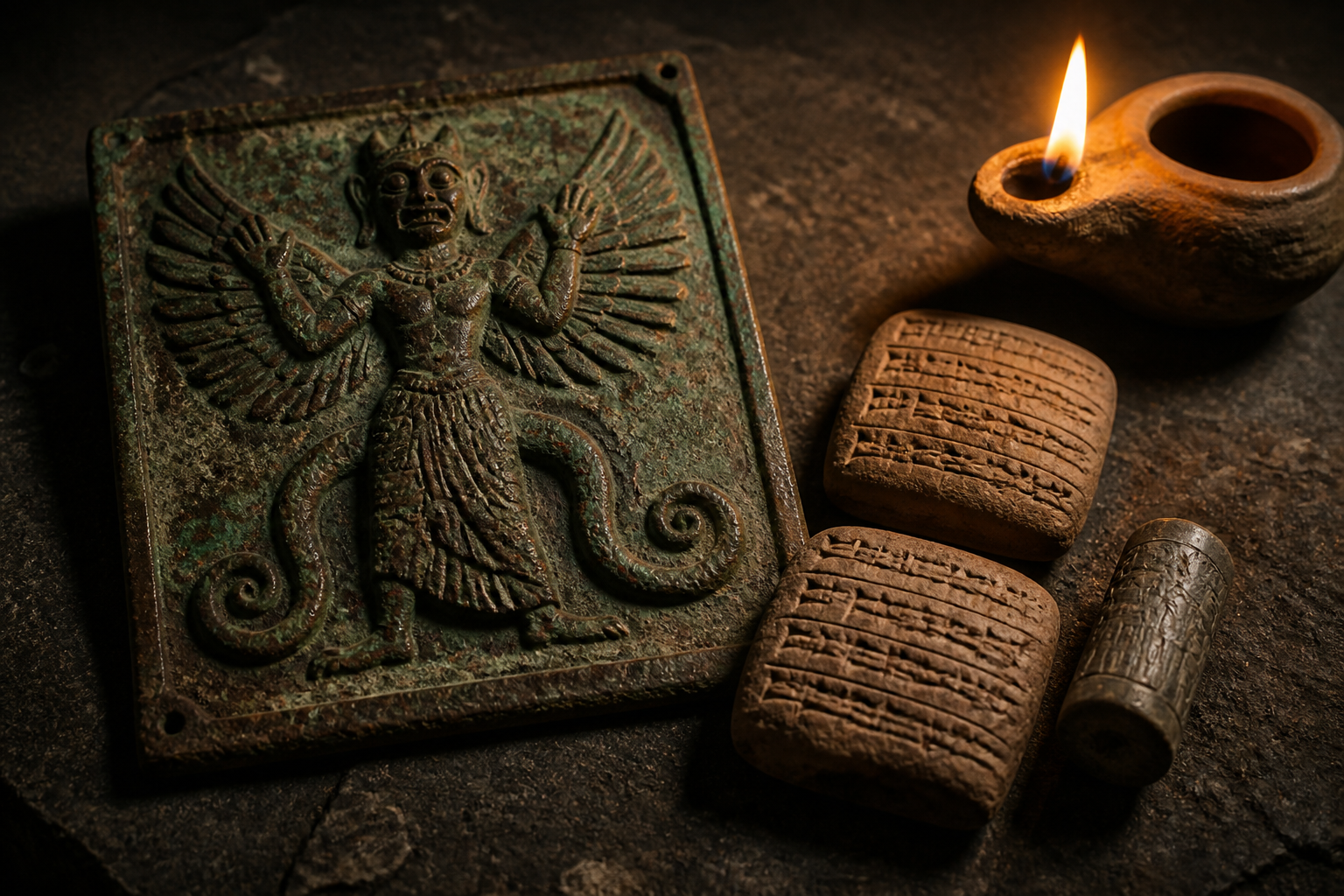
What makes her real to me as a lived belief, rather than a scribal abstraction, is the hardware. Lamashtu amulets survive in quantity: bronze and stone plaques showing a figure with a lion or bird head, suckling a piglet and a dog, holding serpents, standing on a donkey. They were worn and hung in birthing rooms. People spent money on protection from her.
Pazuzu, the Demon You Wanted on Your Side
The counter-measure is one of my favourite details in the whole ancient record. Protection from Lamashtu came largely through Pazuzu — himself a wind demon associated with disease, and by no reasonable standard a benevolent figure. His head appears on the reverse of Lamashtu plaques, and Pazuzu amulets were worn by pregnant women.
The logic is not that Pazuzu was good. It is that he was strong enough to drive her off. That is a much older and more pragmatic model of the supernatural than the good-versus-evil framing most modern vampire fiction runs on, and it recurs in folk practice everywhere: you do not need a saint, you need something the thing you fear is afraid of.
The Lilitu, and Where the Chain Gets Weak
The lilītu and the related lilû and ardat lilî appear in Mesopotamian sources as night spirits associated with wind, storms, and sexual predation on sleepers — often described as unmarried or childless, and dangerous for that reason.
Here is where I have to slow down. The popular account runs: lilitu becomes Lilith, Lilith becomes the first vampire. The linguistic link between lilītu and the Hebrew lilit in Isaiah 34:14 is real and generally accepted. But the fully developed Lilith — Adam’s first wife, refuser of subordination, killer of infants — comes from the Alphabet of Ben Sira, a text of roughly the eighth to tenth century CE. That is a gap of well over two thousand years, across which the figure changes substantially.
So: an ancient demon called lilitu existed. A medieval Jewish figure called Lilith existed. They share a name and some functions. Treating that as a single continuous character who is also the ancestor of Dracula is a story people tell, not a conclusion the sources support.
Was Lamashtu a Vampire?
Not in the strict sense, no, and I think the distinction is worth keeping. Lamashtu is a demon, not a revenant. She was never a living person, never died, was never buried, and does not need to return to a grave. Blood-drinking is present in some descriptions but is not her defining act — child-snatching and disease are.
What she does share with later vampires is the functional core: she explains infant and maternal death, she is female, she operates at night, she is repelled by specific physical objects, and the protections against her are domestic and affordable. Strip the vampire down to what it does for a community and Lamashtu is doing the same job in the second millennium BCE.
The Honest Version of the Lineage
I would put it this way. There is no unbroken bloodline from Lamashtu to Dracula, and anyone offering you one is compressing a lot of gaps. What there is, is a very old and very widely distributed answer to the same question: why do infants die in the night, and what can a household do about it? Mesopotamia gave that answer in cuneiform and cast it in bronze. That is remarkable enough without inventing a family tree.
The Incantation Texts, and What They Ask For
The Lamashtu material survives largely as incantations, and the tone of them is worth quoting the shape of even in translation. They are not philosophical. They are eviction notices — long, repetitive, and specific about the route the demon is to take out of the house.
A typical series names her, lists her epithets and parentage, describes exactly what she does to mothers and infants, and then instructs her to accept the provisions offered — a comb, a spindle, food, a small boat, sandals for the journey — and go. She is bribed and equipped, not destroyed. The underlying assumption is that Lamashtu cannot be defeated, only sent somewhere else, which is a much older model of dealing with the supernatural than exorcism in the Christian sense.
The Lamashtu series was standardised enough by the first millennium BCE to circulate as a recognisable text across Mesopotamia, and copies turn up well outside its core area. This was a professional body of knowledge with practitioners, not a village rumour.
What the Amulets Tell Us That the Texts Do Not
I have a bias towards objects over texts, because texts record what the literate elite thought worth writing and objects record what ordinary households actually paid for.
The Lamashtu plaques are consistent enough across sites and centuries to constitute an iconographic type: the lion or bird head, the donkey she stands on, the piglet and puppy at her breasts, the serpents in her hands, the comb and spindle among the offerings. Someone commissioning one in Assyria centuries after another was made in Babylonia was getting recognisably the same object. That is a stable, transmitted, widely-held belief, not a local eccentricity — and the plaques were made in materials ordinary families could afford, not only in precious ones.
Reading the Ancient Near East Without Flattening It
Two habits I would recommend to anyone going into this material from the vampire side.
- Do not collapse the categories. Mesopotamian sources distinguish carefully between gods, demons, ghosts of the human dead (etemmu) and hybrid figures. The etemmu — a dead person who returns because they were improperly buried or have no one left to make offerings — is actually the closer analogue to a revenant, and it gets far less popular attention than Lilith does.
- Watch the translation layer. A great deal of the vampire framing enters through nineteenth- and early twentieth-century translators reaching for words like ‘vampire’ and ‘ghoul’ to render terms with no English equivalent. The word in the tablet is not the word in the paperback.
The etemmu point is the one I would press hardest. If you want Mesopotamia’s contribution to the vampire, it is not the glamorous Lilith connection. It is the far more mundane and far better documented anxiety that the dead who are not properly buried and not properly fed will come back to the house — which is the same anxiety driving the strigoi, the vrykolakas, and the sickle laid across a throat in a Polish churchyard three thousand years later.
Related from Legendary Mythics
- The Complete History of Vampires: From Ancient Corpses to Count Dracula
- Churel: The Backward-Footed Revenant of the Wronged Woman
- Pontianak: The Vengeful Childbirth Ghost of the Malay World
About This Article

Written by Elias Blackwood. Elias Blackwood has spent 25 years as an obsessive collector of world mythology and folklore, from Greek and Norse epics to Japanese yokai and West African trickster tales — entirely self-taught, for the love of it. His reading draws on comparative mythology, cultural anthropology, and a personal library of translations most people have never heard of. More about this site.
Verify this against a primary source
Specifics change, and your situation may differ from the one described here. These are the authorities worth checking directly:
- Theoi Project — Greek mythology texts with primary source citations
- Perseus Digital Library — classical texts in the original and in translation
- Encyclopaedia Britannica — edited reference for figures and traditions