Of every vampire tradition I have followed over twenty-five years, the tlahuelpuchi of rural Tlaxcala is the one that unsettles me most — not because it is the strangest, but because it is the best documented. Most vampire folklore reaches us through a haze of second-hand retellings and eighteenth-century pamphlets. The tlahuelpuchi was recorded in living communities, by anthropologists, from people who genuinely believed and who could name the infants they had lost.
What the Tlahuelpuchi Is Said to Be
The tlahuelpuchi (also written tlahuelpuchi or tlahuelpoche, from Nahuatl) is a person — nearly always described as a woman — born with an involuntary condition that compels her to drink the blood of infants. That word involuntary is the heart of the belief and the thing that separates it from most European vampire lore. She does not choose it. She cannot be cured of it. In the accounts collected in Tlaxcala, the condition manifests at puberty and must be satisfied roughly once a month or the tlahuelpuchi herself will sicken and die.
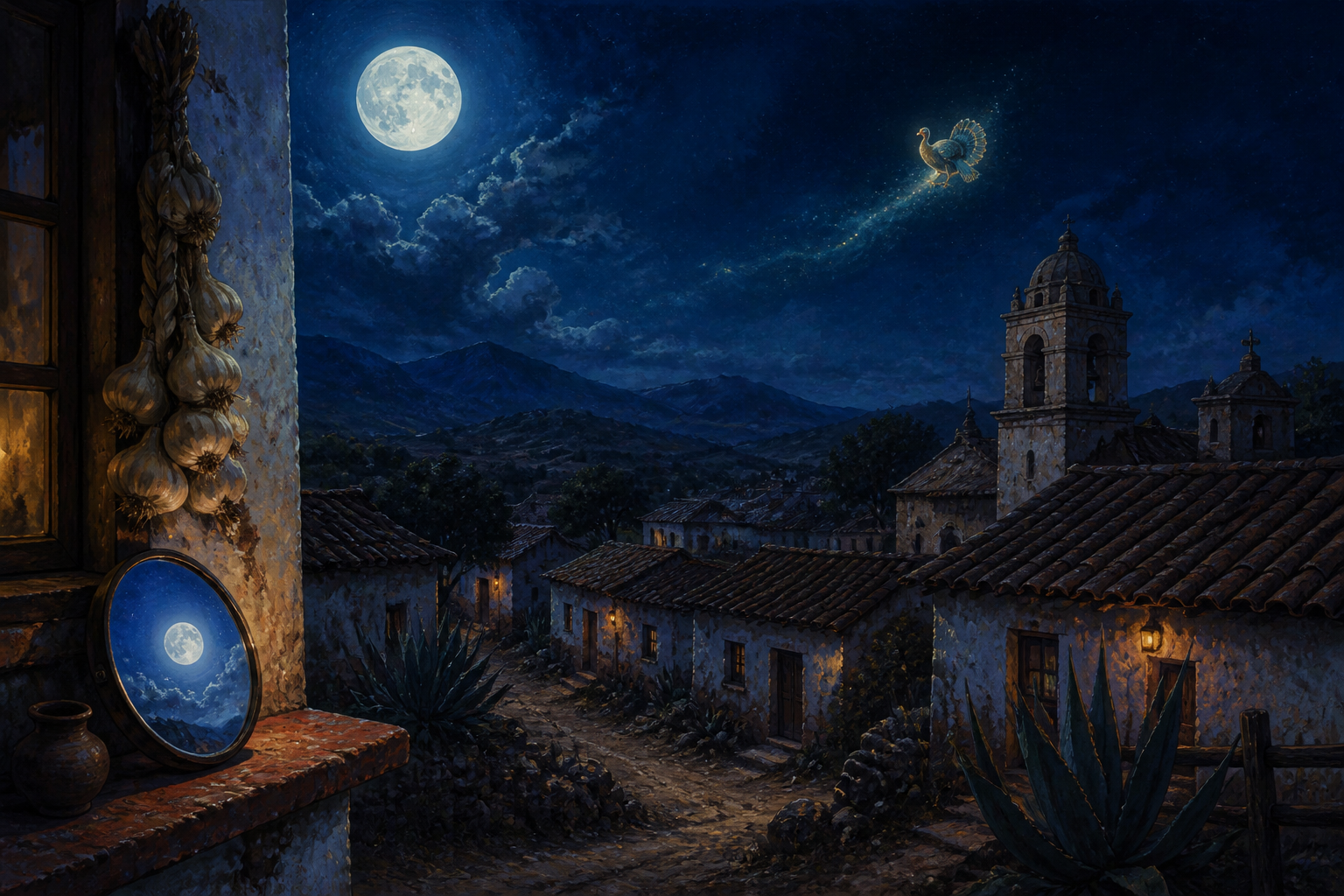
Before hunting she is said to detach and leave behind the lower half of her body, taking the form of a bird — a turkey, a buzzard, sometimes a hen — or occasionally a flea, a cat or a dog. She is described as emitting a luminous glow while transformed, which is the detail that recurs most consistently across informants and the one that links her to blood-witch traditions on the other side of the world.
The Nutini and Roberts Study: Why This Case Is Different
What makes the tlahuelpuchi unusual in the literature is Hugo Nutini and John Roberts’ Bloodsucking Witchcraft: An Epistemological Study of Anthropomorphic Supernaturalism in Rural Tlaxcala, published in 1993. Nutini and Roberts worked in Tlaxcala across roughly two decades and assembled case material on hundreds of infant deaths that local communities attributed to the tlahuelpuchi, concentrated in the middle of the twentieth century.
I want to be careful here, because this is where the subject turns from folklore into something heavier. The deaths were real. The infants died. What Nutini and Roberts documented was a community’s explanatory framework for sudden infant death in an era before that had a clinical name — and the anthropologists themselves noted that the reported cases clustered in cold months and in sleeping arrangements where overlaying was plausible. Reading their case tables is not like reading a bestiary. It is like reading a coroner’s ledger with a supernatural column appended.
The Protective Measures
The apotropaics recorded in Tlaxcala are specific and domestic, which is usually a sign that a belief is genuinely lived rather than literary:
- Metal on or near the cradle. Scissors, a knife, a safety pin, or a medal — often arranged in a cross.
- Garlic and onion hung at the doorway or placed beneath the infant’s bedding.
- A mirror positioned so the tlahuelpuchi would meet her own reflection.
- Tortillas marked with a cross, or a cross of maize placed in the room.
The mirror detail deserves attention. It appears in almost identical form in Philippine belief about the manananggal and in Caribbean accounts of the soucouyant, and I do not think that is borrowing so much as convergence: reflection as a test of the unnatural is an idea a great many cultures arrive at independently.
Why a Bird, and Why a Glow
The turkey form is worth pausing on. In central Mexico the turkey is a domestic, everyday bird — not exotic, not frightening. The horror of the tlahuelpuchi is precisely that she is ordinary until she is not. She is your neighbor. She may not even want to be what she is. Several of Nutini and Roberts’ informants described tlahuelpuchis with something close to pity.
The luminosity, meanwhile, puts the tlahuelpuchi in a wide family of glowing blood-witches — the Ashanti obayifo, the Ewe adze, the Caribbean soucouyant — all of whom are said to travel as points of light. Whether that reflects diffusion through the Atlantic slave trade, independent invention, or the simple fact that unexplained lights at night are universally unnerving, I do not think the evidence lets us say.
How the Tlahuelpuchi Is Said to Be Identified
Identification in the Tlaxcalan accounts is retrospective and social rather than forensic, which is characteristic of witchcraft belief generally. A tlahuelpuchi is not caught in the act; she is worked out afterwards. Informants described a cluster of signs: a woman who kept irregular hours, who was seen abroad at night, whose household suffered no infant deaths of its own, who had a reputation for a sharp tongue or an unexplained income. Elderly women living alone were disproportionately named.
Nutini and Roberts were explicit that accusation followed existing social fault lines. That is the pattern in every witchcraft complex I have read about, from Tlaxcala to Salem to the Ashanti obayifo: the supernatural category is real to the community, and the people who get sorted into it are the ones already standing slightly outside it.
What Happened to an Accused Woman
Here the tradition diverges sharply from European vampire lore, where the accused is already dead and the remedy is applied to a corpse. The tlahuelpuchi is alive, and in the recorded cases the community response ranged from avoidance and ostracism to, in a small number of documented instances, lynching.
I think that is the fact that ought to anchor any honest account of this belief. Vampire folklore is usually safe to enjoy because its victims are imaginary. This one had a body count on both sides of the ledger — the infants who died, and the women who were blamed.
What I Take From the Tlahuelpuchi
Most vampire folklore is about the dead. The tlahuelpuchi is about the living, and about a community trying to make sense of the worst thing that can happen to a family. Strip away the bird form and the glow and what remains is a framework for assigning cause to a death that had no visible cause — and, uncomfortably, for assigning blame. That is a function European vampire panics performed too, and it is the reason I think this tradition belongs in any serious survey of the subject rather than as a footnote to it.
The Blood Pact and the Inherited Curse
One element sets the tlahuelpuchi apart from almost every European vampire I have looked at, and it is the part I find most revealing about how the belief functioned socially. The condition was understood to be inherited, not caught. A tlahuelpuchi was born, not made — the affliction manifesting at puberty, without the person having done anything to bring it about.
That produced a genuinely awkward theology. The tlahuelpuchi was not damned for her choices; she was compelled by a hunger she could not refuse, and Nutini and Roberts record informants describing the condition with something close to pity alongside the fear. She could not be cured, could not confess her way out of it, and — crucially — her own family were not permitted to harm her. Killing a tlahuelpuchi was said to bring the curse onto the killer’s own household, which meant the community had to find someone outside the bloodline to act.
It also meant suspicion clustered around families rather than individuals, and could reactivate a generation later. Once a household was thought to carry it, a daughter growing up in that house inherited the reputation whether or not anything was ever alleged against her personally.
Where the Belief Sits in Tlaxcalan History
It would be a mistake to file the tlahuelpuchi as a pre-Columbian survival that happened to persist. The word is Nahuatl, and the shape of the figure — the shapeshifting, the association with darkness — has clear indigenous roots. But the version documented in the twentieth century is a genuinely colonial hybrid: the protective measures include garlic, metal and mirrors alongside Christian crosses and blessed objects, and informants explained the tlahuelpuchi’s compulsion in vocabulary borrowed from Catholic ideas of possession and sin.
Rural Tlaxcala kept its Nahuatl-speaking communities and its household-level religious practice intact through four centuries in a way that many regions did not, and the tlahuelpuchi is one result — an old category still doing active work inside a Catholic village, without either layer having erased the other.
Related from Legendary Mythics
- Vampires of Africa & the Caribbean: The Soucouyant, Sasabonsam, and Others
- Soucouyant: The Skin-Shedding Fireball Vampire of the Caribbean
- Obayifo: The Glowing Witch-Vampire of the Ashanti
- Manananggal: The Self-Severing Winged Vampire of the Philippines
About This Article

Written by Elias Blackwood. Elias Blackwood has spent 25 years as an obsessive collector of world mythology and folklore, from Greek and Norse epics to Japanese yokai and West African trickster tales — entirely self-taught, for the love of it. His reading draws on comparative mythology, cultural anthropology, and a personal library of translations most people have never heard of. More about this site.
Verify this against a primary source
Specifics change, and your situation may differ from the one described here. These are the authorities worth checking directly:
- Theoi Project — Greek mythology texts with primary source citations
- Perseus Digital Library — classical texts in the original and in translation
- Encyclopaedia Britannica — edited reference for figures and traditions